


Audio By Carbonatix
Mystery surrounds the "completely unprecedented" deaths of hundreds of elephants in Botswana over the last two months.
Dr Niall McCann said colleagues in the southern African country had spotted more than 350 elephant carcasses in the Okavango Delta since the start of May.
No one knows why the animals are dying, with lab results on samples still weeks away, according to the government.
Botswana is home to a third of Africa's declining elephant population.
Warning: Some people may find the following images upsetting
Dr McCann, of the UK-based charity National Park Rescue, told the BBC local conservationists first alerted the government in early May, after they undertook a flight over the delta.
"They spotted 169 in a three-hour flight," he said. "To be able to see and count that many in a three-hour flight was extraordinary.
"A month later, further investigations identified many more carcasses, bringing the total to over 350."
"This is totally unprecedented in terms of numbers of elephants dying in a single event unrelated to drought," he added.
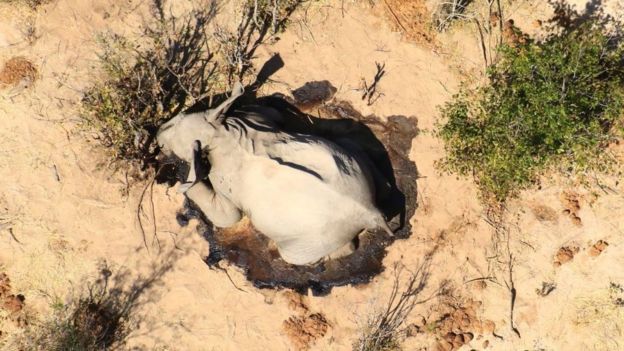
Back in May, Botswana's government ruled out poaching as a reason - noting the tusks had not been removed, according to Phys.org.
There are other things which point to something other than poaching.
"It is only elephants that are dying and nothing else," Dr McCann said. "If it was cyanide used by poachers, you would expect to see other deaths."
Dr McCann has also tentatively ruled out natural anthrax poisoning, which killed at least 100 elephants in Bostwana last year.
But they have been unable to rule out either poisoning or disease. The way the animals appear to be dying - many dropping on their faces - and sightings of other elephants walking in circles points to something potentially attacking their neurological systems, Dr McCann said.
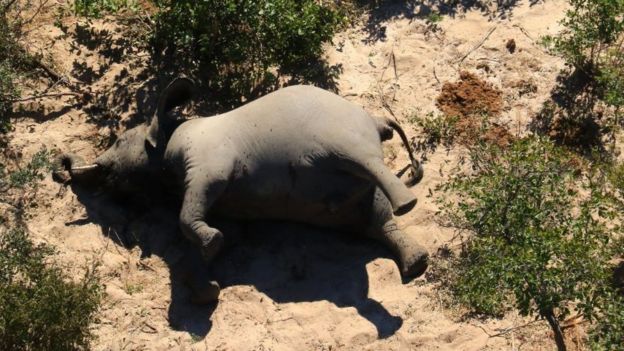
Either way, without knowing the source, it is impossible to rule out the possibility of a disease crossing into the human population - especially if the cause is in either the water sources or the soil. Dr McCann points to the Covid-19 pandemic, which is believed to have started in animals.
"Yes, it is a conservation disaster - but it also has the potential to be a public health crisis," he said.
Dr Cyril Taolo, acting director for Botswana's department of wildlife and national parks, told the Guardian they had so far confirmed at least 280 elephants had died and were in the process of confirming the rest.
However, they did not know what was causing the animals' deaths.
"We have sent [samples] off for testing and we are expecting the results over the next couple of weeks or so," he said.
Latest Stories
-
Vibes The Movie: Big Ghun’s Ghanaian film earns five nominations at 2026 REFFA
28 minutes -
MamaCare CEO warns unresolved conflicts among health workers could undermine maternal and neonatal care
52 minutes -
Health professionals urged to translate medical knowledge into practice to save mothers
58 minutes -
Conflicts among care providers linked to maternal, neonatal deaths – Expert
3 hours -
GIS marks 10th TIME conference, champions improved teaching practices
3 hours -
BRICS Or Balance? What Ghana’s bid really means
3 hours -
GPRTU wants full TRAFFITECH-GH implementation to start in 2027
3 hours -
Mahama announces plans to import electric wheelchairs for PWDs
3 hours -
KGL U17 Colts 2026: Western beat Prempeh Elite Academy to set up final final with Greater Accra Region
4 hours -
Late Solanke strike salvages 10-man Spurs draw at Man United
4 hours -
Gender Ministry to monitor welfare of Nana Akua Addo’s children amid domestic violence case
4 hours -
Benedict Okyere Yeboah: Ghana’s football problem goes beyond sacking a coach
4 hours -
GPL 2026/27: Darkwah Wiafe’s winner sees All Blacks beat Kotoko
4 hours -
ITF World Tour : Patel Wins Boys’ Singles Final at J100 Accra
5 hours -
Ghana must pursue BRICS partnership if it brings economic benefits – Kpebu
5 hours