

Audio By Carbonatix
The nation needs a long-term development plan (DP) to serve as a blueprint for successive governments to implement.
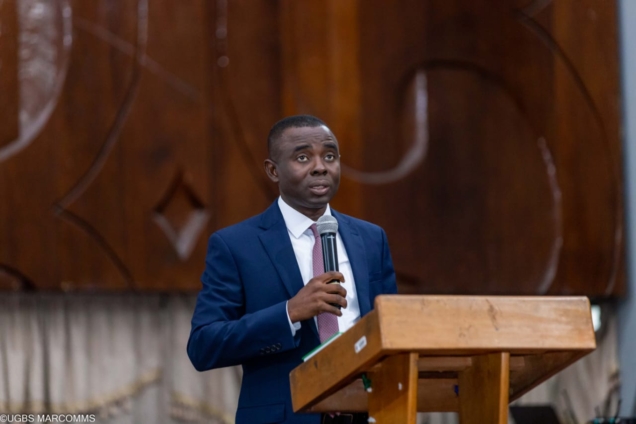
A Professor of Finance and Afreximbank Research Fellow, Joshua Yindenaba Abor, said such a plan would also guide the implementation of policies and programmes of successive governments.
Prof. Abor, who is a former Dean of the University of Ghana Business School (UGBS), said: “The system where one party draws a development plan and another party comes and abandons it is not good for the nation but we can cure that by ensuring that the government that develops a development plan does so with all stakeholders involved.
“So, once you have the buy-in of stakeholders, it will be difficult for the next government to abandon it because they were part of the process,” he added.
Delivering a lecture on the changing roles of national development banks in Africa, the financial economist said it must also be forward-looking by a minimum of 40 years and be respected and utilised by all future governments within that time frame.
Since its establishment, the National Development Planning Commission (NDPC) has prepared three long-term development plans that have largely been underutilised.
The most recent one, the 40-Year Development Plan (2018-2057) with a vision of achieving “a just, free and prosperous society”, has been shelved while manifestoes have become the source of policies and programmes.
Event
Dubbed “DBG-UGBS Development Finance Dialogue Series,’’ the round table meeting saw Prof. Abor examine contemporary roles of NDBs in Africa, their business models, challenges they face and how the continent could make them more effective to achieve national development aspirations.
It was an initiative of the business school with support from the bank to educate graduate students of the UGBS on the relevance of development finance and roles of development banks.
Prof. Abor, who is also an External Fellow at the Centre for Global Finance, shed more light on his latest book “The changing role of national development banks in Africa: Business models, governance and sustainability,” published by Palgrave Macmillan in August this year.
Concerns
The former visiting scholar of the International Monetary Fund (IMF) said the country’s inability to stick to one long-term development plan opened it up to piecemeal and party-based policies and programmes that lacked the capacity to propel the nation to sustained development.
That, he said, contributed gravely to the nation’s limited and unsystematic development over the years.
It could also limit the ability of national development banks (NDBs) to unlock growth poles and fund sustainable development given that their operations would not be drawn from a national development plan by successive governments, Prof. Abor added.
The Development Bank Ghana (DBG) is the new NDB which was established in 2020, and licensed in 2021 to address the long-term, patient funding gap that faced businesses and the economy.
It added to the Ghana Export-Import (Exim) Bank established in 2016 to support export development.
Linking NDBs to dev't plans
Prof. Abor, who is also a Fellow of the Ghana Academy of Arts and Sciences, further said while NDBs were critical institutions to national development the world over, they functioned better when their roles and operations were drawn from a national development plan.
He said development finance institutions were a critical avenue for providing countercyclical financing during and after periods of shocks, as well as offer a pool of resource to fund the UN Sustainable Development Goals (SDGs).
Prof. Abor said they also enhanced inclusive financing, especiallyw when they lend to small and medium enterprises (SMEs).
He added that DBs also promoted innovation and structural transformation, crowded in private capital by de-risking key investment areas, helped to fund public goods, climate action, as well as deepened the financial market due to their ability to provide long-term financing.
Recommendations
Prof. Abor said NDBs needed to prioritise governance systems and that board members must also be allowed to complete their term.
He said NDBs also needed to implement strong and robust impact evaluation mechanisms, as well as ensure a balanced funding mix where loans were procured in local and foreign currencies to address the currency mismatch and minimise the foreign exchange risk component in their books.
On regulations, he proposed that NDBs adopt a proportionate approach of implementing Basel III from the Basel Accord, an international framework that sets standards for bank capital, to avoid suffering liquidity constraints.
Latest Stories
-
Hearts of Oak coach Kapor raises alarm over poor pitches in Ghana football
2 minutes -
Dorimon Traditional Council endorses policy to formalise female chieftaincy
5 minutes -
DVLA expands from 33 to 63 offices after opening 30 new service centres across Ghana
6 minutes -
State Housing Company offers 195 homes with a 5% discount; prices start at GH¢950,000
9 minutes -
Learn Deutsch opens German language examination centre in Accra
10 minutes -
Decline in external buffers complicates foreign exchange outlook – IC Insights
10 minutes -
Ghanaian filmmakers urged to tell local stories and take them to the world
15 minutes -
Educated but unable to communicate? The missing link in Ghana’s University education
18 minutes -
Informant demanded $20 million from NACOC for information on major drug consignment – Muntaka
24 minutes -
Gov’t introduces mental health and drug tests for security recruits amid suicide concerns – Interior Minister
25 minutes -
DVLA generates GH¢27.14m from dealer plates between January and September 2026
28 minutes -
DVLA registers over 7,700 excavators in Ghana under new tracking initiative
33 minutes -
DVLA introduces six Ghanaian languages for driving theory tests
34 minutes -
DVLA prints 440,000 licences to clear backlog dating to 2023
34 minutes -
Yagaba chief calls for sanitation officers as Mamprugu Moagduri prepares to enforce bylaws
35 minutes