

Audio By Carbonatix
On December 7th, over 15 million Ghanaians are expected to head to the polls to elect a president and some 275 members of parliament. The total number of polling stations has increased from 28,992 in 2016 to 31,851 (provisional).
The regional breakdown of these numbers are yet to be published by the Electoral Commission. For over 1 million first-time voters, election observers and the diplomatic community, it is important to understand what happens on election day, from when ballots are cast to the declaration of the results.
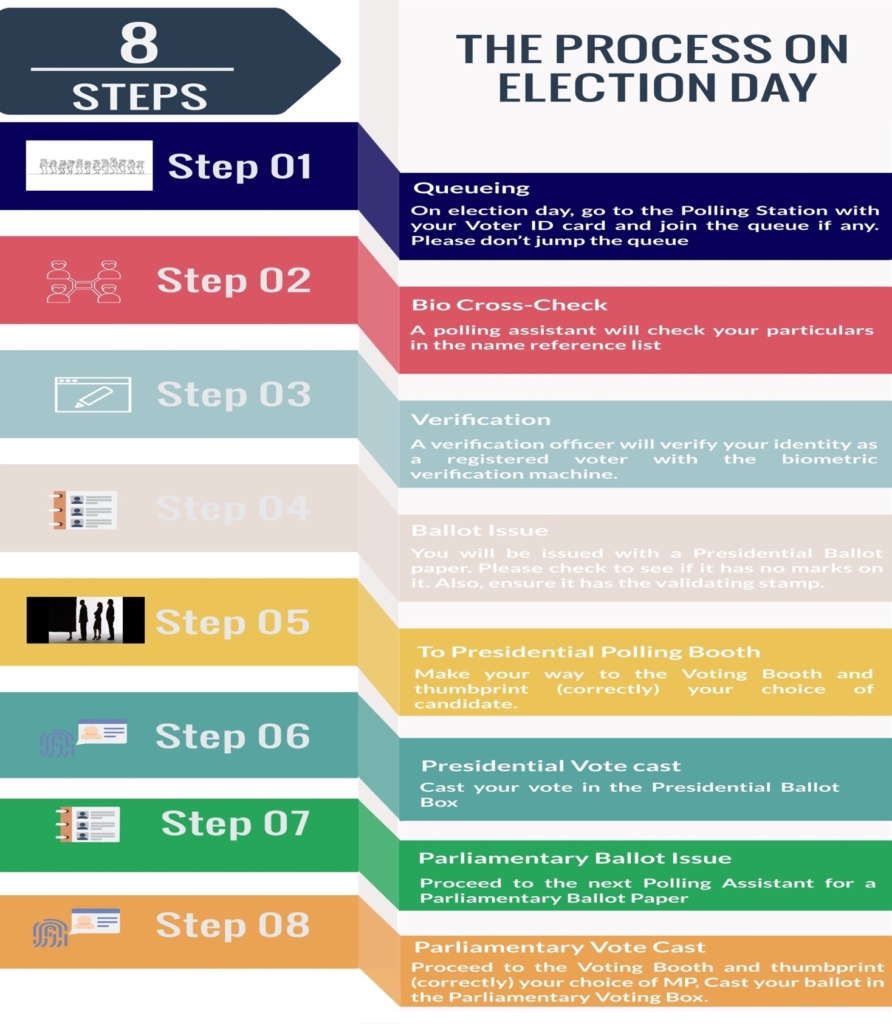
Here is the process of vote casting;
The law states that a person after casting their ballots should leave the Polling Station, they can return at the close of polls for the count.Each constituency is broken down into electoral areas and then further divided into polling stations.
At the polling stations you are likely to see a Returning Officer (RO), Presiding Officer (PO), about 5 Polling Assistants, 2 Party Representatives; Presidential Candidate and Parliamentary Candidate for each party or candidate and at least 1 security personnel. Both the presidential candidate and parliamentary candidates can pick a Counting Agent each if they choose. Unless otherwise directed by the candidate, a polling agent appointed by a candidate shall act as a counting agent.
After casting of votes, the next step is vote counting and collation of results. Counting and declaration of results at voting stations are done in the presence of party representatives by the presiding officer.
Each party representative is expected to sign a form accepting the openness of the process or to fill a form contesting the procedure and asking for a recount. If there is a need for recounting, the PO would do so accordingly. In the event the PO feels there isn’t good enough reason to recount, the recounting will be done by the RO at the Constituency Collation Center.
Ballot boxes, under security presence, are sent to the next stage which is known as the constituency collation centers where all polling station figures are pooled together and summed. The officer in charge declares two sets of results, the presidential and parliamentary figures.
The winner of the parliamentary vote becomes the MP-elect for the constituency whiles the figures for the presidential race are sent to the regional collation centers. There, other constituencies will be added and a regional lump figure is declared.
In essence the process is clear and straightforward with multiple checks and presiding members from different parties, election officials and in some cases election observers from multiple domestic and international bodies
Latest Stories
-
Heritage Series notes: BoG promises more inclusive cedi with improved sizes, tactile features
9 minutes -
‘We want answers’ – Family seeks probe into 14-year-old’s death 12 days after starting SHS
19 minutes -
No preacher has the right to impose beliefs on bus passengers – Kwesi Pratt Jr backs preaching ban
23 minutes -
Africa Maritime Security Forum opens in Accra with call for stronger continental cooperation
24 minutes -
Techiman North MP fulfills promise with new CHPS Compound in Kokoago
35 minutes -
Enterprise Trustees, Sinapi Aba launch ‘Asetenapa Plan’ to promote retirement savings among informal workers
36 minutes -
Gov’t working to ensure GAUA strike is called off by October 16 – Haruna Iddrisu
41 minutes -
KAIPTC Commandant calls for continent-wide strategy to tackle Africa’s maritime security threats
53 minutes -
GRIDCo investigates Mallam substation fire as power restoration continues in Accra
54 minutes -
20% digital tax is not E-Levy – GRA boss
1 hour -
Defence Minister calls for intelligence-sharing and regional cooperation to tackle maritime insecurity
1 hour -
Afenyo-Markin failed to comply with procedural rules in defamation suit – Sammy Gyamfi’s lawyers
1 hour -
GRA recovered GH¢1.3bn out of about GH¢1.4 bn unpaid VAT from ECG – Anthony Sarpong
1 hour -
KMA to extend daily toll collection to nights and weekends
1 hour -
Ghana secures second consecutive term on UN Human Rights Council
1 hour