


Audio By Carbonatix
Over 17million Ghanaians will go to the polls on December 7th to elect a President and 275 MPs.
In the run-up to the polls, IntelAfrique Ltd., one of Ghana’s foremost political advisories, has commenced a series of incisive special reports on key aspects of the elections.
The question on the minds of many political watchers and development partners is will Ghana’s elections be free, fair and peaceful? What are the risks associated with the elections?
A number of factors will have to be assessed in other to conclude whether the elections will be peaceful or otherwise. Every election has risks and vulnerabilities and their associated triggers.
IntelAfrique commends the Government and people of Ghana for the peaceful and orderly pre-election environment observed in the country ahead of the upcoming 2020 General Elections.
Challenges, however, remain and state, non-state actors and development partners must analyse the triggers and develop a robust response to deal with potential threats in the run-up to the elections.
This report will highlight the major demonstrations, strikes and protests that has taken place since the advent of the NPP government in 2017 to date.
This is important because according to UNDP and International IDEA, “as elections are becoming a more common and accepted means of determining who governs a country, and states become more experienced in conducting them, the number of election protests and the probability of election violence has not declined”.
Elections is not just about what happens on election day. Every process leading up to the elections is important, something International IDEA and the European Commission calls ‘the electoral cycle approach’, to assist all to understand the cyclical nature of the various challenges faced in electoral processes.
A polarized, highly charged and agitated electoral environment poses the risk of a less-than-peaceful election.
The Akufo-Addo administration, like all others before it, has witnessed a series of protests which have increased as the 2020 elections draw close, only slowing down as a result of the outbreak of the coronavirus pandemic.
The causal factor for the demonstrations ranges from pure political concerns, labour unrests, student protests, and respective residents of communities’ demand for social amenities, among others.
Outlined below are the demonstrations and protests in the last four years.
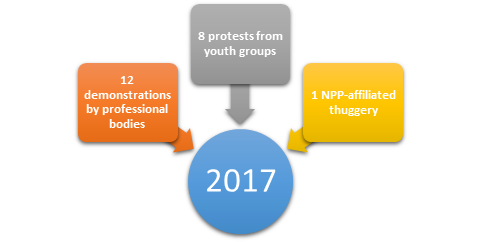
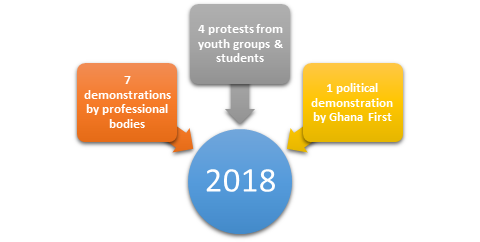
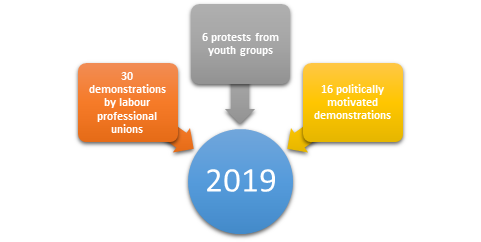
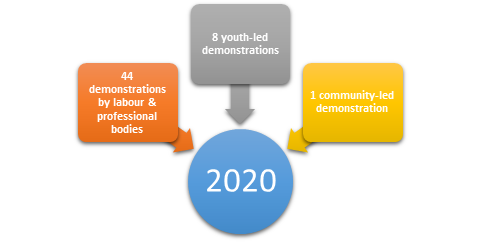
All these protests may or may not represent the unpopularity of the government, however, with the elections less than 70 days away, President Akufo-Addo would surely hope his administration has seen the last of them, lest unresolved demands cost him his second term bid.
Drawing on its research papers on this topic, International IDEA has classified and described 26 internal and 10 external risk factors that can trigger or contribute to triggering election-related violence.
Internal factors (Alihodžić and Asplund 2018a) are election-specific and do not exist outside of the electoral context.
External factors (Alihodžić and Uribe Burcher 2018) originate and exist outside the electoral context. They include exogenous conditions, such as the ones outlined above, that can negatively influence electoral processes.
This report has sought to distinguish the processes leading up to the elections and structural factors.
We conclude with a call on all sections of society to work together to address the above challenges and issues, whilst paying attention to the need for combining long- and short-term approaches to addressing both process triggers and structural causes of election-related violence.
Latest Stories
-
KAIPTC Commandant calls for continent-wide strategy to tackle Africa’s maritime security threats
3 minutes -
GRIDCo investigates Mallam substation fire as power restoration continues in Accra
4 minutes -
20% digital tax is not E-Levy – GRA boss
14 minutes -
Defence Minister calls for intelligence-sharing and regional cooperation to tackle maritime insecurity
18 minutes -
Afenyo-Markin failed to comply with procedural rules in defamation suit – Sammy Gyamfi’s lawyers
29 minutes -
GRA recovered GH¢1.3bn out of about GH¢1.4 bn unpaid VAT from ECG – Anthony Sarpong
31 minutes -
KMA to extend daily toll collection to nights and weekends
33 minutes -
Ghana secures second consecutive term on UN Human Rights Council
37 minutes -
KATH Catheterisation lab targets December completion amid specialist staffing concerns
37 minutes -
Government working to address economic challenges driving youth into galamsey – Mahama
47 minutes -
Domestic Capital Africa campaign targets US$600bn pension funds for SME growth
48 minutes -
Women leaders’ wisdom and work deserve recognition – Mahama
58 minutes -
NRSA to refund surplus from auctioned vehicles of non-subscribers after deducting towing costs
59 minutes -
Ghana must integrate AI into mainstream education – DigiMarkt Project Board
60 minutes -
Armwrestling: Ghana unveils World Armwrestling Championship squad, appeals for travel support
60 minutes