

Audio By Carbonatix
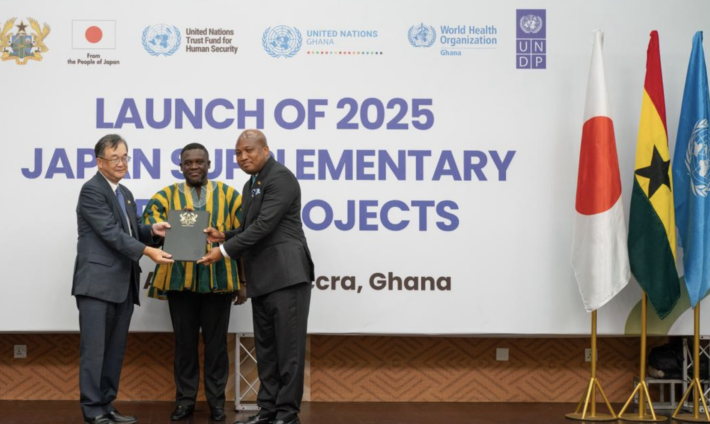
Ghana marked a significant milestone in its technology and national development agenda on Wednesday, when the government and international partners jointly launched three high-impact projects.
The development partners: the United Nations Development Programme (UNDP), the World Health Organisation (WHO), and the Government of Japan are supporting the projects, including artificial intelligence (AI), public health, and peace-building.
The initiatives are receiving approximately US$1.5 million under Japan’s 2025 fiscal year Supplementary Budget, aimed at harnessing AI to improve health outcomes and drive public sector digital transformation and advancing peace-building efforts at Bawku in the Upper East Region.
Mr Samuel Okudzeto Ablakwa, the Minister of Foreign Affairs, whose outfit hosted the programme, said the interventions aligned with Ghana’s national priorities in conflict resolution, digital governance, and universal health coverage.
He described the initiatives as transformative, noting that they were not just catalytic funding from Japan, but a powerful testament to a shared commitment to stability, digital inclusion, and human security for all Ghanaians.
“With a total value of approximately 1.5 million dollars, it represents far more than a financial commitment. It stands as a powerful testament to the imperial friendship, shared values, and solidarity that have characterised the enduring relations between Ghana and Japan,” he said.
Mr Samuel Nartey George, the Minister of Communication, Digital Technology and Innovations, highlighted AI’s potential of contributing US$19.9 trillion to the global economy by 2030, saying Ghana was determined to tap into the benefits therein.
He announced that Cabinet had approved a national AI strategy, to be launched by President John Dramani Mahama on April 24, to provide a policy architecture within which both the public sector AI capacity building project and the health AI programme would be situated.
Mr George paid tribute to UNDP, the WHO, and the Government of Japan for their continued support in advancing development in all aspects of the economy, expressing the country’s readiness to deepen partnerships with them.
Mr Niloy Banerjee, UNDP Ghana Resident Representative, said three initiatives touched on 13 out of the 17 United Nations Sustainable Development Goals (SGDs), showing how the convergence of political will, multilateral resources, and technical ambition could provide transformative and integrated solutions.
He emphasised the principle of “leaving no one behind” as a guide in the implementation process, with meaningful participation from women, youth, and all vulnerable groups.
“Strengthening health systems and advancing responsible digital innovation can reinforce stability, build resilience, and drive sustainable development. With limited time remaining to achieve the SDGs, there is a clear need for urgent and coordinated action,” Mr Banerjee said.
He promised continuity of work with Ghana and its development partners to deliver practical, people-centered solutions to strengthen resilience and drive inclusive growth.
Mr Yoshimoto Hiroshi, Japan’s Ambassador to Ghana, noted that the joint governmental and stakeholder initiatives reaffirmed the partnership with Ghana, built on seventy years of cooperation that would continue.
He said all three projects, while addressing different dimensions of development, were united by a common thread within Japan’s long-standing commitment to human security, “ensuring both freedom from fear and freedom from want.”
The Ambassador noted that the projects stemmed from a 2021 agreement between Japan and UNDP to upscale the deployment of digital technologies to strengthen Ghana’s health systems, calling for ethical principles to guide its use in remaining people centred.
Dr Fiona Braka, the WHO Representative, described Ghana as standing at a defining moment in its digital transformation journey, marked by rapid expansion of AI and digital technologies.
She said such development offered unprecedented opportunities to strengthen health systems, improve decision-making, anticipate health threats, and reach communities that had traditionally been left behind.
Dr Braka acknowledged risks characterised by those digital technologies – data privacy, equity, trust, and cybersecurity – and called for strategic frameworks and actions to carefully managed them to avoid widening existing inequalities.
She said Ghana’s experience under the programme would offer a model for countries across West Africa and beyond, with AI governance frameworks, data-privacy safeguards, and climate-health early warning systems being piloted in that regard.
“Together, we are showing that technological innovation and human security are not competing agendas but mutually reinforcing goals,” she said, pledging WHO’s full commitment to ensure that AI became a force for equity, resilience, and better health for all.
Latest Stories
-
Ghana at the heart of global PR excellence
3 minutes -
Ghana Institute of Architects clarifies position on ARC-ASG dispute amid ongoing case
4 minutes -
NDC supporters storm Fomena constituency office over alleged disqualification of chairman aspirant
7 minutes -
NPA CEO assures tanker drivers of action on welfare concerns
8 minutes -
Karpowership seeks contract extension as Ghana’s power demand grows
11 minutes -
Gender Ministry inaugurates committee to drive early childhood development
13 minutes -
Four Schools, One Crown: Prempeh, Corpus Christi, Mfantsipim and St Augustine’s battle for NIQ trophy
13 minutes -
HIV status cannot be used to deny employment under Ghana law – Ghana AIDS Commission
14 minutes -
Buffer Stock calls for expansion of national storage capacity as it falls below 50,000 metric tonnes
15 minutes -
Central Regional Minister urges use of religious platforms to change environmental, sanitation practices
38 minutes -
Henry Kweku Banning
38 minutes -
Execution of US murderer Christa Pike halted an hour before it was due to happen
40 minutes -
GoldBod generates US$1.87bn in FX in September, exceeds monthly target
44 minutes -
SOE comments controversy: ‘We must never abandon our humanity because of judicial office’ – CJ
53 minutes -
Samuel Kojo Brace declares intention to contest NPP parliamentary primary in Ahanta West
55 minutes