

Audio By Carbonatix
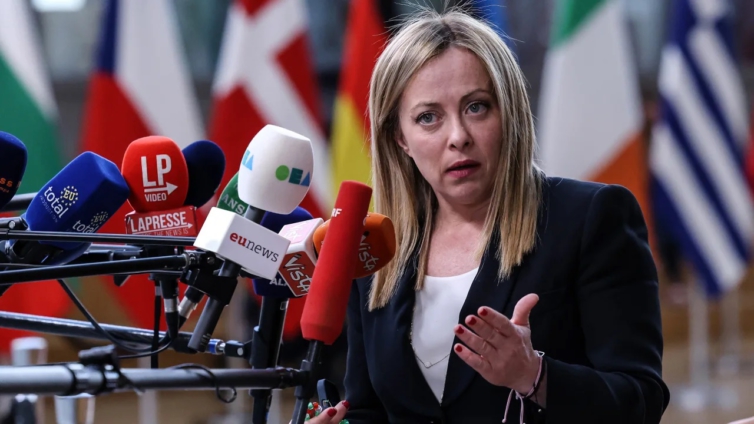
Italians who use English and other foreign words in official communications could face fines of up to €100,000 ($108,705) under new legislation introduced by Prime Minister Giorgia Meloni’s Brothers of Italy party.
Fabio Rampelli, a member of the lower chamber of deputies, introduced the legislation, which is supported by the prime minister.
While the legislation encompasses all foreign languages, it is particularly geared at “Anglomania” or use of English words, which the draft states “demeans and mortifies” the Italian language, adding that it is even worse because the UK is no longer part of the EU.
The bill, which has yet to go up for parliamentary debate, requires anyone who holds an office in public administration to have “written and oral knowledge and mastery of the Italian language.” It also prohibits use of English in official documentation, including “acronyms and names” of job roles in companies operating in the country.
Foreign entities would have to have Italian language editions of all internal regulations and employment contracts, according to a draft of the legislation seen by CNN.
“It is not just a matter of fashion, as fashions pass, but Anglomania has repercussions for society as a whole,” the draft bill states.
The first article of the legislation guarantees that even in offices that deal with non-Italian-speaking foreigners, Italian must be the primary language used.
Article 2 would make Italian “mandatory for the promotion and use of public goods and services in the national territory.” Not doing so could garner fines between €5,000 ($5,435) and €100,000 ($108,705).
Under the proposed law, the Culture Ministry would establish a committee whose remit would include “correct use of the Italian language and its pronunciation” in schools, media, commerce and advertising.
This would mean that saying “bru-shetta” instead of “bru-sketta” could be a punishable offense.
The move to safeguard the Italian language joins an existing bid by the government to protect the country’s cuisine.
It has introduced legislation to ban so-called synthetic or cell-based cuisine due to the lack of scientific studies on the effects of synthetic food, as well as “to safeguard our nation’s heritage and our agriculture based on the Mediterranean diet,” Meloni’s Health Minister Orazio Schillaci said in a press conference.
Latest Stories
-
Artificial stability or sustainable equilibrium? Rethinking the Cedi’s performance
3 minutes -
GIPA CEO calls for investment to support Ghana’s economic transformation
8 minutes -
Banks to suspend lending to public sector workers under Controller and Accountant General’s payroll
17 minutes -
GAUA strike leaves some KNUST administrative offices operating below capacity
36 minutes -
Three suspected illegal miners arrested in Tano-Boin Forest Reserve
47 minutes -
AratheJay brings Nimo Live Experience to Cape Coast on October 11
50 minutes -
UBIDS hosts WAC-SRT closing conference as regional partners push for sustainability beyond funding cycle
55 minutes -
FIFA Ranking: Ghana drop five places to 70th following AFCON qualifying defeats
56 minutes -
No rift between Agric and Finance Ministries — Eric Opoku dispels rumours
56 minutes -
BRICS: Jinapor cautions Ghana against ‘free lunch’ as NPP demands scrutiny
59 minutes -
Bono East Education Directorate invites basic school teachers for SHS/SHTS reposting
1 hour -
Wa West MP commissions education and health infrastructure projects across rural communities
1 hour -
Daily Insight for CEOs: Building new revenue streams
1 hour -
‘Save part of the cake for us’ – Ga Mantse asks Roads Ministry to create jobs quota for Ga indigenes
1 hour -
COCOBOD raises GH¢3.4bn in first cocoa notes offer, 15% below indicative GH¢4bn target
1 hour