

Audio By Carbonatix
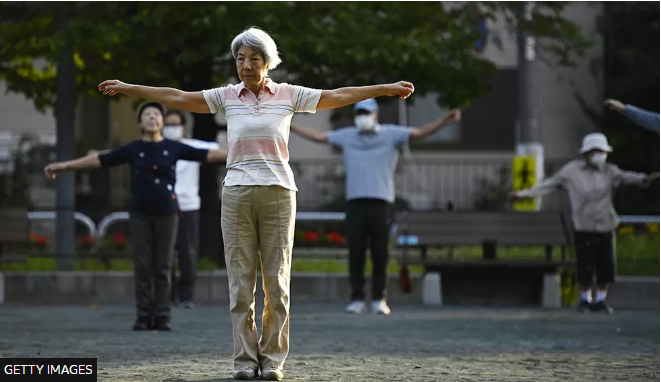
For the first time ever, more than one in 10 people in Japan are now aged 80 or older.
National data also shows 29.1% of the 125 million population is aged 65 or older- a record.
Japan has one of the lowest birth-rates in the world and has long struggled with how to provide for its ageing population.
It has the world's oldest population, measured by the proportion of people aged 65 or up, the United Nations says.
That proportion stands at 24.5% in Italy and 23.6% in Finland, which rank second and third respectively.
In Japan, those aged over 65 are expected to account for 34.8% of the population by 2040, according to the National Institute of Population and Social Security Research.
The country's elderly employment rate is among the highest across major economies - workers aged 65 or more make up more than 13% of the national workforce.
But this has done little to relieve the burden on the country's social security spending.
Japan has approved a record budget for the next fiscal year, in part due to rising social security costs.
Efforts to boost its birth rates have also met with little success amid the growing cost of living, and notoriously long working hours.
Birth rates are slowing in many countries, including Japan's neighbours, but the problem is particularly acute in Japan.
The country was estimated to have had fewer than 800,000 babies born last year - the lowest number since records began in the 19th century.
In the 1970s, that figure was more than two million.
Prime Minister Fumio Kishida said in January that his country is on the brink of not being able to function as a society because of its declining birth rate.
However authorities remain hesitant about accepting migrant workers as a solution to falling fertility.
Other countries in Asia are facing similar demographic challenges.
Last year, China's population fell for the first time since 1961, while South Korea has reported the lowest fertility rate in the world.
Latest Stories
-
Why must I renew my vehicle’s registration number every 2 years?
1 minute -
Parliamentary Privilege and the Limits of Personal Liberty: A study on the immunity of members of parliament from arrest in Ghana
2 minutes -
Kwabenya Court denies bail to six accused in alleged 3.9-tonne cocaine shipment
3 minutes -
Ghana opposes calls to abolish ICC, urges stronger action against crimes against humanity
10 minutes -
Cedi remains under pressure due to Christmas demand; going for GH¢11.90 at forex bureaus
12 minutes -
NDC opens nominations for 2026 regional executive elections on October 6
12 minutes -
Ghanaian nurses to receive higher pay, health insurance and rent allowance under new Saint Kitts and Nevis agreement
20 minutes -
JoyNews’ Emmanuel Adu Gyamfi named ‘Digital Tourism Icon of the Year’ in Ahafo Region
25 minutes -
Hurricane Polo makes landfall on Mexico’s Pacific coast
29 minutes -
US ban on Canadian alcohol and dairy comes into effect as trade war drags on
31 minutes -
GES orders SHS heads to refund unauthorised fees collected from parents
39 minutes -
AFCON 2027Q: ‘We don’t need to cry over spilled milk’ – Damba on Ghana injury concerns
42 minutes -
NDC communicator blames documentation, payroll validation for teachers’ promotion arrears delay
44 minutes -
2026 JoyNews Impact Maker Award winner brings clean water to Yoko Tsume after years of cattle dugout dependence
51 minutes -
Sarkodie commends Mahama for rejecting US health compact
51 minutes