

Audio By Carbonatix
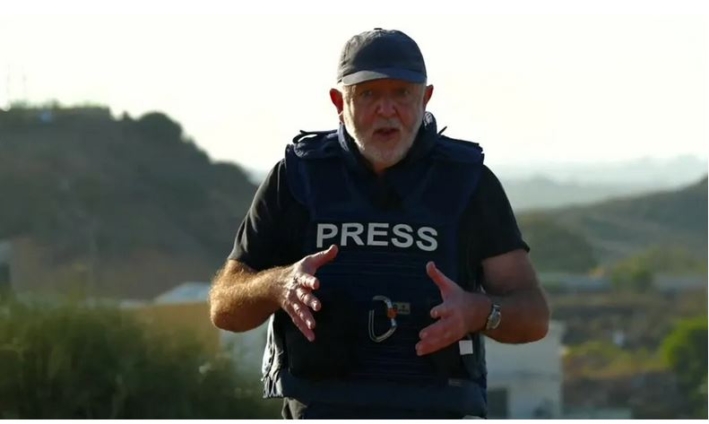
More than 50 journalists have sent an open letter calling on Israel and Egypt to provide "free and unfettered access to Gaza for all foreign media".
The letter is signed by correspondents and presenters for broadcasters with UK bases, including the BBC's Jeremy Bowen, Lyse Doucet and Mishal Husain.
It says the need for comprehensive on-the-ground reporting is "imperative".
Israel's military says its troops have taken journalists on escorted trips in Gaza to allow them to report safely.
Palestinian journalists and media workers have reported from inside Gaza since the start of the war between Israel and Hamas in October, but dozens have been killed, injured or gone missing.
In the letter, the 55 journalists write that "foreign reporters are still being denied access to the territory, outside of the rare and escorted trips with the Israeli military".
The escorted trips are highly controlled and often only to show tunnels that the military says are used by Hamas or weapons stores.
Only one foreign journalist has been granted entry into Gaza through Egypt on an escorted visit. CNN's Clarissa Ward - who is among the signatories of the letter - was able to spend only a few hours on the ground in the southern border city of Rafah with an Emirati medical team in December.
The letter calls on Israel's government to "openly state its permission for international journalists to operate in Gaza".
It also asks Egyptian authorities to allow foreign press access to the Rafah crossing between Egypt and Gaza.
The letter continues: "It's vital that local journalists' safety is respected and that their efforts are bolstered by the journalism of members of the international media. The need for comprehensive on-the-ground reporting of the conflict is imperative.
"The risks of conflict reporting are well understood by our organisations who have decades of experience of reporting in warzones around the world and in previous wars in Gaza."
The broadcasters represented in the letter are the UK's BBC, ITV, Channel 4 and Sky News, and the US outlets ABC, CBS, CNN and NBC.
A number of journalists who signed the letter have been reporting from Israel during the conflict.
In November, the BBC's international editor Jeremy Bowen travelled with Israeli forces into Gaza. While the BBC had editorial control of the report, the section with the Israeli forces was viewed by them.
When asked for comment on the letter, an Israel Defense Forces (IDF) spokesperson said: "The IDF is currently conducting a war against the terror organisation Hamas.
"In order to allow journalists to report safely, the IDF accompanies them when in the battlefield."
Last month, the Foreign Press Association (FPA) in Jerusalem accused Israel of imposing an unprecedented ban on independent foreign press access to Gaza, after the Israeli High Court of Justice rejected a petition from the organisation and ruled that restrictions on entry were justified on security grounds.
The FPA said defence authorities had told the court that journalists in Gaza could be put at risk in wartime and endanger soldiers by reporting on troop positions. They also argued that it was too dangerous for Israeli personnel to be present at the Israeli border to facilitate press entry to Gaza.
The court's ruling also cited defence authorities as stating that the Rafah crossing was "under the control and sovereignty" of Egypt, and that "to the best of [their] knowledge" the Egyptian government was allowing foreign journalists to enter Gaza. However, in late October a senior Egyptian official said it was the Israeli military stopping journalists from entering.
Almost 30,000 people have been killed in Gaza during the war between Israel and Hamas, the territory's Hamas-run health ministry says.
Israel's military launched an air and ground campaign after Hamas's attacks on Israel on 7 October, in which around 1,200 people were killed and 253 others were taken hostage.
According to the Committee to Protect Journalists (CPJ), at least 83 Palestinian and two Israeli journalists and media workers have been killed since the start of the war.
Latest Stories
-
Law Students’ Network warns executive dominance could undermine constitutional review
2 minutes -
Mahama to meet relevant stakeholders over concerns about the new Customs Act
9 minutes -
CHASS demands a 20% increase in SHS funding and payment of outstanding debts
11 minutes -
Investigation launched after male body found in County Cork
13 minutes -
We have been scammed by NDC, government is only doing PR – Abanga Fuseini
13 minutes -
Tamale Teaching Hospital records 44 new breast cancer cases in six months
15 minutes -
GES declares October 30 CPD day for private school teachers; learners to observe holiday
15 minutes -
South Korea to support Ghana’s forts and castles restoration with $4.5m over five years
17 minutes -
School headscarf ban sparks rare protests in Azerbaijan and row with Turkey
25 minutes -
Ghana explores underwater sightseeing and shipwreck tourism
26 minutes -
Association of Women Lawyers calls for national sexual offenders register to protect school children
27 minutes -
Soaring commodity prices influenced our 2026 revised growth forecast of 5.7 % for Ghana – IMF
30 minutes -
Government urged to recruit more speech therapists to support children with language disorders
32 minutes -
Chef Abbys: Feeding 50,000 people, putting food security on Ghana’s agenda
1 hour -
Ho set to host Republic Bank–JoyNews Habitat Fair as multiple firms prepare to showcase housing solutions
1 hour