

Audio By Carbonatix
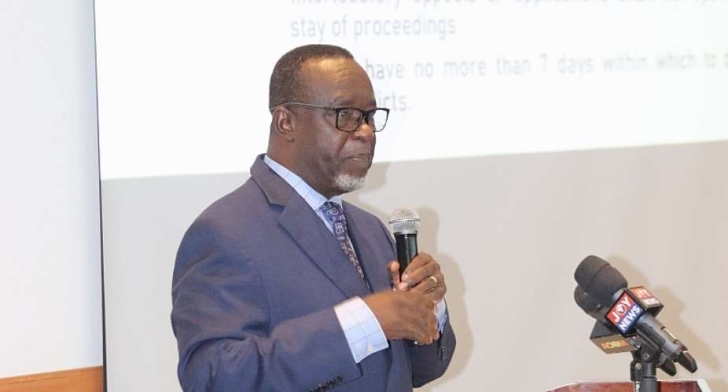
Acting Chief Justice Paul Baffoe-Bonnie has called for a radical overhaul of justice delivery, declaring that the system must be "firmly anchored on leadership, innovation, and technology" to remain relevant.
Addressing the judiciary and the Bar at a special church service on Saturday, October 4, to mark the opening of the 68th Legal Year in Accra, Justice Baffoe-Bonnie asserted that the rule of law cannot afford to be static when the world is in flux, particularly when facing what he himself has previously termed the “existential threat that Galamsey is,” which he noted has only “become worse” as of September 2025.
“Our courts must therefore remain bastions of fairness, impartiality and accountability. Yet we must also recognise that justice is not static. The world around us evolves, and so too must our methods, tools, and leadership. To remain relevant, justice delivery must be anchored on three critical pillars: leadership, innovation and technology,” he stated.
Leadership in the Face of Systemic Corruption
Justice Baffoe-Bonnie emphasized that leadership in the courts extends beyond the courtroom, serving as a bulwark against corruption and inspiring public trust.
He stressed that judges, administrators, and officers must model integrity and humility, while the Bar carries the parallel responsibility of advocating “diligently, ethically, and responsibly.”
This call for ethical leadership is vital given the scale of judicial intervention now required to tackle environmental crimes.
The Attorney General recently disclosed that the state is currently prosecuting approximately 600 illegal miners spanning 65 active dockets nationwide, a massive undertaking that demands supreme judicial integrity and efficient case management.
Innovation to Break the Backlog
The Acting Chief Justice confronted the endemic problems of heavy caseloads, case backlogs, limited resources, and procedural delays, asserting they cannot be solved by simply repeating old methods.
“Innovation demands that we ask difficult questions: How can we simplify procedures without sacrificing fairness? How can we strengthen alternative dispute resolution mechanisms to increase its complementary role to litigation?” he asked.
He also pointed to the moral imperative to protect the most vulnerable:
“How can we empower vulnerable groups – women, children and the marginalised – to access justice with dignity and without fear?” This is critical in areas ravaged by galamsey, where civil society groups are pushing the government for the ultimate procedural innovation: the declaration of a targeted State of Emergency under Article 31(9) of the Constitution, arguing the crisis is "likely to deprive the community of the essentials of life”.
Technology as the New Frontier of Justice
Justice Baffoe-Bonnie stressed that the role of technology has shifted from optional convenience to “essential” necessity.
The courts must now be equipped to handle complex scientific evidence, such as toxicology reports detailing the presence of genotoxic agents.
For instance, new research confirms that a “single molecular hit to a DNA from a genotoxic agent [like arsenic] can initiate cancer”, with studies showing an unacceptable cancer risk (CR) of 0.16 and a projected incidence of 78 cases per 1000 infants exposed through contaminated food in affected areas.
Such data requires sophisticated electronic case management and digital registries to be properly submitted, tracked, and adjudicated.
“Electronic case management, and digital registries are no longer optional experiments — they are the new frontiers of justice,” he stated, adding that technology “enhances transparency by allowing litigants to track their cases, reduces delays by automating repetitive processes and widens access by breaking geographical barriers.”
He concluded with a crucial caveat: “Technology must not create new divides between those who can access it and those who cannot. As we digitise, we must ensure that no citizen is left behind — that rural communities, the elderly and those without digital literacy are equally empowered to benefit from modernized justice systems.”
Latest Stories
-
Gender Ministry launches breast cancer campaign, pushes support over stigma
14 minutes -
Feed Ghana Programme cuts food import dependence
18 minutes -
Mahama welcomes Global Mercy Hospital Ships back to Ghana
22 minutes -
Tourism Minster calls for improved maintenance, consistent storytelling at tourist sites
28 minutes -
Katamanso Police Station appears complete outside but unfinished inside – Aidoo
34 minutes -
COMAC wants fuel taxes frozen to ease pressure on consumers
52 minutes -
COMAC pushes for crude oil revenue windfall to support struggling downstream sector
1 hour -
Gold slips before US payrolls data, set for second weekly loss
1 hour -
New Mexico wants Meta to pay up to $40 billion in penalties after data privacy trial
2 hours -
Oil rises slightly as market weighs mixed supply signals
2 hours -
Jordan ‘Last Dance’ jersey sells for £9m
2 hours -
Nigeria charges man with running fictitious government agency
2 hours -
COMAC renews call for full deregulation of fuel prices
2 hours -
Putin warns West that Russia is ready to use every weapon to protect Kaliningrad
3 hours -
Fuel sector overcrowded as 245 OMCs compete for market share – COMAC CEO
4 hours