

Audio By Carbonatix
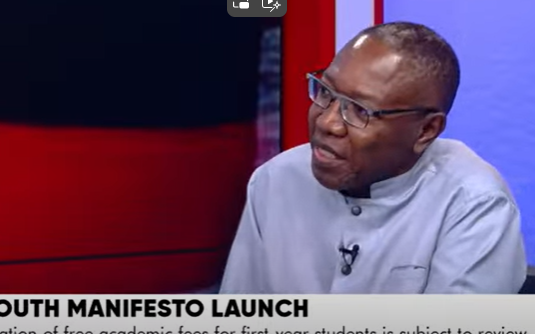
The Member of Parliament for Builsa South and Deputy Ranking Member on the Education Committee, Dr Clement Apaak, says that the implementation of free academic fees for first-year students would be subject to review.
This comes after the flagbearer of the National Democratic Congress (NDC), announced that first-year tertiary students would be exempt from paying academic fees.
Mr John Dramani Mahama explained that this initiative is part of the NDC’s broader effort to ease the financial burden on parents supporting their children's education.
But a section of Ghanaians have since questioned how the flagbearer would implement such a policy when his party has raised issues with how the free SHS policy was implemented.
However, speaking on JoyNews' AM Show, Mr Apaak allayed the fears of all concerned individuals.
According to him, if challenges arise after the policy's implementation, an NDC government would assess the situation and make necessary adjustments.
"We are not a group that is averse to reviews. We are not saying that when we start it, there perhaps would not be one or two issues. It can be subjected to reviews, and if we start the implementation and issues come up, we are willing to conduct an assessment and review, and see how we can resituate it, so to speak.”
The Builsa South MP stated that once the policy of free academic fees for first-year students is implemented, it is expected to be reviewed periodically.
He clarified that the NDC's acknowledgment of potential reviews does not imply an expectation of failure.
Dr Apaak also noted that Ghanaians are weary of government initiatives that do not address their suffering.
According to Dr Apaak, now is not the time for frivolous activities; rather, the NDC's proposal is a well-considered approach aimed at addressing a significant barrier in education.
"A barrier that stands between the transitions from secondary to tertiary, and so we believe that dealing with this matter the way we have prescribed it, is going to impact positively because students who otherwise should be taking classes in public institutions and tertiary institutions at this moment are not taking classes and are not pursuing tertiary education because of this initial barrier that we are talking about.
"I know some who have not been able to take their places in tertiary institutions because of the inability to mobilize the needed resources to ensure they take up their places”.
Latest Stories
-
Caveman Watches partners with Mfantsipim School for 150th anniversary
17 minutes -
We’ll pursue GH¢15m defamation suit against Sammy Gyamfi to its logical conclusion – Afenyo-Markin’s lawyers
17 minutes -
Martin Kpebu urges Afenyo-Markin not to return to court over Sammy Gyamfi lawsuit
26 minutes -
GRA submits preliminary report on drug shipment case to Mahama – Commissioner-General
54 minutes -
Sammy Gyamfi using ‘procedural roadblocks’ to dodge defamation case? – Afenyo-Markin’s lawyers
55 minutes -
The illusion of a good deal: Why some everyday money-saving habits may be costing you more
1 hour -
Family seeks autopsy, police investigation into death of student 12 days after Abomosu SHS enrolment
1 hour -
Trade Minister urges employers to leverage industrial opportunities to create jobs
1 hour -
Asantehene plants trees to commence Jimi Watercourse Rehabilitation destroyed by galamsey
2 hours -
15 arrested, 6 trucks impounded over sandwinning activities on Kumasi-Accra Expressway
2 hours -
OFFICIAL: Vinicius will miss El Clásico, suspended four games
2 hours -
Prayer vigil held after four arson attack murders
2 hours -
GRA fully recovers $154k legacy debt owed by foreign entities between 2022 and 2024
2 hours -
Kwesi Pratt Jr warns bus preachers are adding to passengers’ stress with accident prophecies
2 hours -
MTN Ghana to spend $1.1bn in 3 years, build 500 new sites as MoMo hits 44% Growth
2 hours