

Audio By Carbonatix
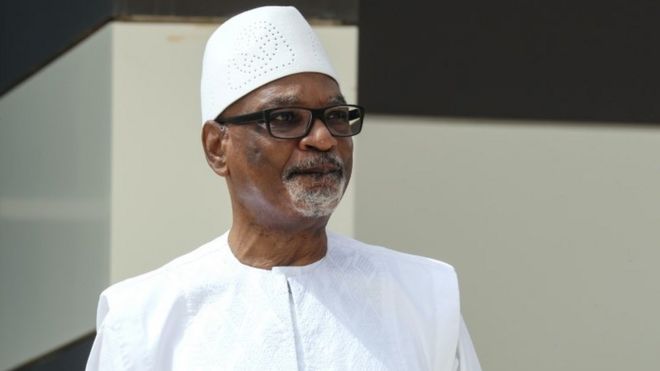
Mali President Ibrahim Boubacar Keïta has announced the dissolution of the constitutional court in an attempt to calm unrest that saw four people killed in street protests on Friday.
The president said he would not tolerate such violence.
The court has been at the centre of controversy after it overturned provisional results for parliamentary elections in March.
There are growing calls for President Keïta to resign.
Opponents are unhappy with his handling of Mali's long-running jihadist conflict, an economic crisis and the disputed elections.
A new opposition coalition led by the conservative Imam, Mahmoud Dicko, has been insisting on further reforms after rejecting earlier concessions from the Malian president, including the formation of a unity government.
What's the latest in Mali?
"I have decided to repeal the licences of the remaining members of the constitutional court," the president said in an evening television address on Saturday.
"This de facto dissolution of the court will enable us, from next week, to ask relevant authorities to nominate new members so that the reformed court can quickly help us find solutions to the disputes arising from the legislative elections," he added.
President Keïta also suggested that he could agree to re-run some of the disputed parliamentary elections, which is one of the protesters' demands. This was recommended last month by the West African regional bloc, Ecowas.
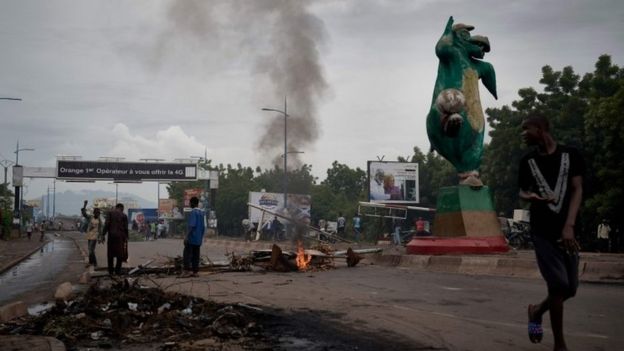
Four people died in Friday's protest in the capital Bamako, authorities say.
Speaking earlier on Saturday, Prime Minister Boubou Cissé said he and the president were open to talks and promised to form an inclusive government "very quickly".
"I will put in place a government with the aim of being open to address the challenges of the moment," he told Radio France International.
But this came as the opposition coalition said security forces detained two of the protest leaders, Choguel Kokala Maïga and Mountaga Tall. Another protest leader, Issa Kaou Djim, was arrested on Friday.
In addition, security forces "came and attacked and ransacked our headquarters", opposition coalition spokesman Nouhoum Togo said.
On Saturday evening, correspondents described the capital as tense with protesters blocking several roads with barricades. However, numbers were down on Friday's protests, which forced the state broadcaster off the air.
Why are people protesting?
These demonstrations are the third since June.
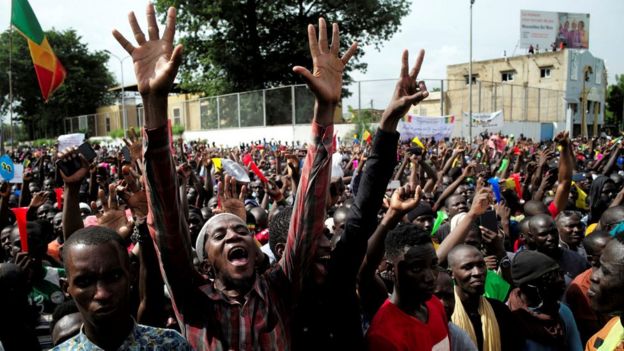
Protests started after the opposition coalition rejected concessions from President Keita designed to end a political stand-off over a disputed legislative election in March.
The opposition this week said the movement had dropped its demand for President Keïta to step down. But it still called this protest because it wants more reforms.
President Keïta secured a second five-year term in 2018, but has faced increased opposition over a rise in jihadist violence and an economic crisis.
Malians will hope this instability does not play into the hands of the jihadists who are behind the escalating violence in the north and centre of the country.
In a sign of the insecurity, one of Mali's opposition leaders, Soumaila Cissé, was kidnapped by an unknown group just days before the parliamentary elections. He was still elected to the National Assembly.
Latest Stories
-
Power restoration fault suspected in Kumasi Central Market fire
51 minutes -
The 7-foot giant of Ngleshie Amanfro: Seven-foot Ghanaian Ephraim Saawa dreams of joining the national basketball team
1 hour -
Government promises support for Kumasi Central Market fire victims
2 hours -
Vibes The Movie: Big Ghun’s Ghanaian film earns five nominations at 2026 REFFA
2 hours -
MamaCare CEO warns unresolved conflicts among health workers could undermine maternal and neonatal care
2 hours -
Health professionals urged to translate medical knowledge into practice to save mothers
3 hours -
Conflicts among care providers linked to maternal, neonatal deaths – Expert
4 hours -
GIS marks 10th TIME conference, champions improved teaching practices
4 hours -
BRICS Or Balance? What Ghana’s bid really means
5 hours -
GPRTU wants full TRAFFITECH-GH implementation to start in 2027
5 hours -
Mahama announces plans to import electric wheelchairs for PWDs
5 hours -
KGL U17 Colts 2026: Western beat Prempeh Elite Academy to set up final final with Greater Accra Region
5 hours -
Late Solanke strike salvages 10-man Spurs draw at Man United
6 hours -
Gender Ministry to monitor welfare of Nana Akua Addo’s children amid domestic violence case
6 hours -
Benedict Okyere Yeboah: Ghana’s football problem goes beyond sacking a coach
6 hours