

Audio By Carbonatix
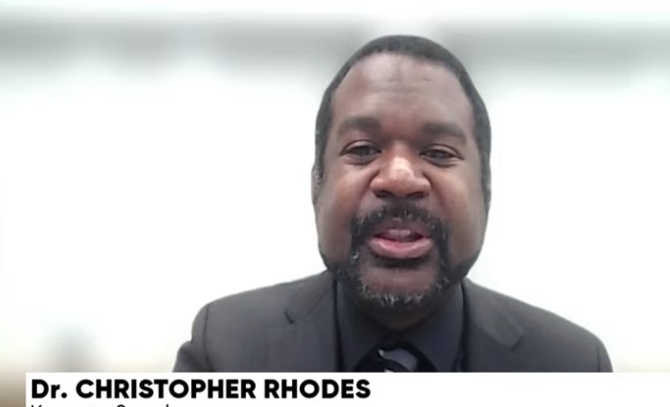
A senior lecturer in social sciences at Boston University and lecturer in the Department of Government at Harvard University, Prof Christopher Rhodes, says the media was a key force in driving the American Revolution and shaping the foundations of modern democracy.
Delivering the keynote address virtually on the opening day of the State of Journalism, Media, and Communication Conference 2026 (SJMCC 2026) on Wednesday, July 15, Prof Rhodes argued that the contribution of journalists to the struggle for liberty has often been overlooked despite its historical significance.
Speaking on the theme "Beyond Enemy of the People: Journalism, Civic Culture, Media Partisanship, and Democratic Renewal in an Age of Democratic Backsliding," he said the role of newspapers and journalists in securing democratic freedoms deserves greater recognition.
"I started to research the role of journalists and journalism in the American Revolution," he said.
"And from there, I decided to explore the role of journalism and journalists in the Indian independence struggle as well. These two struggles for freedom are not only the birth moments of our two respective nations, but they are pivotal moments in world history."
According to him, journalism served as a powerful force in advancing freedom, democracy and independence long before the establishment of modern democratic institutions.
"Among the various anniversaries we've celebrated and the histories we've compiled, the roles of journalism have often been underappreciated."
Drawing on historical accounts, Prof Rhodes explained that newspapers in the American colonies became powerful instruments for mobilising public opinion against British colonial rule.
"The ability of these newspapers to freely criticise the colonial government came from liberal policies and permissive applications of the law that created an atmosphere of free press within the colonies."
He noted that the influence of newspapers extended far beyond their readership, as information was widely shared by word of mouth.
"Because the news from the press was shared in oral form, the written word was spread much deeper into society and was probably more powerful than any one form of media message today."
Prof Rhodes also pointed to Britain's Stamp Act as a turning point that galvanised newspapers against colonial rule.
"This created a situation in which you had a press, which on the one hand was free from government restrictions, but on the other hand was now threatened by government taxation."
"And so that press was partisan and fiercely anti-royalist, both out of principle and out of self-interest."
He said newspapers continued to rally support for the revolutionary cause even after the repeal of the Stamp Act, with press freedom eventually becoming a constitutional right.
"Freedom of the press was seen as so fundamental to the United States and to democracy that it was enshrined in the First Amendment of the U.S. Constitution."
Latest Stories
-
Education Ministry commends Ghanaian teachers on World Teachers’ Day 2026
3 minutes -
NPP can reconcile with aggrieved members who want to return – Nana Akomea
15 minutes -
Tamale Child Deaths: Vehicle owner arrested as IGP deploys homicide team
31 minutes -
From ShattaFest to MoMo Fest: Entertainment takes centre stage in youth engagement
37 minutes -
Nigerian military aircraft crashes, killing 32
42 minutes -
MTN encourages Ghanaians to use MoMo for saving, investing and financial planning
42 minutes -
Absa Bank Ghana names Stephen Ato Frimpong as Board Chair
50 minutes -
Pickford ‘almost caused crash’ with careless driving
52 minutes -
Author and former politician Jeffrey Archer dies aged 86
1 hour -
No education reform can succeed without teachers – Education Ministry
1 hour -
Gauff condemns racist abuse after China Open win
1 hour -
Medvedev disqualified for hitting spectator with ball
2 hours -
Oliseh scores twice in late comeback win for France
2 hours -
Pentagon stops using Anthropic AI tools after blacklisting company, BBC told
2 hours -
From despair to dance: Family of nurse Salomey Baffoe rejoices after GH¢100k bail granted
2 hours