

Audio By Carbonatix
A divided U.S. appeals court ruled on Friday that most of Donald Trump's tariffs are illegal, undercutting the Republican president's use of the levies as a key international economic policy tool.
The court allowed the tariffs to remain in place through October 14 to give the Trump administration a chance to file an appeal with the U.S. Supreme Court.
Trump has made tariffs a pillar of U.S. foreign policy in his second term, using them to exert political pressure and renegotiate trade deals with countries that export goods to the United States.
The tariffs have given the Trump administration leverage to extract economic concessions from trading partners but have also increased volatility in financial markets.
"The statute bestows significant authority on the President to undertake a number of actions in response to a declared national emergency, but none of these actions explicitly include the power to impose tariffs, duties, or the like, or the power to tax," the court said.
The Treasury, the U.S. Trade Representative's office and the Commerce Department had no immediate response to the ruling.
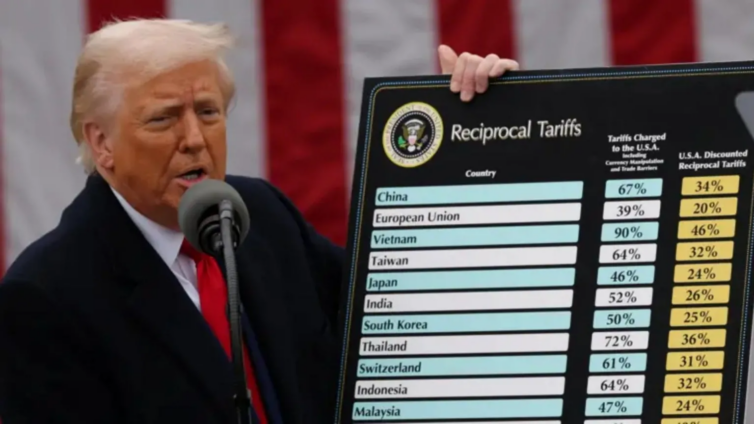
The 7-4 decision from the U.S. Court of Appeals for the Federal Circuit in Washington, D.C., addressed the legality of what Trump calls "reciprocal" tariffs imposed as part of his trade war in April, as well as a separate set of tariffs imposed in February against China, Canada and Mexico.
Democratic presidents appointed six judges in the majority and two judges who dissented, while Republican presidents appointed one judge in the majority and two dissenters.
The court's decision does not impact tariffs issued under other legal authority, such as Trump's tariffs on steel and aluminium imports.
Trump justified both sets of tariffs - as well as more recent tariffs - under the International Emergency Economic Powers Act. IEEPA gives the president the power to address "unusual and extraordinary" threats during national emergencies.
"It seems unlikely that Congress intended, in enacting IEEPA, to depart from its past practice and grant the President unlimited authority to impose tariffs," the ruling said. "The statute neither mentions tariffs (or any of its synonyms) nor has procedural safeguards that contain clear limits on the President’s power to impose tariffs."
The 1977 law had historically been used for imposing sanctions on enemies or freezing their assets. Trump, the first president to use IEEPA to impose tariffs, says the measures were justified given trade imbalances, declining U.S. manufacturing power and the cross-border flow of drugs.
Trump's Department of Justice has argued that the law allows tariffs under emergency provisions that authorise a president to "regulate" imports or block them completely.
Trump declared a national emergency in April over the fact that the U.S. imports more than it exports, as the nation has done for decades. Trump said the persistent trade deficit was undermining U.S. manufacturing capability and military readiness.
Trump said the February tariffs against China, Canada and Mexico were appropriate because those countries were not doing enough to stop illegal fentanyl from crossing U.S. borders, an assertion the countries have denied.
There was little reaction to the ruling in after-hours stock trading.
"Companies will probably continue to operate as though the tariffs will stay in effect since the court is letting the levies stay in place for now," said Brian Jacobsen, chief economist at Annexe Wealth Management.
He said the Trump administration will probably resort to other powers to impose temporary tariffs.
The appeals court ruled on two cases, one brought by five small U.S. businesses and the other by 12 Democratic-led U.S. states, which argued that IEEPA does not authorise tariffs.
The Constitution grants Congress, not the president, the authority to impose taxes and tariffs, and any delegation of that authority must be both explicit and limited, according to the lawsuits.
The New York-based U.S. Court of International Trade ruled against Trump's tariff policies on May 28, saying the president had exceeded his authority when he imposed both sets of challenged tariffs. The three-judge panel included a judge who was appointed by Trump in his first term.
Another court in Washington ruled that IEEPA does not authorise Trump's tariffs, and the government has appealed that decision as well.
At least eight lawsuits have challenged Trump's tariff policies, including one filed by the state of California.
Latest Stories
-
Pentecost University to host international sustainability conference
6 minutes -
Ampofo Ankrah did not collect World Cup visa money – Lawyer
16 minutes -
Baffour Awuah to spend night in EOCO custody – Atta Akyea
18 minutes -
Torgbiga Wenya III opposes proposed elevation of 36 Anlo chiefs to Paramount status
26 minutes -
The strengthening El Niño and what it could mean for Ghana
29 minutes -
Baffour Awuah formally charged with money laundering, loss of public funds – Lawyer
30 minutes -
Drone flight over EOCO building could attract 30-year jail term – Security consultant
38 minutes -
Flying drone over EOCO premises is strictly prohibited – Security consultant
38 minutes -
SIC file was surrendered to client, EOCO has no reason to search Manhyia South MP’s firm – Atta Akyea
39 minutes -
EOCO search of Baffour Awuah’s law firm raises confidentiality concerns – Atta Akyea
40 minutes -
“I will never ignore an invitation from EOCO if I had received one” — Manhyia MP
42 minutes -
Baffour Awuah ready to cooperate fully with EOCO investigation – Bosome Freho MP
1 hour -
How a Ghanaian technology is helping fish farmers detect hidden threats before fish die
1 hour -
AI tool helps Ghanaian farmers identify crop threats from field observations
1 hour -
NEIP: Designing a Ghana Startup Agency that builds enterprises, not programmes
1 hour