

Audio By Carbonatix
For a farmer, a yellow spot on a tomato leaf may seem insignificant.
But that small change could be an early sign of a disease or pest infestation that, if not identified and addressed quickly, could spread across a farm and threaten an entire harvest.
The challenge is that many farmers rely largely on experience to determine what may be affecting their crops. By the time the cause becomes clear, significant damage may already have occurred.
Changing weather and climate conditions are adding another layer of uncertainty, influencing pest behaviour and creating conditions that can favour outbreaks.
It is against this backdrop that a Ghanaian researcher has developed an artificial intelligence technology designed to help farmers identify crop threats from what they observe in the field.
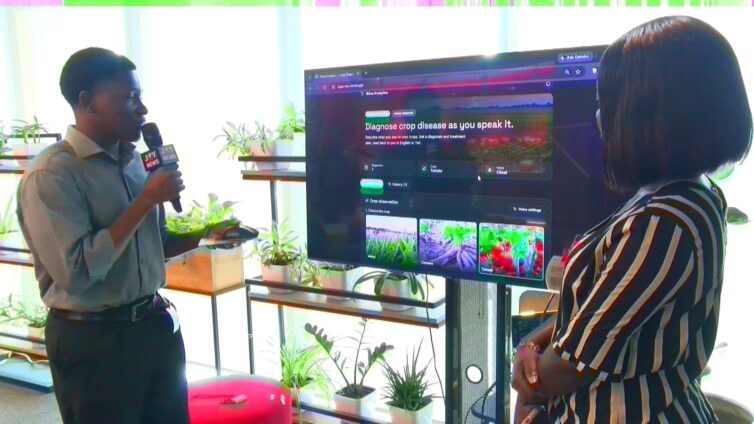
Known as Ndua Analytics, the platform was developed by University of Ghana Research Assistant and YARA Research Fellow, Nana Benyin Eboe Nyamekye Essel-Biney.
Rather than requiring farmers to have specialised agricultural knowledge, the system allows them to describe what they are seeing on their crops and receive a possible diagnosis.
“I implemented my few-shot learning model into a web application which is able to take in observations from farmers on the condition of their crops from what they see, and the system is able to diagnose the crops to give it what is wrong, the disease or the pests that’s wrong with it,” he explained.
Ndua Analytics is currently being piloted on maize, cassava and tomatoes.
A farmer who notices yellow spots on tomato leaves, for example, can select tomatoes on the platform and enter the symptoms observed.
The system analyses the information and generates a possible diagnosis before providing recommendations on treatment, prevention and longer-term management.
The developer has also incorporated language accessibility into the platform for farmers who may struggle with technical agricultural terms or English.
The system uses speech and translation technology to provide responses in English and a local Ghanaian language, with different voice settings also available.
“In case the farmers cannot read or understand the English, if it’s in [the local language], it will be easier for them to have an idea what to do and what is wrong,” Nana Essel-Biney said.
Unlike several agricultural AI tools that depend heavily on images, Ndua Analytics currently does not require farmers to upload photographs of affected plants.
Instead, it works primarily from descriptions of symptoms.
Nana Essel-Biney said the decision was deliberate because poor camera quality, movement and shadows can affect images and potentially reduce the reliability of a diagnosis.
The text-based approach has also allowed him to develop the model with relatively limited datasets.
However, building the technology has presented its own challenges.
Agricultural information had to be carefully processed for the model to interpret it correctly, while the limited availability of local-language datasets created another hurdle.
The team has used translation technology to address some of these challenges and plans to expand the language options as development continues.
The need for earlier detection is becoming more important as weather conditions influence the behaviour of pests.
Meteorologist and Visiting Professor at the University of Leeds, Prof. Benjamin Lamptey, says seasonal pests such as armyworms can emerge at unexpected times when weather conditions become favourable.
“Armyworm is a pest and they attack crops and they are seasonal. Sometimes they attack at a time you don’t expect. Certain favourable weather conditions make them comfortable, then they can attack,” he said.
Researchers, he noted, are exploring ways of identifying when such pests are likely to emerge, with artificial intelligence potentially playing a role.
“There’s a lot of work being done on how to be able to identify their onset. So if you have AI being used as well in this area, it becomes very interesting,” he explained.
But Prof. Lamptey believes technology alone will have limited impact if scientific information does not reach the people who need it.
He said researchers, institutions that produce climate information and users of that information must work together to turn research into practical solutions.
“If you take these three communities to work together, we can make impact, we can solve problems,” he said.
He identified the three groups as the research community, the operational or industry community and the user community.
Farmers, policymakers and agricultural extension officers are among those who depend on climate information, he said.
“You want that information to be usable, you want that information to be relevant, you want that information to address needs,” Prof. Lamptey stated.
Ndua Analytics remains a developing platform, with its current pilot focused on three crops.
Nana Essel-Biney plans to expand it to include crops such as rice, onions, ginger and garlic.
He also intends to incorporate geographical information to account for differences in disease and pest conditions across regions, while adding more Ghanaian languages.
The platform currently requires a link to access, with a login system planned for future versions.
Prof. Lamptey is also calling for greater investment across Ghana’s research and innovation chain.
He said support should extend beyond young researchers to include mid-career researchers and experienced mentors who can help turn research into practical solutions.
“It’s a whole value chain and we have long term, medium term and short term,” he said.
Ghana, he added, cannot afford to wait for young researchers to complete years of experimentation before practical solutions emerge.
“We can’t wait for the young people to experiment and do research before they come up with a solution. We need to have solution,” he said.
For farmers, the stakes are high.
A spot on a leaf may be easy to dismiss. A pest can arrive unexpectedly, and favourable weather conditions can help an outbreak spread.
Ndua Analytics is an attempt to narrow the gap between what a farmer sees in the field and what the farmer needs to know — using artificial intelligence to turn an early observation into information that could help protect a crop before a small problem becomes a major loss.
Latest Stories
-
Baffour Awuah ready to cooperate fully with EOCO investigation – Bosome Freho MP
12 minutes -
How a Ghanaian technology is helping fish farmers detect hidden threats before fish die
21 minutes -
AI tool helps Ghanaian farmers identify crop threats from field observations
26 minutes -
NEIP: Designing a Ghana Startup Agency that builds enterprises, not programmes
32 minutes -
Breast cancer diagnosis is not a life sentence – Gender Minister urges early treatment
34 minutes -
‘How does a bad settlement translate into criminality?’ – Atta Akyea questions EOCO
40 minutes -
Foreign Affairs Ministry launches ‘ECOWAS for All’ campaign to boost public awareness
48 minutes -
Baffour Awuah’s EOCO questioning centred on SIC matter – Bosome Freho MP
51 minutes -
Kwaku Bonsam appeals to Mahama, Ablakwa to facilitate his US travel for skin graft; says he’ll fund it
1 hour -
Baffour Awuah arrested after surrendering to EOCO
1 hour -
Baffour Awuah cooperating with investigators after surrender and arrest – EOCO
1 hour -
Destruction of aspirants’ posters breaches democracy—Ashanti NPP Communications Director
2 hours -
BNI investigates Ampofo Ankrah over alleged $623,000 World Cup visa scheme
2 hours -
GoldBod’s $1.87bn boost strengthens Ghana’s path beyond IMF support – Institute of Fiscal Policy Research
2 hours -
NPP National Delegates Conference: Police announce road closures, diversions around Baba Yara Stadium
2 hours