

Audio By Carbonatix
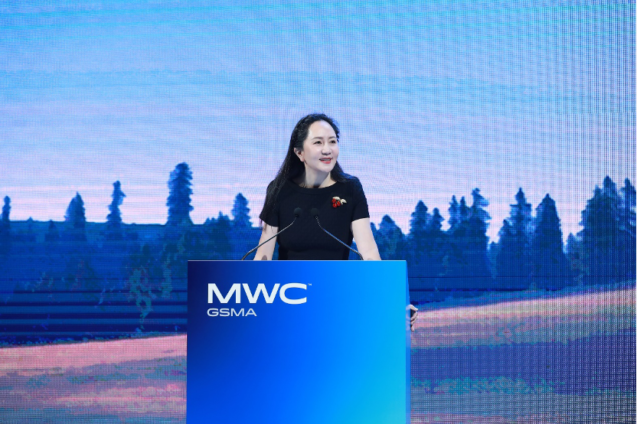
At the opening day of MWC Shanghai 2023, Sabrina Meng, Huawei's Rotating Chairwoman and CFO gave a keynote titled "Embracing 5G transformation".
Meng pointed out that 5G has been in commercial use around the world for four years now. It's driving new value creation, and 5.5G is the next step forward for 5G.
Science and technology are moving towards large, complex systems. This requires matching technology to specific scenarios and performing systems engineering, in order to pave the way for 5G's ongoing success.

5G is creating value along three different fronts
5G has been in commercial use for four years now. Across all industries and countless households around the world, it's changing the way we work and live, creating tremendous economic, industrial, and social value.
For consumers, 5G, cloud, and AI have set off a chain reaction, new forms of business are emerging in great quantities, and a multiplier effect is readily clear.
For industries, to become a driver of productivity, 5G has to become a component of production systems. That's the only way for 5G to see large-scale industrial applications. Strategic patience, in-depth understanding of industrial scenarios, and ongoing improvements to ROI have given 5G a foothold in industrial applications.
Moving ahead, 5G will give rise to new devices and applications that deliver a more immersive experience, like 5G New Calling and naked-eye 3D. 5G is also ushering in a new era of super-connectivity between things, bringing new strength to IoT networks and driving new forms of productivity.
5.5G is the next step forward for 5G. 5.5G will feature 10 gigabit downlink speeds, gigabit uplink speeds, the ability to support 100 billion connections, and native AI. It will not only connect people better – it will also create incredible new business opportunities with more targeted support for industrial needs in domains like IoT, sensing, and advanced manufacturing.
Taking 5G to the next level and paving the way for ongoing success
The ladder to success isn't built on ongoing progress with a single technology. It's built on matching technology to specific scenarios and real-world needs. And systems engineering is key to taking the next step up.
The commercial deployment of 5G has created a growing appetite for more groundbreaking, leapfrog innovation. So how can we pave the way for 5G's ongoing success?
This will require finding the right technology for different scenarios and performing more comprehensive systems engineering. This will also require diving deeper into industrial scenarios, truly understanding customers' pain points, and adopting a more holistic systems engineering mindset.
The industry needs to work more closely together both up and down the value chain – with peers and partners, customers and developers – throughout the entire product lifecycle, from R&D and procurement, to supply and marketing. The industry needs to pave the way for 5G's ongoing success by working on solution modeling and optimization, as well as tools and methodologies.
Building up integrated capabilities and exploring the future of communications
The digital infrastructure of the future intelligent world will be deeply integrated into every aspect of people's lives, industry, and society. It won't be based on advancements in individual technologies, but rather on incredibly massive, complex systems – the convergence of multiple elements. It's going to require systems-level thinking and design.
When watching a chess game, you can see the big picture. But when you're playing chess, you focus on the details. Likewise, systematic capabilities to integrate technology and transform management are critical for the future success of 5G.
Meng spoke about two specific types of integrated capabilities. "The first is integrating different technologies. We can achieve greater synergy across clouds, networks, edge, and devices through systematic design and cross-domain innovation. When coupled with optimization across software, hardware, chips, and algorithms, we can address the challenges associated with developing complex solutions for vastly different industrial scenarios."
"The second," she continued, "is the ability to integrate different approaches to management. Digital and intelligent transformation is not just about technology itself. It's more about transforming your approach to management. Going digital requires redefining the relationships between people, events, things, and theory, and adopting a more open, forward-looking management approach to address future challenges."
Meng concluded: "Information technologies like 5G, 5.5G, AI, and cloud will help us rise with the tide and take us forward to an intelligent world. The best scenery is always ahead. Let's create a bright future together."
Latest Stories
-
Stronger GTA-private sector partnership needed to grow tourism – GHATOF
4 minutes -
Amazon eyes Ghana for broadband expansion after talks with Mahama
49 minutes -
National Investment Quiz 2026: Six schools qualify for quarter-finals
1 hour -
‘Do not let Russia pay for its madness with lives of your people’ – Zelensky to Ghana, 46 other countries
1 hour -
6,079 promotion cases fully processed and paid – CAGD says amid nationwide teachers’ strike
2 hours -
Teacher unions to meet government Monday over nationwide strike
2 hours -
Photo story: Republic Bank-JoyNews Habitat Fair clinic wraps up after three days of housing solutions, expert engagement
2 hours -
National Peace Council urges investment in youth to sustain Ghana’s peace
2 hours -
Afenyo-Markin urges youth to speak up against injustice
3 hours -
CAF annuls Edo Queens victory, orders WAFU B final to resume from extra time
3 hours -
Interior Minister urges traditional authorities to enforce anti-bushfire bye-laws
3 hours -
3rd Republic Bank-JoyNews Habitat Fair Clinic ends on a high note after three days of strong patronage
3 hours -
Ten climbers missing after avalanche hits Himalayan base camp
4 hours -
NPP had more permanent fuel relief measures than current GH¢2 diesel cut – Amin Adam
4 hours -
Photos from the 3rd Republic Bank-JoyNews Habitat Fair Clinic
4 hours