

Audio By Carbonatix
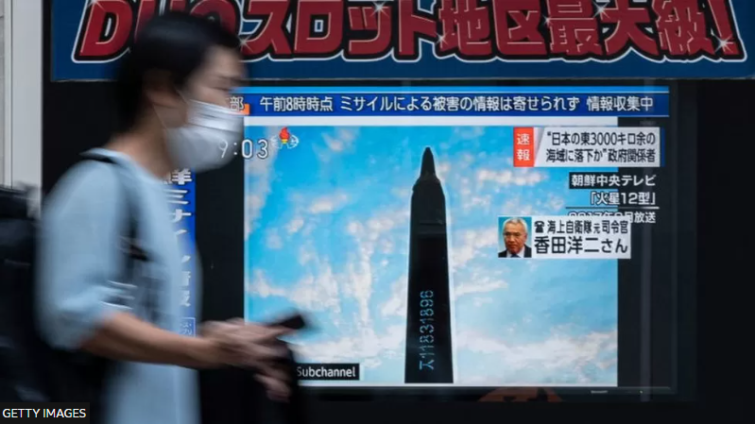
North Korea has fired a suspected intermediate range ballistic missile over part of northern Japan.
It prompted a warning from the Japanese government for people on the island of Hokkaido to take cover during its flight, and the temporary suspension of some train operations.
It is the first North Korean missile launch over Japan since 2017.
The UN prohibits North Korea from ballistic and nuclear weapons tests.
"North Korea appears to have launched a missile. Please evacuate into buildings or underground," the Japanese government said in a rare alert issued at 07:29 local time on Tuesday (22:29 GMT Monday).
Officials said the missile fell into the Pacific Ocean about 3,000 km (1,860 miles) from Japan, and that no injuries had been reported in connection with it.
Japan's Prime Minister Fumio Kishida strongly condemned the actions, describing the launch as "violent behaviour", and the Japanese government has called a meeting of its National Security Council.
The launch appears to be a deliberate escalation designed to get the attention of Japan and the US, who have largely been ignoring North Korea's leader Kim Jong-un.
It is in complete contravention of international norms to fly missiles towards or over other countries without any pre-warning or consultation.
Most countries avoid doing it completely as it can easily be mistaken for an attack, and while it is not as a big as a nuclear test - which could be next - it is nevertheless hugely provocative.
The US has responded, with the top US diplomat for East Asia, Daniel Kritenbrink, describing North Korea's decision as "unfortunate".
It comes as Japan, the US and South Korea staged trilateral military exercises earlier last week, which have been known to provoke Pyongyang.
The missile launch is the fifth carried out by Pyongyang in a week. On Saturday, two rockets came down in waters outside Japan's exclusive economic zone.
Many of North Korea's missile tests are conducted on a high, lofted flight path - reaching a high altitude, avoiding flights over its neighbours.
But firing over or past Japan allowed North Korean scientists to test missiles under circumstances "that are more representative of the conditions they'd endure in real-world use", analyst Ankit Panda told news agency Reuters.
Earlier this month, North Korea passed a law declaring itself to be a nuclear weapons state, with leader Kim Jong-un ruling out the possibility of talks on denuclearisation.
Pyongyang conducted six nuclear tests between 2006 and 2017, despite widespread sanctions.
Latest Stories
-
Why must I renew my vehicle’s registration number every 2 years?
27 seconds -
Parliamentary Privilege and the Limits of Personal Liberty: A study on the immunity of members of parliament from arrest in Ghana
2 minutes -
Kwabenya Court denies bail to six accused in alleged 3.9-tonne cocaine shipment
2 minutes -
Ghana opposes calls to abolish ICC, urges stronger action against crimes against humanity
9 minutes -
Cedi remains under pressure due to Christmas demand; going for GH¢11.90 at forex bureaus
11 minutes -
NDC opens nominations for 2026 regional executive elections on October 6
11 minutes -
Ghanaian nurses to receive higher pay, health insurance and rent allowance under new Saint Kitts and Nevis agreement
20 minutes -
JoyNews’ Emmanuel Adu Gyamfi named ‘Digital Tourism Icon of the Year’ in Ahafo Region
24 minutes -
Hurricane Polo makes landfall on Mexico’s Pacific coast
28 minutes -
US ban on Canadian alcohol and dairy comes into effect as trade war drags on
30 minutes -
GES orders SHS heads to refund unauthorised fees collected from parents
38 minutes -
AFCON 2027Q: ‘We don’t need to cry over spilled milk’ – Damba on Ghana injury concerns
42 minutes -
NDC communicator blames documentation, payroll validation for teachers’ promotion arrears delay
43 minutes -
2026 JoyNews Impact Maker Award winner brings clean water to Yoko Tsume after years of cattle dugout dependence
50 minutes -
Sarkodie commends Mahama for rejecting US health compact
50 minutes