

Audio By Carbonatix
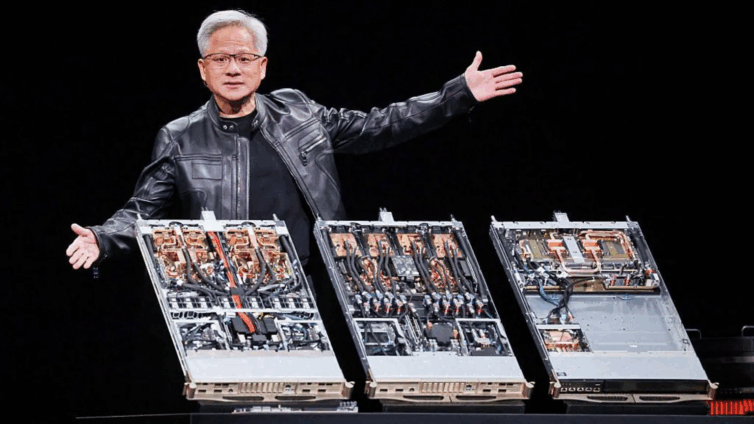
Nvidia boss Jensen Huang has blasted US rules that blocked exports of advanced computing chips to China, arguing that they were backfiring against American companies.
At a press conference at the annual Computex conference in Taipei, Taiwan, he called the policies a "failure".
His comments come just days after the Trump administration said it was dropping rules blocking exports to China entirely and restricting sales to dozens of other countries.
The measures, announced in the final days of Joe Biden's presidency, drew fierce pushback from tech companies, including Nvidia.
The US started imposing controls on exports related to semiconductors during Trump's first term, citing concerns about letting technology with potential military use fall into the hands of companies connected to the Chinese government.
The Biden administration tightened the restrictions significantly.
During Biden's four-year tenure, Nvidia's share of the Chinese market dropped from 95% to 50%, Mr Huang said on Tuesday.
He argued that the restrictions had pushed Chinese companies toward home-grown alternatives, spurring Chinese investment in the industry.
"The fundamental assumptions that led to the AI diffusion rule in the beginning, in the first place, have been proven to be fundamentally flawed," he told reporters.
Mr Huang's comments reflect an ongoing debate in the US over how to balance global business interests with economic and national security concerns, against a backdrop of tensions with China.
Trump has spearheaded sweeping trade tariffs, despite objections from business groups.
But he has taken a more mixed approach to the tech industry, from which he drew critical support during last year's re-election campaign.
The decision to drop the most expansive Biden-era rule helped facilitate AI deals between firms such as Nvidia and countries including Saudi Arabia, which was announced during Trump's tour of the Middle East last week.
But the White House has tightened restrictions in other ways, barring US firms from sales of advanced technology to dozens of new companies, mostly from China.
Last month, the Commerce Department said it would impose new licensing requirements for exports of certain Nvidia chips.
It has said it intends to replace the Biden-era restrictions with its own approach.
It also recently issued an alert to US firms, warning them that using Huawei chips risked violating US rules.
Beijing has since pushed back against that move, accusing the US of undermining the framework agreed during trade talks in Switzerland earlier this month.
Latest Stories
-
GloMeF CEO urges intensified public education on new road traffic regulations
11 minutes -
‘Any tax on ChatGPT is an attack on education and innovation’- Akim Swedru, MP
14 minutes -
Obuasi SHTS sexual abuse scandal exposes systemic failure in child protection – Moving Masculinity
15 minutes -
Hubtel CEO calls for national data-sharing framework to boost AI development
18 minutes -
Twelve Golden Rules of real estate development in Ghana, Africa
22 minutes -
Five new telephony cell sites in Ashanti Region to be activated in October 2026 – Sam George
22 minutes -
Mahama cuts sod for Afienya Industrial Park, targets 120 enterprises
27 minutes -
Rush for fuel from accident tankers is stealing, punishable by law – NPA boss, Edudzi Tamakloe
33 minutes -
GhIG pushes for legislation to regulate geoscientists’ activities
39 minutes -
Mfantsipim @150: Ace Anan Ankomah leads project to preserve school’s musical heritage
43 minutes -
Gov’t launches rCOMSDEP in Ahanta West, Mpohor Fiase to promote responsible community mining
45 minutes -
AI is forcing professionals to rethink how they deliver value – Hubtel CEO
48 minutes -
Daily Insight for CEOs: Strengthening the CEO’s Leadership Legacy
48 minutes -
Jimmy Aglah’s ‘When the River Testified’ approved by NaCCA as Supplementary Reader
57 minutes -
Hubtel willing to contribute to Ghana’s proposed AI fund – CEO
1 hour