

Audio By Carbonatix
The National Youth Authority (NYA), Osman Abdulai Ayariga, has reaffirmed government’s commitment to positioning Ghana’s youth as central architects of national development.
He emphasised that young people must be treated not as passive beneficiaries but as “co-creators and designers of their future.”
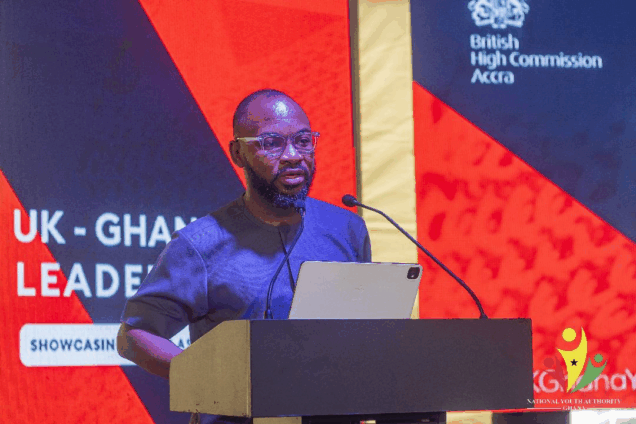
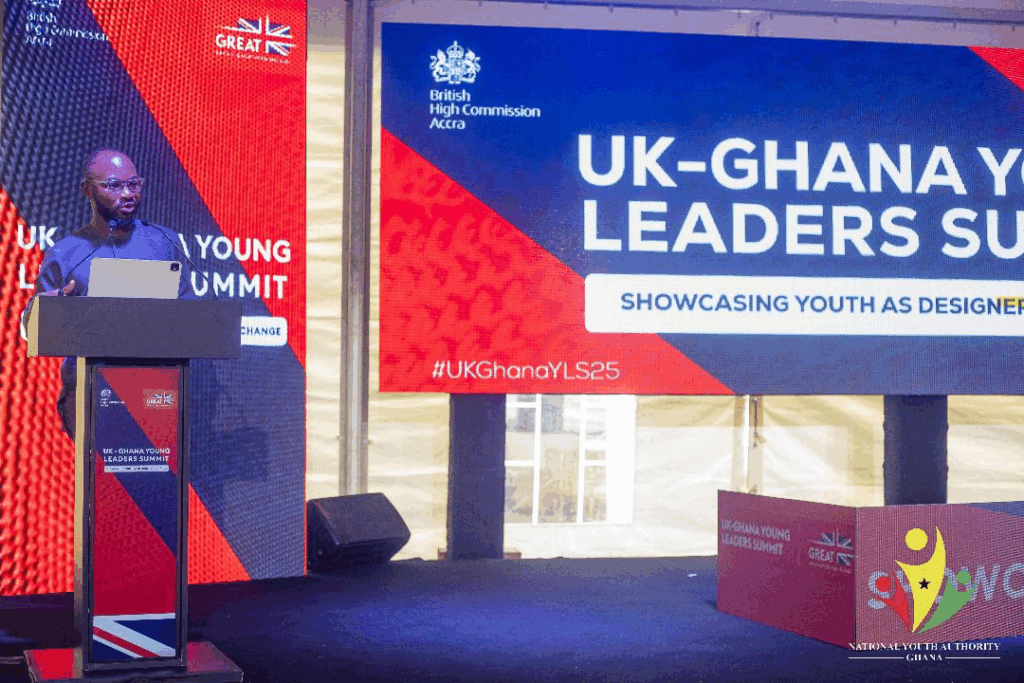
Speaking at the UK-Ghana Young Leaders’ Summit 2025 in Accra under the theme “Youth Empowerment for a Sustainable Future,” Mr. Ayariga highlighted a series of strategic initiatives by the Authority aimed at strengthening youth participation in governance, environmental stewardship, and entrepreneurship.
He underscored that the Authority’s vision is guided by the National Youth Policy (2022–2032), which places youth empowerment at the core of Ghana’s economic, civic, and environmental transformation.
Mr. Ayariga announced the rollout of the Ghana Youth Federation (GYF), a new umbrella body that unifies youth groups across sectors to amplify their voices in governance and development.
He also pointed to the Youth Parliament Initiative, now operational at district, regional, and national levels, as a democratic space where young people directly influence policymaking.
On climate change, the NYA CEO stressed that the Authority is determined to make youth the driving force of Ghana’s climate resilience agenda.
He cited the establishment of the National Youth Action Group on Climate Change (NYAGCC) in 2023, which brings together youth-led organisations, civil society, ministries, and state agencies to harmonise advocacy and solutions.
Complementing this is the Youth Advocacy on Climate Change and Mitigation (YACCM) programme, which has already trained more than 228 youth leaders.
These leaders, he revealed, have transferred climate-smart farming knowledge to over 6,000 young people nationwide, linking environmental stewardship with sustainable livelihoods.
“These interventions are not isolated efforts,” Mr. Ayariga said.
“They directly contribute to the United Nations Sustainable Development Goals—particularly SDG 13 on Climate Action and SDG 16 on Peace, Justice, and Strong Institutions.”
Addressing the young innovators and leaders present, Mr. Ayariga hailed their contributions in entrepreneurship, civic innovation, and environmental advocacy as “the heartbeat of our national agenda.”
“You are living proof that youth can design sustainable futures,” he said.
“You deserve not only recognition but sustained support. The National Youth Authority remains committed to providing the platforms, partnerships, and policies that will enable you to lead with even greater impact.”
The summit, hosted in collaboration with the British High Commission and the UK-Ghana Network, brought together young leaders, policymakers, and development partners to deliberate on youth-driven solutions for shared prosperity and sustainability.
Latest Stories
-
APL says GoldBod terminated US$1bn Goldstream deal over failure to meet obligations
4 minutes -
Daily Insight for CEOs: Making better decisions under pressure
5 minutes -
Weta rice farmers seek urgent support after floods destroy crops
6 minutes -
Mahama commits GH¢200m in 2027 Budget to complete Police Hospital expansion
9 minutes -
Standard Chartered Bank delivers strong returns and sustainable shareholder value
20 minutes -
Akufo-Addo’s role in the artificial cedi stability is indisputable — Facts do not bend to political convenience
23 minutes -
Breaking Bad actor RJ Mitte dies aged 34
30 minutes -
Wontumi pleads not guilty in GH¢30m Exim Bank loan case
34 minutes -
Beyond the Flyer: Awareness without screening is not enough
41 minutes -
Bekwai MP donates GH¢100,000 to hospital for specialist equipment
48 minutes -
Van Vicker sues Lil Win for defamation, demands GH¢10m
54 minutes -
FIFA/ FIBA agency Pep Sports moves to admit Ghana’s 7-Foot Basketball talent to its Ultra-Modern Sports campus after MyJoyOnline report
56 minutes -
GAUA strike disrupts academic plans at University of Ghana as students, parents express frustration
1 hour -
Dad’s Army/African Polistas crowned champions of 2026 Accra Polo Club Trustees’ Cup
1 hour -
Mahama approves Integrated Basic Education Model, with funding expected in 2027 under GETFund formula
1 hour