


Audio By Carbonatix
Ghana has taken a historic leap toward agricultural sovereignty as the Asantehene, Otumfuo Osei Tutu II, threw his weight behind a pioneering initiative to cultivate wheat on Ghanaian soil.
In a at the Manhyia Palace, a high-powered delegation from Arima Farms Ghana and the Council for Scientific and Industrial Research (CSIR) sought royal blessings for the ‘Ghana Wheat Initiative’.
To mark the dawn of this new era, the team formally requested to name the project's most elite, high-performing variety ‘Opemsuo Wheat’—a title that carries the prestige of the Ashanti Monarchy and signals the region's role as the project's primary production hub.
The $450 Million Drain
Ghana currently spends over $450 million annually on wheat imports, with national consumption soaring past 1.2 million metric tonnes. By establishing the Ashanti Region as the focal point for national expansion, the project aims to replace foreign dependence with home-grown security.

The scientific backbone of the project relies on heat-tolerant varieties, including Wheat Pride 999 from India and genetic lines from the International Maize and Wheat Improvement Center (CIMMYT). These seeds have been specifically curated for their ability to thrive in tropical heat while delivering high yields and superior nutrition.
From South India to West Africa
The Managing Director of Arima Farms Limited, Ms. Saalai Manikam, noted that her confidence in the project stems from direct ecological parallels between Ghana and her home in South India.
“I’m from South India, which has similar climatic and ecological conditions to Ghana, and we have successfully cultivated wheat there. If it can be done in that climate, then why not in Ghana?” she challenged. “We brought in tropical wheat varieties specifically suited for this climate. Research by the Crops Research Institute has taken into consideration the ecological zones and the right cultivation patterns.”
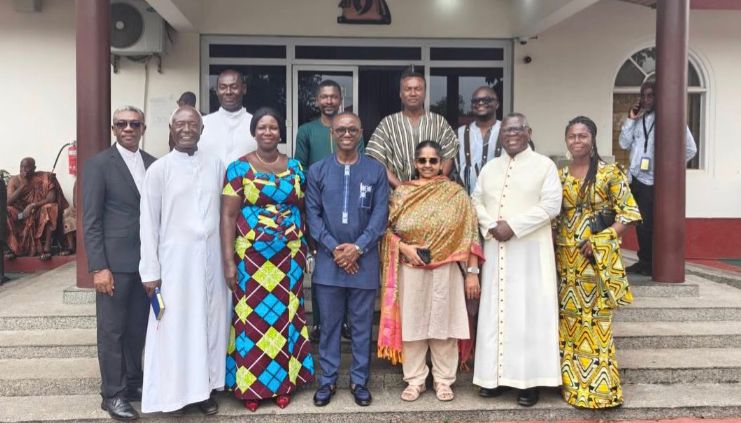
Ms. Manikam revealed an incremental rollout strategy, beginning with a pilot involving 500 smallholder farmers before a wider national scale-up. “Gradually, over five to ten years, we can reach full self-sufficiency,” she added.
Challenging Scientific Myths
For decades, the consensus was that Ghana’s climate was unsuitable for wheat. However, the Crops Research Institute (CSIR-CRI) has spent two years shattering those assumptions through rigorous field trials across diverse ecological zones.
The Director of CSIR-CRI, Professor Maxwell Darko Asante, confirmed that the experimental phase is nearing a triumphant conclusion.

“We have been able to find heat-tolerant wheat varieties and tested them across regions, and we can assure that many of these lines are well adapted to our environment, with plans to officially release them onto the market next year,” Prof. Asante stated.
A Call for National Convergence
The project is a multifaceted partnership involving the Indian Government, traditional authorities, the Catholic Church, and the private sector.
Nana Barima Acheampong Sarpong II, Business Development Director of Arima Farms, stressed that this "history-making" moment requires a unified national front to succeed.
“We are making history where we have brought wheat and we’re starting from the Ashanti Kingdom. We are requesting that the government, political parties, traditional authorities, the private sector and the church all come together. If we forge this partnership, in the next five to ten years Ghana should not be importing wheat,” he asserted.
He further expressed optimism that the local ‘Opemsuo’ variety would soon surpass the quality of wheat currently sourced from neighbouring Burkina Faso. “That is our focus,” he concluded.
With royal endorsement now secured, the Ashanti Region is set to transition from a consumer of imported flour to a producer of the very grain that feeds the nation, potentially sparking a new wave of investment in local milling and agro-processing industries.
Latest Stories
-
Power restoration fault suspected in Kumasi Central Market fire
41 minutes -
The 7-foot giant of Ngleshie Amanfro: Seven-foot Ghanaian Ephraim Saawa dreams of joining the national basketball team
1 hour -
Government promises support for Kumasi Central Market fire victims
1 hour -
Vibes The Movie: Big Ghun’s Ghanaian film earns five nominations at 2026 REFFA
2 hours -
MamaCare CEO warns unresolved conflicts among health workers could undermine maternal and neonatal care
2 hours -
Health professionals urged to translate medical knowledge into practice to save mothers
2 hours -
Conflicts among care providers linked to maternal, neonatal deaths – Expert
4 hours -
GIS marks 10th TIME conference, champions improved teaching practices
4 hours -
BRICS Or Balance? What Ghana’s bid really means
5 hours -
GPRTU wants full TRAFFITECH-GH implementation to start in 2027
5 hours -
Mahama announces plans to import electric wheelchairs for PWDs
5 hours -
KGL U17 Colts 2026: Western beat Prempeh Elite Academy to set up final final with Greater Accra Region
5 hours -
Late Solanke strike salvages 10-man Spurs draw at Man United
5 hours -
Gender Ministry to monitor welfare of Nana Akua Addo’s children amid domestic violence case
6 hours -
Benedict Okyere Yeboah: Ghana’s football problem goes beyond sacking a coach
6 hours