

Audio By Carbonatix
Coronavirus cases are increasing across Europe - with some countries reporting record rises in the number of daily infections.
Several countries have announced drastic new measures in an attempt to stop COVID-19 spreading further.
Here is a snapshot of what's happening across the continent right now.
Italy
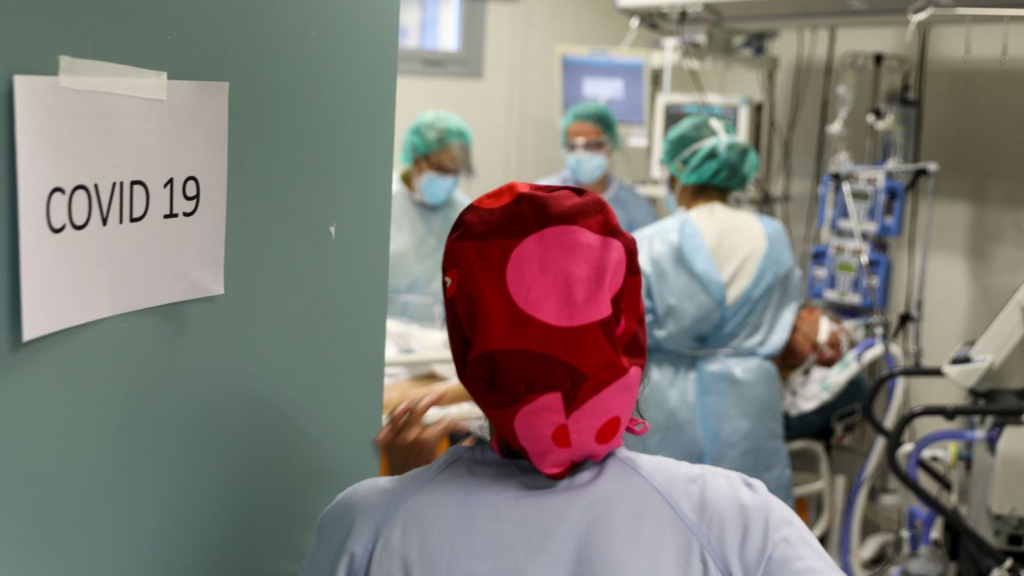
Infections are surging once again in the region of northern Italy where the pandemic first took hold in Europe.
On Wednesday, a record 7,332 cases were reported nationwide - more than the 6,557 seen on the worst day in March.
Live coronavirus updates from the UK and around the world
Italy's cases per 100,000 residents have doubled in the last two weeks to nearly 87 but death figures are lower, hovering at about 40 compared with the worst day in March, when there were 969.
The government wants to avoid another lockdown but has refused to rule out closing cities or provinces.
Instead, bars and restaurants face a midnight curfew and casual sports are banned, as are celebrations in public venues. As of last week, masks are mandatory indoors and outdoors.
Germany
More than 5,000 new daily cases were reported in Germany for the first time since mid-April and Chancellor Angela Merkel has warned "this won't end well" if action is not taken.
"We must call especially on young people to do without a few parties now in order to have a good life tomorrow or the day after," she said.
In places where the infection rate is more than 35 per 100,000 people, masks will be mandatory in crowded public places. They have been mandatory on public transport and in shops since April. Bars and restaurants will also close early.
In areas with more than 50 infections per 100,000 people, parties will be limited to 10 people, and bars and restaurants will close at 11pm. People will also be encouraged to avoid non-essential travel to and from places on this list.
Markus Soeder, the leader of the state of Bavaria, warned: "We are much closer to a second lockdown than we might want to believe. It is perhaps not five to midnight, but rather the stroke of midnight."
France
The country reported 22,591 new daily cases on Wednesday - the third time in six days that the daily total has surpassed 20,000.
COVID-19 patients also occupy a third of the country's intensive care beds.
Astate of emergency has been declared, and President Emmanuel Macron has announced a curfew between 9pm and 6am for the worst-affected areas.
Ile-de-France and eight metropolitan areas - including Grenoble, Lille, Lyon, Aix-Marseille, Saint Etienne and Toulouse - will be under curfew for four weeks, starting on Saturday.
It means people cannot go to restaurants or visit friends, but there will be no restrictions on public transport or on travel between regions.
Spain
Spain became the first European Union country to pass 900,000 cases on Wednesday.
Hospitalisations are on the increase too, but the number of severe cases remains far lower than during the first wave.
Authorities in Catalonia have ordered bars and restaurants to close for 15 days and limited the numbers of people allowed in shops.
Ireland
There will be a ban on all household visits from Thursday night, unless it is for childcare or compassionate reasons.
The border counties of Donegal, Cavan and Monaghan have been moved to the second-highest level of restrictions.
This means closing gyms, pools, leisure centres, and non-essential shops. It also means encouraging people to work from home.
The rules will be in place until 10 November.
Czech Republic
Schools have been closed to tackle an infection rate of 521 per 100,000 people over 14 days - the highest rate in Europe.
The country's education minister Robert Plaga said: "It's necessary to do it and to do it fast."
The health ministry said the number of infected teachers and education staff had jumped to more than 4,500 since September - a higher number than among health workers.
Belgium
Intensive care beds could be full by the middle of November if the virus continues to grow at the current rate in Belgium.
The country has recorded an infection rate of 429 cases per 100,000 people over 14 days - the second-worst in Europe.
Curfews were introduced last week and bars in Brussels were closed for at least a month.
Russia
Russia has reported more than 10,000 new cases for 11 consecutive days - and the 14,231 reported on Wednesday marks its highest number since the pandemic began.
There were restrictions in the spring but most of these were lifted during summer, and officials are trying to avoid a second lockdown.
In Moscow, the elderly have been urged to isolate and school holidays have been extended by one week, with some students moving to online lessons.
Latest Stories
-
At least 30 feared dead in crush at Haitian tourist site
59 minutes -
Four arrested over murder of Scottish businessman in Kenya
1 hour -
New Mainoo deal closer, says Man Utd boss Carrick
1 hour -
Sinner beats Alcaraz to return to world top spot
2 hours -
An inappropriate joke nearly ended his career. Now he’s back with more humour
2 hours -
GPL 2025/26: Dreams FC stage stunning comeback to hammer Eleven Wonders
3 hours -
Livestream: The Probe examines Kumasi’s looming water crisis
3 hours -
MTN Ghana gears up to lead Africa’s AI revolution
3 hours -
Philanthropist Alhaji FuZak donates Da’wah bus to Ambariya Sunni community
3 hours -
GUTA calls for suspension of Publican AI system over trade disruptions
3 hours -
TTAG raises alarm over proposed recruitment of 7,000 teachers, demands national posting roadmap
4 hours -
Civilians feared killed after reports of air strike on Nigerian market
4 hours -
Bishop Simon Kofi Appiah installed as new Jasikan Diocese Bishop
4 hours -
Trump’s Strait of Hormuz blockade threat raises risks and leaves predicaments unchanged
4 hours -
US Court backs extradition of former MASLOC CEO Sedina Tamakloe-Attionu to Ghana
4 hours