

Audio By Carbonatix
At Adagya D/A School in the Bosomtwe District of Ashanti Region, the daily realities of school life for many female students are defined not just by academic pressure, but by the silent burdens of menstruation, poor sanitation, and inadequate infrastructure.
These interlinked challenges are now threatening the well-being and future of hundreds of girls, prompting calls for urgent intervention.
A recent health talk organized at the school turned into a revealing and emotional session as girls shared the difficulties they face during their periods.
What was intended as an educational gathering exposed a deeper crisis.
“Madam, is it wrong to have your period twice a month?” one girl asked. Another also quizzed, “Is it a sickness to get your menses at the age of eleven?”

These simple but telling questions highlight the deep gaps in reproductive health education and access to trusted information.
Beyond the lack of knowledge, many girls are forced to stay home during their menstruation due to the absence of functioning, private washrooms.
According to Madam Millicent Amoateng, the Assistant Headmistress, the school’s sanitation facilities are in “deplorable condition,” offering no privacy or hygiene for menstruating students.
“We are grateful for this intervention, but we have other urgent needs. Our washroom facilities are in deplorable condition. We call on individuals, organizations, and government bodies to help us provide a healthier environment for our students,” she pleaded.
This lack of basic menstrual health support has wider social consequences.

Agyei Selena, the Girl Child Coordinator at Adagya D/A School, expressed concern over how some girls respond to these challenges. “When they can’t afford pads, they turn to these boys for money,” she said, referring to local tricycle operators, commonly called “pragya” riders. “This sadly leads to cases of teenage pregnancy. We need to support our girls at home and in school to protect their dignity and their future.”
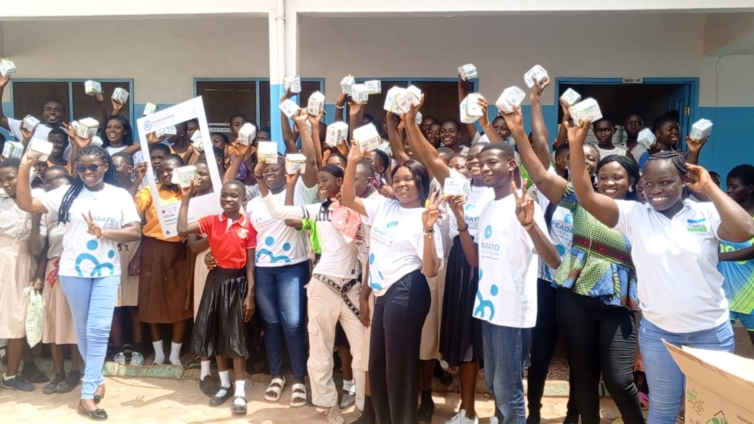
In response to these pressing issues, the PEADATO Foundation organized an outreach program in anticipation of Menstrual Hygiene Day.
The foundation donated sanitary pads to 600 female students and provided vital education on menstrual hygiene management.
According to Dr. Gertrude Agyemang Asiedu, Chairperson of the PEADATO Board, this initiative is about more than providing pads. “This is about building confidence and self-esteem in young girls. Understanding menstrual hygiene is fundamental to ensuring that girls take care of themselves with pride and without shame,” she emphasized.
Dr. Asiedu also pointed out how menstrual-related absenteeism disrupts the educational journey of many girls.

“Many girls choose to stay home during their periods, which disrupts their education. Our mission is to change that narrative by both supplying sanitary pads and educating them that menstruation is a natural, healthy part of life.”
Portia Oduro Frimpong, Program Management Officer at PEADATO, explained that the foundation’s intervention was informed by research and a continued presence in the district. “We studied the community’s needs before coming here. This is not our first engagement in the Bosomtwe District, and we are committed to returning whenever necessary,” she said.
One student, Abigail Opoku Asamoah, shared how the program changed her perspective. “I’ve learned the right way to dispose of pads, the importance of hygiene, and that menstruation is not something to be ashamed of. Thanks to PEADATO, I now feel clean, confident, and proud.”
While PEADATO’s support is a vital first step, the broader crisis at Adagya D/A School demands more than one-off interventions. Safe washroom facilities, adequate classroom space, and ongoing reproductive health education are essential for empowering girls and ensuring they stay in school.
In addition to menstrual health challenges, the school faces serious overcrowding. Some classrooms hold more than 80 students, making effective teaching nearly impossible. Students are packed into poorly ventilated rooms, with limited desks and materials, which discourages participation and makes learning uncomfortable.
Teachers also lack basic furniture like tables and chairs to teach effectively.
The situation is a clarion call to government agencies, NGOs, and compassionate individuals. These girls do not just need supplies they need a system that supports their dignity, health, and right to education. Solving these challenges is not only about fixing a school, but about investing in a generation of young women striving for a better future
Latest Stories
-
Prosperity Architecture: Drawing II – Organising institutions for shared prosperity
13 minutes -
First female prime minister named in Morocco after winning elections
22 minutes -
Burkina Faso’s junta leader opens major gold refinery to keep mining profits at home
30 minutes -
Nigeria’s Ben Dancer completes 168-hour dance marathon, awaits Guinness verdict
40 minutes -
I’m now a minister of God – Actress Jumoke Odetola announces
49 minutes -
Banks accounted for 86% total enquiries for credit in 2025
50 minutes -
‘I paused for my mom’ – Kizz Daniel opens up on music break
54 minutes -
Habib Iddrisu rejects argument that court cases bar Parliament from investigating drug scandal
1 hour -
Over 25m enquiries conducted by financial institutions for credit appraisals, others in 2025
1 hour -
Venezuelan man shot by ICE in Texas is charged with assault
1 hour -
Eiffel Tower chief to quit after female staff replaced by men during religious visit
1 hour -
South Africa to clean up high-risk areas after 12 women killed
2 hours -
Kpandai case sets the precedent – Habib Iddrisu challenges Speaker’s rejection of drug probe
2 hours -
Habib Iddrisu questions Speaker Bagbin’s rejection of motion after Parliament recall
2 hours -
More than 400 detained as France student protests escalate
3 hours