

Audio By Carbonatix
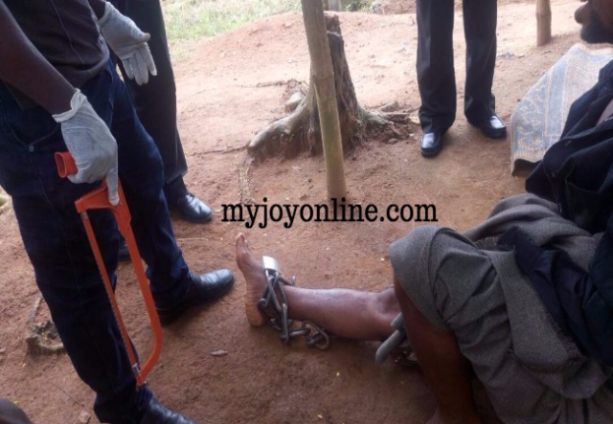
Thousands of people with mental health conditions are chained around the world with some, as young as 10 years, confined for weeks, months and even years against their will, the Human Rights Watch Report has said.
The Report, which was launched virtually, ahead of this year’s World Mental Health Day on October 10, indicated that men, women, and children, were chained or locked in confined spaces in about 60 countries across Asia, Africa, Europe, the Middle East, and the Americas.
The 56-page Report: “Living in Chains: Shackling of People with Psychosocial Disabilities Worldwide,” examines how people with mental health conditions are often shackled by families in their own homes or in overcrowded and unsanitary institutions, against their will, due to widespread stigma and a lack of mental health services.
“Many are forced to eat, sleep, urinate, and defecate in the same tiny area," it said.
“In state-run or private institutions, as well as traditional or religious healing centres, they are often forced to fast, take medications or herbal concoctions, and face physical and sexual violence."
The Report includes field research and testimonies from Ghana, Afghanistan, Burkina Faso, Cambodia, China, Indonesia, Kenya, Liberia, Mexico, Mozambique, Nigeria, Sierra Leone, Palestine, South Sudan, Yemen and the self-declared independent state of Somaliland.
“Shackling people with mental health conditions is a widespread brutal practice that is an open secret in many communities,” said Kriti Sharma, Senior Disability Rights Researcher at Human Rights Watch (HRW) and author of the Report.
“People can spend years chained to a tree, locked in a cage or sheep shed because families struggle to cope and governments fail to provide adequate mental health services.”
The Report said while a number of countries were paying greater attention to the issue of mental health, shackling remains largely out of sight.
It noted that there were no data or coordinated international or regional efforts to eradicate shackling.
The Report said in response, the HRW had been working with mental health advocates with live experiences, and human rights and anti-torture organisations around the world to launch a global #BreakTheChains campaign to end shackling of people with mental health conditions.
The HRW interviewed more than 350 people with psychosocial disabilities, including children, and 430 family members, staff working in institutions, mental health professionals, faith healers, government officials, and disability rights advocates.
Based on a study of 110 countries, HRW found evidence of shackling of people with mental health conditions across age groups, ethnicities, religions, socioeconomic strata, and urban and rural areas in about 60 countries.
It said globally, an estimated 792 million people, or one in 10, including one in five children, had a mental health condition.
“Yet governments spend less than two per cent of their health budgets on mental health.”
The report said even when mental health services were free or subsidized, distance and transport costs were a significant barrier.
It said in the absence of proper mental health support and lack of awareness, many families felt they had no option but to shackle their relatives; stating that they were often worried that the person might run away or hurt themselves or others.
The report urged national governments to act urgently to ban shackling, reduce stigma, and develop quality, accessibility and affordable community mental health services.
Governments should immediately order inspections and regular monitoring of state-run and private institutions and take appropriate actions against abusive facilities, the Report said.
Latest Stories
-
Every year, the lawyers come out, and so does the nonsense! – Ace Ankomah writes
21 seconds -
Digital transformation without an ownership culture can digitise poor service
4 minutes -
Fishing communities demand revocation of offshore gold exploration licences over livelihood concerns
7 minutes -
How Ghanaian tycoon Manoj Lakhiani built a water and plastics empire from a $25,000 loan
8 minutes -
GoldBod recovers GH¢38.7m of GH¢55.8m outstanding receivables; remainder subject to legal action – Sammy Gyamfi
15 minutes -
GEXIM Bank donates GH¢200,000 worth of medical equipment to Korle-Bu Child Health Department
18 minutes -
Majority rejects Minority’s claims over GH¢49.7m South Africa evacuation
19 minutes -
GEXIM urges banks to support refurbishment of Korle-Bu Teaching Hospital’s Child Health Department
23 minutes -
Don’t appoint your cheerleader as referee
27 minutes -
Ghana needs stronger international cooperation to fight cybercrime – CSA
29 minutes -
CSA warns of growing cyber threats as Ghana’s digital dependence increases
36 minutes -
USTED dean warns GAUA strike could disrupt Ghana’s restored academic calendar
49 minutes -
Bechem meat processing factory 50% complete, set for March 2027 completion – Kwakye Ofosu
1 hour -
NDC can appoint whoever they want to EC, but Ghanaians will make a decision in 2028 – Titus Glover
1 hour -
GoldBod initiative has created over 1,300 public and private sector jobs – Sammy Gyamfi
1 hour