

Audio By Carbonatix
The initiation of the process that could lead to the removal of the Chief Justice, Justice Gertrude Sackey Torkornoo, from office has attracted varied views from lawyers and constitutional law experts.
While all the lawyers and experts who spoke to the Daily Graphic in separate interviews described the process as a lawful constitutional exercise, some called for constitutional reforms to adequately safeguard the independence of the Judiciary.
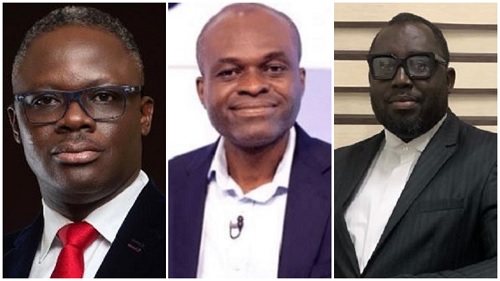
They were private legal practitioner and Constitutional Law lecturer at the University of Professional Studies, Accra (UPSA) Law School, Albert Quashigah; private legal practitioner and award winning journalist, Samson Lardy Anyenini; and private legal practitioner, Martin Kpebu.
Statement
Last Tuesday, the Spokesperson to the President and Minister of Government Communication, Felix Kwakye Ofosu, released a statement announcing that President John Dramani Mahama had forwarded to the Council of State for consultation three petitions seeking the removal of Justice Torkornoo.
The statement explained that the move by President Mahama was in line with Article 146 of the 1992 Constitution.
Article 146 governs the processes for the removal of Justices of the Superior Courts, the Chief Justice and persons whose offices are analogous with Justices of the Superior Courts such as the Chairperson and Deputy Chairpersons of the Electoral Commission (EC) and Commissioner and Deputy Commissioners of the Commission on Human Rights and Administrative Justice (CHRAJ).
Constitutional process
For Mr Kpebu, the petitions and the subsequent move by President Mahama in forwarding them to the Council of State for consultation could lead to some uneasiness within the judiciary, but stated that the process was totally in line with the tenets of the law.
He explained that the consultation with the Council of State was to determine whether or not there was a prima facie case against the Chief Justice, which would inform whether a committee should be set up to investigate and determine the merit or otherwise of the petitions.
“The name of the game is evidence. If there is no evidence to warrant the removal of the Chief Justice, she cannot be removed. Ghanaians will not agree if the Chief Justice is removed without any basis,” he said.
However, Mr Kpebu said, there was the need to protect the independence of the Judiciary, adding that the constitutional review process initiated by President Mahama must ensure a comprehensive change to the Constitution to safeguard the independence of the Judiciary.
He said the current arrangement whereby the President also appoints the Chief Justice and Justices of the Superior Courts did not promote independence of the Judiciary.
“The current architecture of the Constitution does not promote judicial independence. From the way President Mahama wants to leave a good legacy, it will be good if the reforms will remove the power of the President to appoint the Chief Justice and Justices of the Superior courts,” Mr Kpebu added.
Regulations
Mr Anyenini, who was counsel for Richard Nyamah, the petitioner whose petition led to the removal from office of the former Commissioner of CHRAJ, Lauretta Vivian Lamptey, in 2015, and has written extensively on Article 146, reiterated his position on the need to enact a law that would regulate the use of Article 146, giving detailed procedure and processes.
He said Article 146 only gave a framework on how the removal process ought to be done without the detailed processes that should guide issues such as what constituted the offences under the provision, and procedures to be adopted by the committee to inquire into the petition.
According to him, the need for such an enactment was stated by the Supreme Court in the case of Frank Agyei Twum vs Attorney-General (A-G), and was necessary to properly give effect to Article 146 of the Constitution.
Accountability
On the part of Mr Quashigah, he said the process did not undermine the Constitution but was rather necessary to ensure that judicial officers were held accountable.
“The framers of the Constitution knew that there would be instances where the Chief Justice or a judge would be found culpable for certain behaviours and ought to be held accountable,” he said.
He said the most important aspect of the impeachment process was that it was not arbitrary and that the Chief Justice would be given the opportunity to defend herself.
He made reference to the Frank Agyei Twum vs A-G, which he said had afforded more protections for a Chief Justice facing impeachment procedure.
Mr Quashigah explained that hitherto, there was no need to establish a prima facie case in a situation where a petition for the removal of the Chief Justice had been sent to the President.
Without the Frank Agyei Twum’s case, it would have been an easy process to remove the Chief Justice with much of the process in the hands of the President.
Removal process
Article 146 of the Constitution stipulates that a Justice of the Superior Courts can only be removed from office “for stated misbehaviour or incompetence or on grounds or on ground of inability to perform the functions of his office arising from infirmity of body or mind”.
In view of the Supreme Court’s decision in Frank Agyei Twum vs Attorney-General, if the petition is for the removal of the Chief Justice, it is sent to the President, who forwards it to the Council of State for consultation on the determination of a prima facie case.
If a prima facie case is established, the President, in consultation with the Council of State, will set up a five-member committee, consisting of two Justices of the Supreme Court, and three other members who are neither lawyers nor members of Parliament or members of the Council of State.
The committee will inquire into the petition and make recommendation to the President whether the Chief Justice should be removed or not.
The President is bound to act in accordance with the recommendation of the committee.
Latest Stories
-
GRA submits preliminary report on drug shipment case to Mahama – Commissioner-General
9 minutes -
Sammy Gyamfi using ‘procedural roadblocks’ to dodge defamation case? – Afenyo-Markin’s lawyers
11 minutes -
The illusion of a good deal: Why some everyday money-saving habits may be costing you more
26 minutes -
Family seeks autopsy, police investigation into death of student 12 days after Abomosu SHS enrolment
34 minutes -
Trade Minister urges employers to leverage industrial opportunities to create jobs
41 minutes -
Asantehene plants trees to commence Jimi Watercourse Rehabilitation destroyed by galamsey
1 hour -
15 arrested, 6 trucks impounded over sandwinning activities on Kumasi-Accra Expressway
1 hour -
OFFICIAL: Vinicius will miss El Clásico, suspended four games
1 hour -
Prayer vigil held after four arson attack murders
1 hour -
GRA fully recovers $154k legacy debt owed by foreign entities between 2022 and 2024
1 hour -
Kwesi Pratt Jr warns bus preachers are adding to passengers’ stress with accident prophecies
1 hour -
MTN Ghana to spend $1.1bn in 3 years, build 500 new sites as MoMo hits 44% Growth
1 hour -
I have no regrets joining Assemblies of God – Mahama
1 hour -
Starlink restrictions in Ukraine war linked to political situation, Zelensky aide says
1 hour -
Furniture boost for Techiman North schools as MP donates to 20 institutions
1 hour