

Audio By Carbonatix
Lawyer and Vice President of IMANI Africa, Kofi Bentil, has cautioned the public against surrendering access to their mobile phones to the police without a court order.
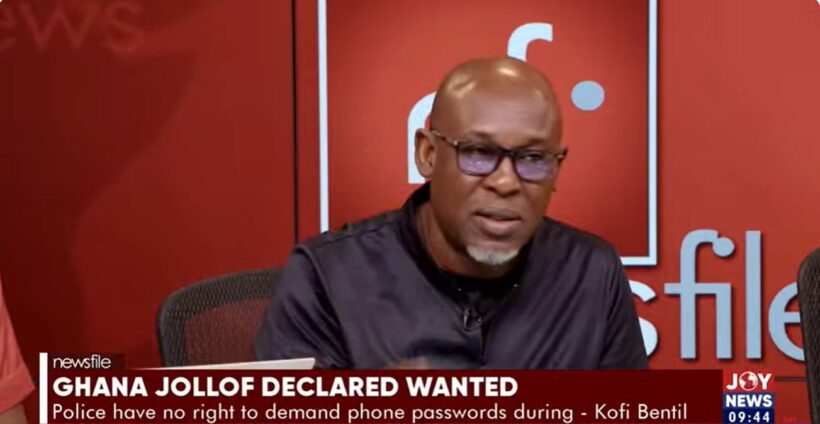
Speaking on JoyNews' Newsfile on Saturday, he said the police do not have the legal authority to access the contents of a suspect’s phone or demand their password simply because the person has been arrested.
Mr Bentil stressed that investigators who wish to search or access the contents of a suspect’s phone must first obtain the appropriate authorisation from a court.
“Even if you are arrested, the police don't have the right to access your phone or demand your passwords. If they want to do that, they should go and get a court order,” he said.
He explained that phones often contain sensitive personal and third-party information, including financial, medical and professional records, which could be exposed if law enforcement officers gain unrestricted access.
“Your phone is your vault. Your money is there. Your private information is there. Your health information is there. All kinds of things are there. And you could even have third-party confidential information on your phone,” he said.
Mr Bentil used the example of a medical professional who may have confidential patient information stored on a phone for legitimate professional purposes, warning that unrestricted access could expose private information belonging to people who are not connected to an investigation.
He therefore advised members of the public to distinguish between physically surrendering a phone and providing the password required to access its contents.
“If they physically take the phone, you have the right not to give them your password and insist on it. They need a court order in order to access your phone,” he said.
Additionally, he noted that citizens are legally entitled to record police officers carrying out their duties in public, adding that "it is not a crime."
According to Mr Bentil, police officers should therefore not prevent members of the public from recording their activities in public spaces, seize their phones, demand passwords or compel them to delete recordings.
“It is not lawful for the policeman, one, to stop you, two, to take your phone, three, to ask you to delete anything, or to request that you submit your password,” he said.
His comments come amid renewed debate over the protection of privacy rights and the powers of law enforcement agencies in relation to mobile phones and digital evidence.
Latest Stories
-
Health Ministry declares Yellow Fever outbreak in Upper West Region
5 minutes -
CRS, LDS hand over 6 renovated NAS facilities to strengthen emergency response
7 minutes -
Labour Minister banks on dialogue to end teachers’ strike, rules out alternative measures
13 minutes -
Transport operators slam gov’t; vow to defy suspension of preaching and hawking restrictions
13 minutes -
Domestic abuse is about power and control, not ordinary relationship conflict – ARK Foundation
16 minutes -
Keep your windows open or risk lung cancer – GAEC warns over deadly radon gas
22 minutes -
‘I was beaten, threatened with death, and was told to stay’ – Abuse survivor recounts ordeal in marriage
59 minutes -
Ato Forson has performed wonders with common fund releases – Northern Regional Minister
1 hour -
Zelensky accuses US of inaction as Russian strikes kill over 70 in two days
1 hour -
Bipartisan majority of Americans blame Trump policies for rising costs, Reuters/Ipsos poll finds
1 hour -
New Trump rules will make it harder for farmers to access US funds for energy projects
1 hour -
John Jinapor warns energy sector board chairs, CEOs against toxic working relationships
1 hour -
Recover, protect and properly account for every cedi of public money – Finance Minister
1 hour -
GTA denies collecting money for US, Canada visas ahead of 2026 World Cup
2 hours -
GTA CEO Maame Efua Houadjeto denies involvement in World Cup visa scandal
2 hours