

Audio By Carbonatix
The Producer Price Inflation (PPI) rose to 4.0% in July 2026, indicating a moderate strengthening of producer price pressures, the Ghana Statistical Service (GSS) has revealed.
This was up from 3.5% in June 2026, an increase of 0.5 percentage points.
The month-on-month inflation, however, stood at 2.0%.
According to the GSS, inflation showed mixed movements across the three broad sectors over the year.
Industry (excluding construction) increased from 3.3% to 5.6%, services and construction eased marginally, from 2.6% to 2.5% and from 4.9% to 4.8%, respectively.
The Mining and Quarrying sector drove the year-on-year growth. It increased from 2.6% to 3.5%, driving the marginal increase in year-on-year inflation.
Three groups recorded inflation rates above the sub-sector average of 3.5%. They were
Extraction of Crude and natural gas, Other mining and quarrying and Mining support service activities.
For construction, two sub-sectors recorded inflation rates below the average of 4.8%.
The construction of buildings was the highest, 7.9%, ahead of specialised works (4.3%) and civil engineering (3.5%).
For manufacturing, two groups recorded a deflation.
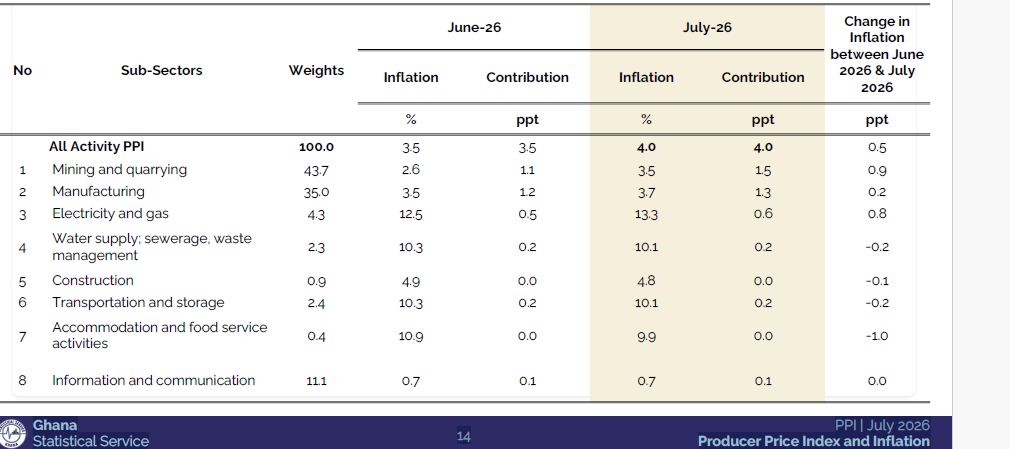
Fifteen industries had producer inflation rates higher than the sub-sector average of 3.7%.
For services, there was no change in producer prices in the telecommunication sub-sector.
Seven sub-sectors recorded rates higher than the sector average of 2.5%.
Policy Implications
For households and consumers, the rising producer prices may translate into higher retail prices in the coming months.
Again, budget carefully for essential services such as electricity, water and transport, where producer pressures remain relatively high.
With regard to businesses and investors, the rising producer prices increase production costs, improve efficiency and manage pricing carefully.
It also maintains adequate inventories of critical inputs to cushion against price increases.
For the government and policymakers, the GSS pointed out that the rising producer inflation calls for prudent policies to contain cost pressures and support sustained economic growth.
Also, there is the need to support sustained economic growth that lower production costs and strengthen competitiveness.
Latest Stories
-
New York Times executive fatally shot allegedly by elderly in-laws
28 minutes -
Teacher Payment Crisis: GES races to protect academic calendar
37 minutes -
US prosecutors reopen case of alleged gang rape at Cornell University
54 minutes -
Journalist to be crowned king in Uganda after bitter succession dispute
1 hour -
OpenAI scraps rollout of new model over safety concerns
1 hour -
Nigerian attempts to break world record by dancing non-stop for seven days
1 hour -
GES urges government agencies to end blame game over teacher payments
3 hours -
GES sets Oct. 5 deadline to resolve teachers’ payment dispute
4 hours -
GES working around the clock to get teachers back to class, says Daniel Fenyi
4 hours -
French PM warns against escalation of school protests after 164 arrested
4 hours -
UK tries to stop Trump’s diesel export ban
4 hours -
Late Olise goal gives France win over Belgium
5 hours -
Mancini enjoys first win since return as Italy boss
5 hours -
Interest payments to average a high 20% of government revenue over next 4 years
5 hours -
Anthropic warns AI may pose ‘existential risks to humanity’ in IPO filing
5 hours