

Audio By Carbonatix
The Trump administration is treating South Africa almost like a pariah, blacklisting its envoys, refusing to send top-level officials to meetings it hosts, and threatening to hit the nation with such high tariffs that its economic crisis is likely to deepen.
The latest sign of this came with the revelation by the second-biggest party in South Africa's coalition government, the Democratic Alliance (DA), that the US government had rejected President Cyril Ramaphosa's special envoy, denying him a diplomatic visa in May and refusing to recognise him as an "official interlocutor".
Ramaphosa had created the post for Mcebisi Jonas, the non-executive chairman of mobile phone giant MTN and a respected former deputy finance minister, to improve South Africa's rock-bottom relationship with the US.
Ramaphosa's spokesman accused the DA of "disinformation", but did not explicitly deny the party's claim. The US State Department declined to comment when contacted by the BBC, citing "visa record confidentiality".
Jonas's appointment came after President Donald Trump had cut off aid to South Africa, accused Ramaphosa's government of persecuting white people, condemned it for bringing a genocide case against Israel at the International Court of Justice (ICJ), and for "reinvigorating" relations with Iran - an implacable foe of the US.
Priyal Singh, a South Africa foreign policy expert at the Pretoria-based Institute for Security Studies think-tank, told the BBC that if the DA's claims about Jonas were true, it would be in line with the Trump administration's strategy to give South Africa the "cold shoulder, and cut off channels of communication that it so desperately needs".
The US has not only cut back bilateral relations with South Africa, but also boycotted it in global bodies like the G20, which Ramaphosa currently chairs, hoping to advance the interests of developing nations in talks with the world's richest states.
The latest sign of this was US Treasury Secretary Scott Bessent's decision to skip Thursday's meeting of G20 finance ministers in South Africa, preferring to send a lower-ranking official instead.
Bessent skipped a similar meeting in February, while Secretary of State Marco Rubio stayed away from a meeting of G20 foreign ministers, saying Ramaphosa's government was doing "very bad things" and he could not "coddle anti-Americanism".
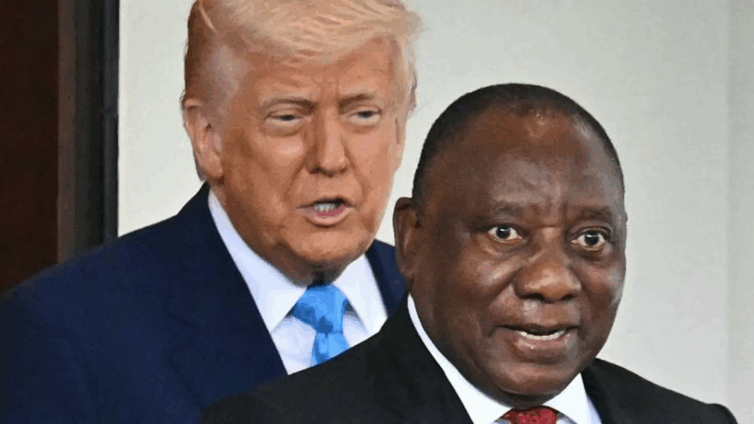
Ramaphosa had hoped to get relations with the US back on an even keel after Trump invited him to the Oval Office in May, only for the US president to ambush him by showing footage and brandishing a sheaf of spurious reports to advance his widely discredited claim that a genocide was taking place against white people in South Africa.
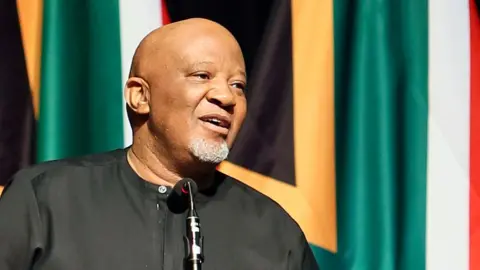
Jonas was strikingly absent from Ramaphosa's high-powered delegation, giving credence to the DA's claim that he was unwelcome in Washington.
This put South Africa back to square one as the US had expelled its ambassador to Washington, Ebrahim Rasool, after he accused Trump, in a leaked speech given at a meeting of a think-tank, of "mobilising a supremacism" and trying to "project white victimhood as a dog whistle" as the white population faced becoming a minority in the US.
In a politically odd decision, Ramaphosa left the post vacant, despite its significance, suggesting that his government had a dearth of well-qualified career diplomats who could rebuild relations with South Africa's second-biggest trading partner.
Instead, Ramaphosa pinned his hopes on a special envoy who, he said at the time of Jonas's appointment, would "lead negotiations, foster strategic partnerships and engage with US government officials and private-sector leaders to promote our nation's interests".
But it is unclear how Ramaphosa expected Jonas to achieve this, given that he, like Rasool, had made controversial remarks about Trump, calling him a "racist" and a "narcissistic right-winger" in a 2020 speech that came back to haunt him after his appointment.
This was compounded by the fact that MTN had a 49% stake in Iran's telecom company IranCell, a major concern for the US.
Compared to its previous stances, South Africa was "more circumspect" - as Mr Singh put it - in its response to US air strikes on Iran in June, merely saying that it viewed the conflict with "great anxiety" and hoped that it could be resolved through dialogue.
W Gyude Moore, a policy analyst at the US-based Centre for Global Development, told the BBC that it was not surprising that South Africa was in Trump's firing line.
He pointed out that South Africa championed what Trump's support base saw as "woke culture". For instance, Ramaphosa regarded the G20 as a forum through which to promote international "solidarity, equality and sustainability", which Rubio had opposed, equating it to "diversity, equity and inclusion", as well as climate change.
Mr Moore said this was also borne out in the Trump administration's attitude towards South Africa's "black empowerment" policy, accusing it of "race-based discrimination" against white people. Ramaphosa's government sees it as necessary to address the legacy of the racist system of apartheid.
"I cannot see how the differences can be resolved. South Africa will just have to carry on and strengthen ties with other countries. It's not the only one in the crosshairs of the Trump administration," Mr Moore added.
But it is a major blow to South Africa, as it had maintained strong trade and aid relations with successive Republican and Democratic administrations despite having sharp differences with them.
Mr Singh pointed out that South Africa, for example, opposed the Republican George W Bush's war in Iraq and Afghanistan, but South Africa still benefited from PEPFAR, the programme he had established to tackle HIV/Aids, until the Trump administration slashed funding earlier this year.
"The Trump administration is completely different and caught everyone off guard. South Africa will just have to weather out the storm and try to mitigate the damage," Mr Singh said.
But the economic consequences could be devastating, especially if Trump imposes 30% tariffs on South African goods from 1 August, as he has threatened to do.
South Africa's central bank chief Lesetja Kganyago said the tariffs could lead to around 100,000 job losses, worrying for a country where the unemployment rate stands at a staggering 32.9%.
The tariffs would hit South Africa's agriculture sector hard. This is ironic as Trump has portrayed himself as a champion of the country's Afrikaner farmers, offering them refugee status in the US.
It also gives them an opportunity to farm in the US and boost its economy in line with Trump's "America First" policy.
Latest Stories
-
Fiabci-Ghana inaugurated to promote professionalism and global collaboration in real estate sector
18 minutes -
‘No flying in just for matches’ – Kofi Adams sets conditions for next Black Stars coach
21 minutes -
Ghana and BRICS: Strategic opportunity, economic imperative or geopolitical gamble?
27 minutes -
SML vs GRA: Court grants preservation order in dispute over US$500 million investment
27 minutes -
Spotify brings audiobooks to Ghana
30 minutes -
GPL 2026/27: ‘We are the team to beat’ – Medeama boss Tanko ahead of Samartex clash
31 minutes -
Parliamentary Select Committee on Health assesses progress of work on KATH maternity block
38 minutes -
Ghana’s fertility rate too high for development – Reproductive health specialist warns
53 minutes -
NLA/KGL Licence Contract: Why Ghana must reform the law to maximise the state’s benefit
58 minutes -
Association of Small-Scale Industries empowers trade executives in Bono East with a mentorship programme
1 hour -
AMA evacuates refuse along Graphic Road, warns against indiscriminate dumping
1 hour -
STC interdicts driver over Pokuase overtaking incident
1 hour -
Ekumfi: How $6m EXIM participation built a $53m industrial asset — now poised for a 24-Hour Economy breakthrough
1 hour -
4 arrested, 142 parcels of suspected Indian hemp seized as officers reject GH¢50k bribe
1 hour -
No MMDCE can say they don’t see galamsey – Local Government Ministry
1 hour