

Audio By Carbonatix
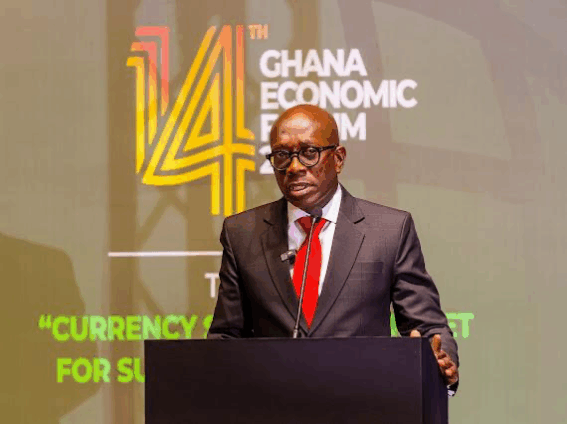
Fidelity Bank’s Deputy Managing Director for Wholesale Banking, Kwabena Boateng, has urged the financial sector, government, and private sector players to “move from gatekeeping to gardening”, a shift from cautious lending to active partnership in building the nation’s productive capacity.
Speaking at the 14th Ghana Economic Forum held at the Kempinski Gold Coast Hotel, on the theme “Currency Value Addition – A Reset for Sustainable Economic Growth,” he emphasised that the real anchor of Ghana’s currency lies not only in its reserves, but in the productivity of its industries and people.
“What gives a currency its real value is not the paper it’s printed on, or the reserves behind it, but the productivity that sustains it,” Mr Boateng said.
“The more we invest in the sectors that create value. agriculture, manufacturing, and exports, the more stable and resilient our currency becomes.”
He noted that while Ghana’s economy has made impressive strides in stabilisation, growing by 6.3% in the second quarter and recording single-digit inflation of 9.4%, financing patterns still reveal an imbalance.
“The services sector continues to expand rapidly, accounting for over 42% of GDP and receiving 36.8% of all bank credit, while manufacturing attracts just 12.4% and agriculture, despite its vast potential, receives a fraction of that,” he observed.
“We have a powerful economic vehicle, but the power isn’t distributed evenly to all its wheels.”
Mr Boateng cautioned that this uneven distribution creates vulnerabilities, urging financial institutions and policymakers to address the “financing conundrum” that perpetuates high risk and underinvestment in productive sectors.
The key obstacle, he diagnosed, is the perception of risk, noting the agriculture sector's high Non-Performing Loan ratio of 54.2%.
“This creates a cycle of caution: high risk leads to less lending, which leads to under-investment, which in turn perpetuates the very risks we fear. To achieve a true economic reset, we must break this cycle.”
To address this, he called for a systemic reset, one that combines finance, policy support, innovation, and partnerships.
Citing Fidelity Bank’s ongoing initiatives, Mr Boateng said the bank is actively demonstrating how patient, purposeful capital can unlock growth in high-impact sectors.
He highlighted two flagship Fidelity Bank initiatives as proof of concept for this systemic change: The BRIDGE-in-Agriculture Programme, implemented in partnership with the Mastercard Foundation, has disbursed over GH¢94 million to SMEs and smallholder farmers, focusing on youth and women entrepreneurs.
Combined with direct lending of GH¢220 million this year, Fidelity’s total agricultural support now exceeds GH¢314 million. Beyond finance, the programme provides technical assistance, market access, and training in climate-smart agriculture.
The Greentech Innovation Challenge initiative bets on young innovators to solve major agricultural challenges in areas like precision agriculture.
The bank's GH¢2 million total investment in these green pioneers has already seen the first cohort generate over GH¢13 million in revenue, with some expanding to Nigeria and Sierra Leone, validating the strategy of coupling innovation with patient capital.
“These programmes show that when you combine patient capital with innovation and technical support, you can turn high-risk sectors into high-impact ones,” Mr Boateng remarked.
Looking ahead, he urged for stronger public–private partnerships to de-risk the real economy, promote export-linked financing, and expand access to green and inclusive finance for women and youth entrepreneurs.
He further called for accountability mechanisms that measure not only credit volumes, but their tangible impact on value creation, exports, and jobs.
Concluding his address, Mr Boateng reaffirmed Fidelity Bank’s resolve to be an active catalyst in Ghana’s transformation journey. “
At Fidelity, we do not simply lend; we partner to build. We want to see a Ghana where our currency is strong, our industries vibrant, and our people, especially our youth and women, empowered to create lasting value,” he said.
The 14th Ghana Economic Forum, organised by the Business & Financial Times, brought together government officials, policymakers, private sector leaders, and development partners to deliberate on strategies for driving sustainable economic recovery and growth.
Latest Stories
-
Domestic tourism and its impact on the local economy
6 minutes -
Top-Up Pharmacy wins Community Pharmacy Chain of the Year at 2026 PSGH Pharma Excellence Awards
6 minutes -
Nigeria military aircraft with 32 on board crashes
8 minutes -
Black Stars need a coach who can inspire players to perform – Ignatius Osei Fosu
9 minutes -
Revenue collector crushed to death on Kasoa-Winneba highway
14 minutes -
GPL Week 5: Stephen Amankona, 8 other outstanding players win NASCO awards
15 minutes -
NPP’s new leadership team has experience to deliver – Dr Asah-Asante
16 minutes -
Mahama committed to developing Volta Region – Chief of Staff
17 minutes -
NPP’s new leadership offers no renewal after ‘micro minority’ defeat – NDC’s Abeiku Hayford
18 minutes -
Blackstar Experience to hold fashion show and summit in November
19 minutes -
Prof Mike Oquaye backs Kojo Bamba’s call for stronger ballot protection
29 minutes -
If police won’t protect you, you’ll protect yourself – Prof Mike Oquaye backs Kojo Bamba’s election
29 minutes -
Spotify makes fandom the ticket with debut Surround Sound experience in Lagos
40 minutes -
Deputy Interior Minister calls for joint action to strengthen Ghana’s cybercrime response
50 minutes -
Gov’t announces plans to create 20,000 jobs in waste management, circular economy
55 minutes