

Audio By Carbonatix
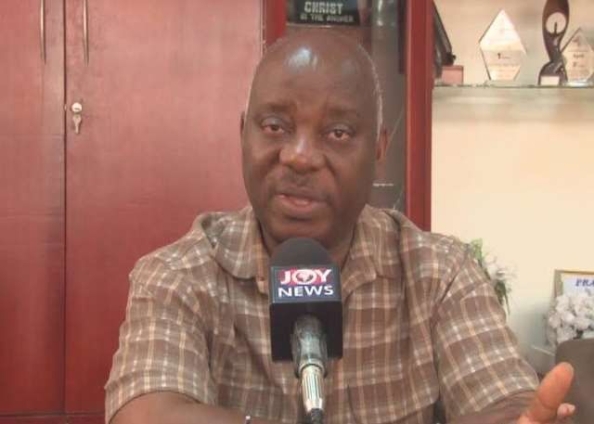
A former General Secretary of the Christian Council of Ghana Rev. Dr. Fred Degbe has called on Ghanaians to end the growing trend of vote buying and selling, a practice fuelling political corruption and hindering national progress.
He highlighted the troubling trend where people seeking elective positions purchase votes to secure their positions. He explained that these candidates often seek to recoup their investments through corrupt practices, thereby stalling the country's development.
The former General Secretary of the National Peace Council made the statement during a public lecture at the University of Education in Winneba at the 10th anniversary of the political science Education department of the school, on the theme, ‘Towards a peaceful 2024 election in Ghana: collaborations among stakeholders in the context of emerging technologies.’
According to the 2021 Population and Housing Census data, 7,317,555 people, or 24.3% of the household population, were identified as multidimensionally poor. Among this group, 43.8% faced severe poverty, experiencing deprivation across multiple dimensions simultaneously.
Rev. Fred Degbe admitted the fact that poverty was one of the reasons for such an act but emphasized the importance of integrity in the voting process, stating that, “no amount of monetary inducement should sway voters from exercising their civic duty with integrity.”
Vote buying typically involves offering gifts, money, or other incentives in exchange for votes during elections. Mr Degbe cited recent instances during the parliamentary and presidential primaries of both the New Patriotic Party (NPP) and the National Democratic Congress (NDC), where this unethical practice was prevalent.
The practice is not only unethical but also illegal. The Representation of the People Act, 1992 (Act 284) explicitly prohibits vote buying, with violators subject to legal penalties. The Criminal Offences Act, of 1960 (Act 29) also criminalizes bribery in elections, underscoring the serious legal consequences of such actions.
Rev. Degbe urged all stakeholders including students at the political science department of the University of Education to be ambassadors of change to curb the canker.
He also urged the media to avoid giving a platform to politicians who use their influence to insult opponents or incite violence, especially as the December elections draw near.
He identified the culture of insults, misinformation, vote-buying, and ethnic divisive campaigning as significant threats to democracy in Ghana. He encouraged the students and all stakeholders to do their part towards a peaceful 2024 elections in Ghana.
Latest Stories
-
GTA denies collecting money for US, Canada visas ahead of 2026 World Cup
10 seconds -
GTA CEO Maame Efua Houadjeto denies involvement in World Cup visa scandal
20 minutes -
Rockland Farms CEO Calls for Greater Support for Women in Agriculture
35 minutes -
AFCON 2027Q: Interim Black Stars technical team to take charge of November games
1 hour -
Gov’t suspends implementation of L.I. restricting preaching and hawking in moving vehicles
1 hour -
Three Saudi nationals killed in Houthi attacks on Riyadh airport
1 hour -
Jinapor demands accountability from energy sector agencies ahead of 2027
1 hour -
Cars torched and shops looted as anti-migrant violence erupts in South Africa
2 hours -
We’ll strengthen unity and party structures to win 2028 election – John Boadu assures Kufuor
2 hours -
Mahama’s meeting with UN financial inclusion renews focus on women’s access to finance – Joyce Bawah Mogtari
2 hours -
‘Africa is not the future; Africa is the now’ — Sammy Gyamfi tells African youth
2 hours -
Mahama begins 2-day ‘Resetting Ghana’ tour of Ahafo Region
2 hours -
It is a nuisance law; stop pretending it is a religious war
2 hours -
KGL U17 Colts 2026: Prempeh Elite Academy, Western Region, two others battle for final berths
2 hours -
LA 2028: Near misses and the crashouts, but Black Queens cannot afford another Olympic Games slip-up
3 hours