

Audio By Carbonatix
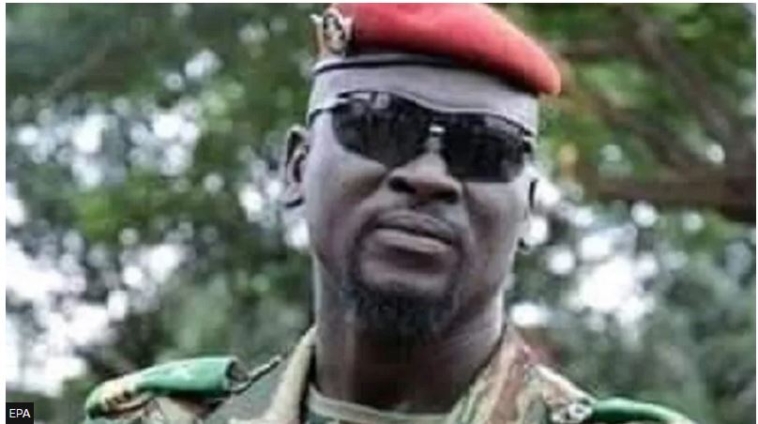
Guinea's military junta has protested to Russia's ambassador after his embassy reportedly warned of possible unrest in the capital, Conakry.
The warning was issued after junta leader Colonel Mamady Doumbouya dissolved the government on Monday, and ordered the closure of all borders.
Ambassador Alexey Popov apologised to the junta for what he called a misunderstanding, Guinean media reported.
Col Doumbouya took power in a 2021 coup.
He dissolved his government on Monday without offering any explanation.
He also ordered the seizure of the passports of sacked ministers, and the freezing of their bank accounts.
Guinean media reported that Col Doumbouya's decision led to the Russian embassy in Guinea advising Russian nationals to be vigilant as there could be unrest in the West African state's capital, Conakry.
The junta reacted angrily, with an official in its foreign ministry summoning Mr Popov to a meeting.
"I explained that it was a misunderstanding, a false translation of what was published. The announcement was published only in Russian for Russian citizens," Mr Popov was quoted as saying by Guinea's state-owned television and radio.
The junta accepted the apology, while Mr Popov said the incident would not affect relations between the two nations.
Guinea is one of several former French colonies in West Africa to be hit by coups in recent years.
The juntas, which seized power in Mali, Niger and Burkina Faso have pivoted toward Russia, while being hostile towards France and the West African regional bloc, Ecowas.
However, Col Doumbouya has tried to maintain good relations with all sides.
He has promised to hold elections to restore democratic rule by the end of 2024.
The junta banned all demonstrations in 2022 and has detained several opposition leaders, and members of civil society groups.
Col Doumbouya overthrew President Alpha Condé in September 2021, saying the army had little choice but to seize power because of rampant corruption, disregard for human rights and economic mismanagement.
Mr Condé was Guinea's first democratically elected president, taking office in 2010 following the end of military rule.
He was re-elected in 2015, but faced protests four years later when he changed the constitution to run for a third term.
Latest Stories
-
David Beckles claims second J60 Accra title
16 minutes -
No France cocaine suspect linked to Mahama, Vice President’s security details – NACOC
23 minutes -
Anwelle Foundation launched in Jirapa to tackle poverty, youth unemployment
44 minutes -
Joy Sports Editor Fentuo Tahiru Fentuo to moderate inaugural Music Meets Football Summit in Zambia
49 minutes -
Court premises too volatile for Baffour Awuah’s attempted arrest by EOCO – Inusah Fuseini
57 minutes -
Drug bust: Under no circumstances will NACOC leadership be compromised – Twum-Barimah
58 minutes -
VIDEO: EOCO’s attempted arrest of Baffour Awuah was flawed beyond saving – Law Lecturer
58 minutes -
Genuine Ghanaian exporters may face heightened foreign inspections over drug busts – Lawyer
58 minutes -
Stakeholders demand action against foreign-led illegal mining in Ahafo Region
3 hours -
Ghana handed tricky draw at 2026 Amputee World Cup
3 hours -
2024 Nyankpala election violence: Youth group petitions authorities over slow probe
3 hours -
Ghana, UNICEF strengthen partnership to advance child protection
3 hours -
Day Two of 3rd Republic Bank-JoyNews Habitat Fair ends with great homeownership offers and financing solutions
3 hours -
Guinness Ghana DJ Awards 2026 Pub Fest celebrates Ghana’s DJ culture as Accra turns up the energy
4 hours -
10th woman found dead in South Africa’s string of killings
4 hours