

Audio By Carbonatix
A Russian journalist who burst onto a live TV news programme to protest against the war in Ukraine has appeared in a Moscow court.
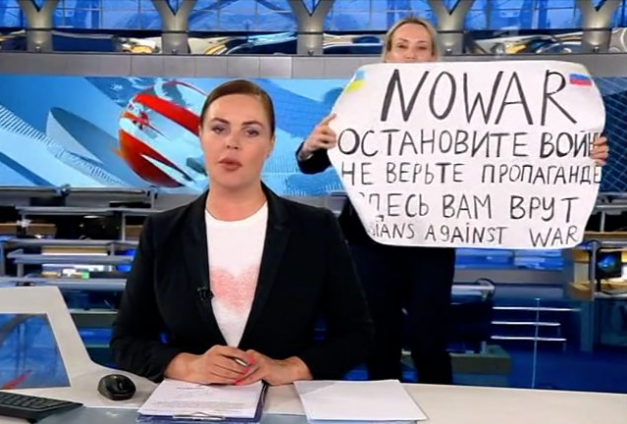
Marina Ovsyannikova, an editor at state-controlled Channel 1, was detained after she ran on to the set on Monday holding an anti-war sign.
She was earlier reported missing by lawyers who said they had been searching for her all night.
She has been charged with organising an unauthorised public event.
The administrative charge could be punished with a fine, community service or up to 10 days in jail.
There were fears she would be prosecuted under a more serious, new criminal law that bans calling Russia's military action in Ukraine an "invasion" or spreading "fake news" about the conflict.
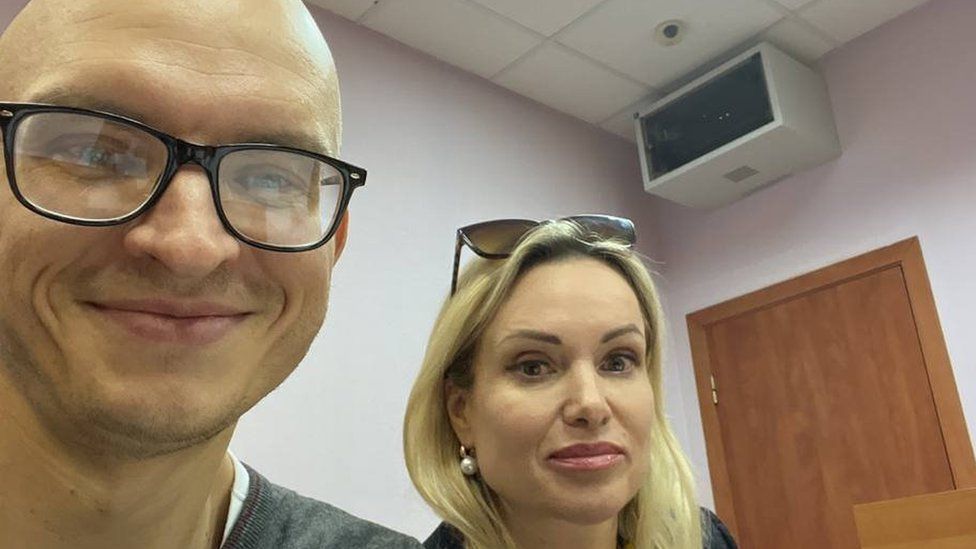
An image circulated widely on Russian media appeared to show Ms Ovsyannikova in court with lawyer Anton Gashinsky.
Ms Ovsyannikova, who said her father was Ukrainian, called on the Russian people to protest against the war, saying that only they could "stop the madness".
"Don't be afraid of anything, they can't imprison all of us," she said.
Ms Ovsyannikova's colleagues at Channel 1 were reportedly surprised by her actions.
One told the Faridaily blog - run by former BBC Russian Service journalist Farida Rustamova - that Ms Ovsyannikova, who has two children, had never discussed politics, but spoke "mostly about children, dogs and the house".
From the moment her identity became known, Ms Ovsyannikova received dozens of comments on her Facebook page in Ukrainian, Russian and English, thanking her for her actions.
Ukraine's President Zelensky also praised her for "telling the truth".
French President Emmanuel Macron said France would launch an effort to offer her protection, either at the embassy or through asylum, and said he would discuss it in his next conversation with President Putin.
But Kremlin spokesman Dmitry Peskov called her actions an act of "hooliganism".
Russian television news has long been controlled by the Kremlin and independent viewpoints are rare on all the major channels.
State-controlled Russian media refer to the war as a "special military operation" and paint Ukraine as the aggressor, describing Ukraine's elected government as neo-Nazis.
Several of the remaining independent media outlets in Russia have stopped broadcasting or publishing after pressure from the authorities, including the radio station Echo of Moscow, and TV Rain - an online TV channel.
Others, like newspaper Novaya Gazeta, are attempting to report on the situation without falling foul of the new censorship laws.
Access to the BBC has also been restricted inside Russia, leading the corporation to issue guidance over how to continue using its services.
Many social media sites have also been blocked, further restricting the number and diversity of news sources available to people inside Russia.
Latest Stories
-
Morocco strike late to overcome 10-man Black Starlets
12 minutes -
Nyaho-Tamakloe calls on Kurt Okraku to resign amid Black Stars struggles
18 minutes -
Societe Generale Group agrees to sell Ghana subsidiary to Attijariwafa Bank
27 minutes -
Accra: Fire breaks out in North Industrial Area at Avenor
33 minutes -
Measure food systems progress not only by productivity but also ability to deliver healthy diets – AGRA
47 minutes -
Black Stars: Seven years of decline while hashtagging love
59 minutes -
Today’s front pages: Thursday, October 1, 2026
60 minutes -
Gov’t to suspend GH¢1 D-Levy on diesel for October and November
2 hours -
Fire destroys belongings in Akweteyman apartment
2 hours -
Baffour Awuah to turn himself in to EOCO today – JoyNews sources
2 hours -
Government identifies payment discrepancy holding up teachers’ strike resolution
2 hours -
BoG signals no FX intermediation for October as GoldBod plans $1bn support for banks
2 hours -
When share ownership becomes personal: The African mindset of the Dangote IPO
3 hours -
Why MFWA Legal Fund matters to Ghana’s democracy
3 hours -
Fuel prices to rise from October 1; diesel could hit GH¢19.60 – COMAC
3 hours