


Audio By Carbonatix
The Deputy Director for Social Welfare in the Central Region has asked Ghanaians to start seeing social protection services as a right rather than a handout.
According to him, social protection which comes in the area of cash grants for the poor and vulnerable, health insurance, and school feeding among others are basic rights that should also come with responsibilities.
Mr. Jacob Asiedu was speaking at a Beneficiary Community Dialogue on Social Protection organised for residents of the Diasso Bethlehem Community in the Upper Denkyira West District Assembly, on Monday, July 1, 2024.
He said, “We keep saying that Social Protection is a right and that’s very true. But you must understand that while the government commits to ensuring that you enjoy these rights, there are some responsibilities that you also must perform, especially for those of you enjoying the LEAP Programme.”
According to the Social Welfare expert, under whose purview the Livelihood Empowerment Against Poverty (LEAP) cash transfer programme is executed in the region, there are three main responsibilities expected of every household that is on the programme.
“The very first one is that if there is a child in that household, you must make sure the child attends school and is not subjected to domestic violence. That is why the government also made basic education free. So, your children cannot be seen going to the farm during school hours or just doing nothing in the name of ‘I don’t have money.’ Children’s going to school is very dear to the heart of the Government,” he explained.
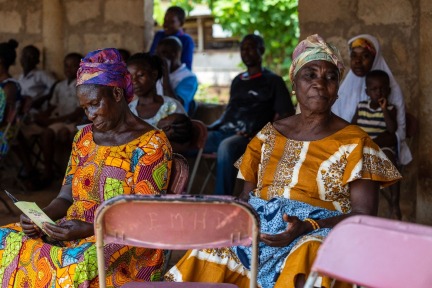
The event was a durbar of about 300 residents including school children, teachers, women and beneficiaries of various SP programmes.
In Mr Asiedu’s estimation, persons in the government’s social protection programmes have a responsibility to keep healthy and balance their diet with nutritious food.
He explained that as much as possible, to prevent avoidable illnesses, beneficiaries must invest some of the money they get from the cash transfer programme into their diets. This, he believes, will ensure they don’t end up spending everything on medical bills because they are often ill.
“You must always keep your environment clean. You must ensure that wherever you live or your household is spick and span,” he emphasised.
In his estimation, the government’s commitment to ensuring that beneficiaries keep enjoying their right to social protection programmes is benchmarked on beneficiaries’ fulfilment of these responsibilities.
He concluded his rather succinct speech by defining social protection in a manner easily understandable to participants in the dialogue.
“When we say social protection, social protection, it is the government’s responsibility to take care of the citizens in various ways. In the past, members of society and extended family members took the responsibility of supporting the aged, pregnant women, the sick and children, especially orphans. This hasn’t stopped. But when democracy started, the government decided to share this responsibility with the family by formalising this help into what we now call social protection. So, social protection is not going to make you rich overnight and it doesn’t take away the help we traditionally offer one another in our communities. Only that now it is the government’s job to see to it that all citizens are assured some level of social protection.”
Partisan Politics and Mining Marring Social Protection Initiatives
Speaking on behalf of the Chief of Diasso Bethlehem at the same event, Kontihene Nana Kwame Bempong, decried the poor implementation of social protection programmes in his community.
The community leader believes that politicisation of state institutions is to be blamed for this situation which he describes as “a sad reality.”
“At the onset of democracy, when the state institutions were working effectively, Ghana was a really good place to live. But today, all the institutions are at the beck and call of the government of the day. This LEAP Programme that we’re talking about, I used to write people’s names because I know those in the community who needed it. But later, the politicians came to take over the programme to the extent that if you don’t belong to a certain political party, you don’t benefit from the cash transfer,” he furiously explained.
Kontihene also lamented how illegal mining is making the youth of his community deaf to social protection messaging.
According to him, the young men in the community need the SP messages as much as the young women and children.
“Unfortunately, they are all gone to the mining fields this morning. It would’ve been very good for them to be here to listen to the information you have come to share with us. But they are not here because the mining is more important to them than anything else,” he stated.
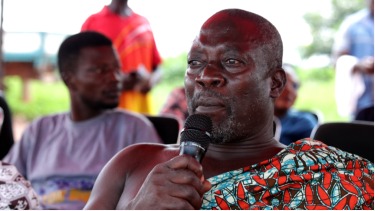
He, however, pledged the unwavering support of the community leadership to social protection activities while admonishing the Ministry to execute their functions devoid of political influences.
“We plead with you to work within your mandate without any partisan colours. We will also hold on to your pieces of advice and do our best always support you,” he concluded.
Beneficiary Community Dialogue
This Beneficiary Community Dialogue is part of the Beneficiary and Community Communication (BCC) initiative which is meant to deepen citizens' understanding of Social Protection interventions and promote inclusive community dialogues.
The initiative is central to the Rights and Social Protection campaign implemented by the Ministry of Gender, Children and Social Protection (MOGCSP) in partnership with the Civil Society Platform for Social Protection Ghana (CSPSP-GH) and the Journalists in Social Protection (JISOP) with funding support from UNICEF Ghana.
Through strategic and localized communication and capacity building, the community dialogue brings citizens to the understanding that social protection is a right of everyone as enshrined in the 1992 constitutions and to give them the tools to demand accountability and efficient implementation of SP policies.
Latest Stories
-
Let The Constitution direct Chieftaincy to deliver “All Development Is Local”
25 minutes -
Ghana explores centre of excellence for hearing, communication and cochlear implant care
2 hours -
Schizophrenia-related disorders lead mental health cases recorded in Ghana
2 hours -
Dutch authorities enlist Ghana in hunt for fugitive drug lord Bolle Jos
3 hours -
Ghana housing finance conference adopts communiqué to improve affordable housing access
7 hours -
Special Initiatives Minister urges Wa Technical Institute to enrol more girls as EU-backed solar training lab opens
7 hours -
In the matter of my first year at the Bar
8 hours -
ActionAid Ghana calls for an end to child marriage, greater investment in girls’ rights
8 hours -
Newsfile to tackle World Cup visa scandal, beach demolitions, education strikes, BRICS bid
8 hours -
UK-Ghana Trade & Investment Summit: Trade Resource Centre to help businesses maximise UK-Ghana trade opportunities
8 hours -
Embassy of Denmark celebrates World Maritime Day
8 hours -
Linking LEAP to productive inclusion could cut extreme poverty by 2030 – UNICEF
10 hours -
Trade Ministry backs use of creative arts to rehabilitate prison inmates
10 hours -
Negotiations with government to continue despite strike suspension – GNAT
10 hours -
‘Ghana cannot afford to waste public resources; every cedi has a job’ – Ato Forson
10 hours