

Audio By Carbonatix
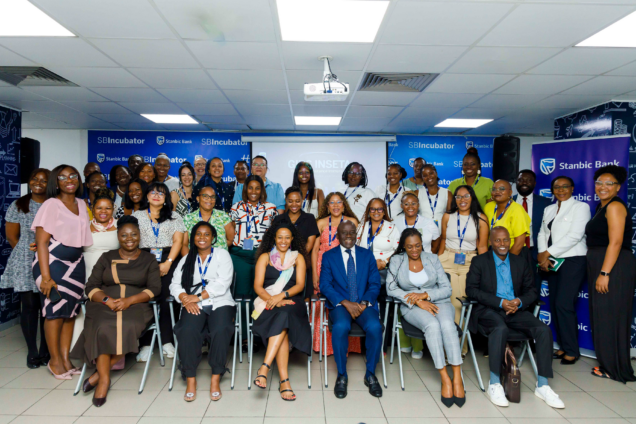
Senior executives of Stanbic Bank Ghana have shared insights into Ghana’s rapidly evolving financial ecosystem with participants of the GIBS INSETA IMPD Women Immersion Programme.
It highlighted how digital innovation, capital markets and inclusive banking are shaping economic growth across emerging markets.
The discussions formed part of the leadership immersion programme organised by the Insurance Sector Education and Training Authority (INSETA) in partnership with the Gordon Institute of Business Science (GIBS).
The initiative brings together women leaders from South Africa’s insurance sector for a year-long development programme that combines academic training with international learning experiences.
During the session, Kobby Bentsi-Enchill, Head of Investment Banking at Stanbic Bank Ghana, provided participants with a broad perspective on Ghana’s financial infrastructure and how it continues to evolve within the realities of a largely informal economy.
He noted that digital financial services, particularly mobile money, have significantly reshaped the country’s payment landscape, extending financial access to millions of individuals and small businesses that previously operated outside the formal banking system.
“Ghana’s financial architecture is unique because it sits at the intersection of formal banking and capital markets, and a very vibrant informal economy.
"Mobile money has played a transformative role in bridging that gap by bringing everyday transactions, micro-enterprises and small traders into a more structured financial environment.”
He added that alongside the use of digital innovation to harness savings and investments, the government securities market continues to play an important role in setting pricing benchmarks and maintaining financial stability to support capital formation.
“Public debt instruments such as treasury bills and bonds remain central to the functioning of Ghana’s financial markets,” he said.
“They provide a stable investment vehicle for both individuals and institutions, while also creating a platform for capital mobilisation that supports national development priorities.”
According to him, the interplay between digital financial services, informal economic activity and established public finance instruments illustrates how emerging markets are developing hybrid financial systems that respond to both modern innovation and long-standing economic realities.
Building on the discussion, Akua Oppong led participants through Ghana’s broader banking and insurance ecosystem, highlighting the complementary roles these sectors play in supporting economic resilience and risk management.
She explained that while banks provide the capital required for expansion and investment, insurance institutions play a critical role in protecting businesses and individuals from unforeseen shocks.
“When banking and insurance sectors collaborate effectively, they create a more resilient financial system. Access to credit alone is not enough; businesses also need risk protection, financial education and the right partnerships to sustain growth.”
She added that strengthening cooperation between the two sectors can deepen financial inclusion, particularly for small and medium-sized enterprises (SMEs) operating in sectors such as agriculture, trade and manufacturing.
“These sectors form the backbone of Ghana’s economy, and when financial institutions work together to support them, the impact extends beyond individual businesses to the wider economy,” she said.
The final session of the day focused on the role of gender-focused banking solutions in promoting inclusive economic development.
Sarfoa Appietu-Ankra, representing Women’s Banking within Business and Commercial Banking at Stanbic Bank Ghana, guided participants through the bank’s women-focused financial proposition and the growing importance of targeted support for women entrepreneurs.
She explained that many women-led businesses continue to face structural barriers in accessing finance, mentorship and market opportunities, despite their growing contribution to economic activity.
“Women entrepreneurs are playing a crucial role in sectors ranging from agriculture and retail to services and manufacturing. However, access to the right financial tools, guidance and partnerships is often the difference between survival and sustainable growth.”
The sessions provided participants with a practical understanding of how Ghana’s financial institutions operate within an emerging market context, offering lessons on capital flows, financial innovation and inclusive economic policy.
For the visiting delegation, the engagement was an important part of the programme’s broader objective: to build a generation of women leaders capable of driving transformation within Africa’s financial services sector.
Latest Stories
-
Atta Akyea denies seeking presidential pardon for Wontumi in galamsey case
16 minutes -
Photos: Mahama commissions 85-bed Police Hospital ward, donates two ambulances
24 minutes -
GTEC directs Ghana’s public universities to reopen by October 16 and begin lectures on October 19
26 minutes -
Star Oil donates GH¢1million towards construction of new CID facility
29 minutes -
Court hands Adjetey Sowah, two others lifetime bans after Amputee Football legal dispute
39 minutes -
NDC appoints Julius Kwame Anthony as a Deputy Communications Director
39 minutes -
Ghana repatriates 120 Nigerians rescued from suspected cybercrime centres
44 minutes -
NPP rejects Emelia Agbenyo’s appointment as Deputy EC Chair, demands withdrawal
48 minutes -
EOCO grants Suame MP John Darko enquiry bail in GH¢27m SIC investigation
52 minutes -
NPP cannot question EC appointment after appointing own people to Commission – Kwakye Ofosu
57 minutes -
BoG deepens public trust with regional stakeholder forum in Techiman
1 hour -
‘We have turned the tide’ – Ato Forson says Ghana is ready to take off
1 hour -
Police arrest man captured in viral video assaulting wife in Agona Nkwanta
1 hour -
KATH Mother and Baby Unit construction stalled for 14 months over unpaid contractor arrears
1 hour -
Government wanted to ‘tilt the balance’ with new EC appointments – Kwakye Ofosu
2 hours