

Audio By Carbonatix
Maalim is traumatised by what he saw in Sudan's western region of Darfur, before he fled across the border to Chad.
"If the people who I worked with know I have shown you these photos and videos, or even that I filmed them, I am a dead man," he tells me as he whips out his phone to show me harrowing pictures of scattered corpses in the city of El Geneina. We have changed his name for his own safety.
Before leaving the country, he was part of a group of people tasked with removing corpses from the streets and burying them in mass graves.
Sudan has been rocked by fierce battles between the paramilitary Rapid Support Forces (RSF) and the army since April, with some of the worst fighting in Darfur, where the RSF originates.
Warning: This report contains distressing images
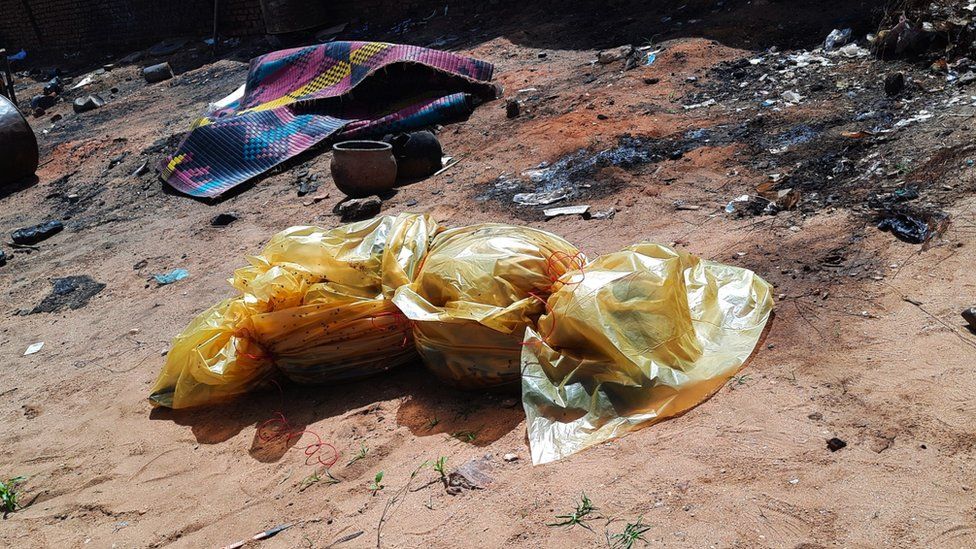
The photos showed dozens of dead bodies, some of them covered with blankets and clothing, others swollen and already rotting. Maalim also showed photos of aid agency compounds, which were wrecked and looted.
"I felt terrible. I felt like they died while in a state of fear and terror. Many of them had been lying dead on the streets for more than a week," he tells us, visibly distressed.
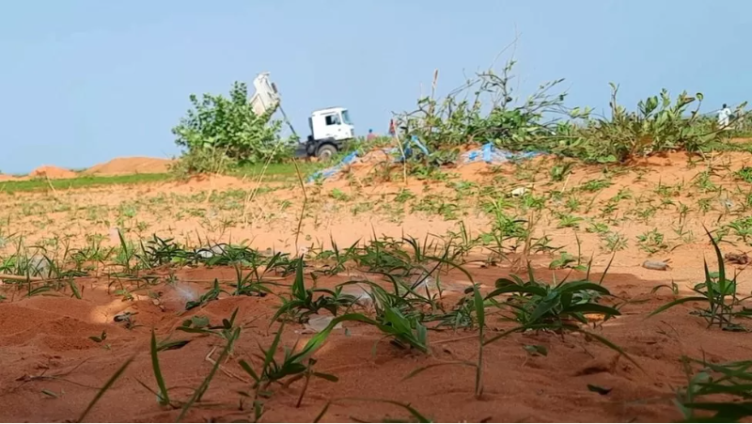
Perhaps the most disturbing footage he showed us was a video he took while hiding in a bush. It showed bodies being dumped from a lorry into a mass grave.
"We went towards the forest graveyard to bury the bodies. But the RSF did not allow us to do so. Under the orders of the RSF, the driver of the truck was ordered to dump the bodies in a pit," Maalim says, adding that the RSF ordered them to leave the area afterwards.
"They should have been buried according to Muslim rituals. We should have held prayers for them. But the RSF insisted that they were discarded like garbage."
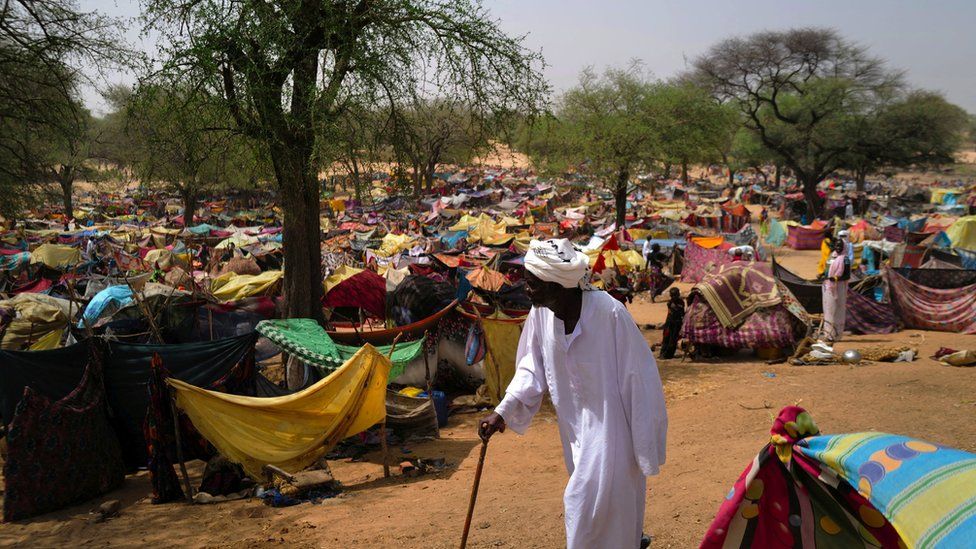
Nobody knows who the bodies belong to or how they were killed. But many families who have sought refuge in Chad tell us the RSF were specifically targeting young men and boys in West Darfur, forcing them out of their hideouts and killing them.
The families say members of non-Arab communities were targeted. They describe being stopped at RSF checkpoints and asked about their ethnicity. They told us they were too frightened to say they were Masalit in case they were killed.
The BBC has asked the RSF to comment on the allegations but it has not responded. But earlier this week it denied allegations it was involved in similar attacks on members of the Masalit community in May.
Maalim's account matches details in a UN report published on 13 July, saying local people were forced to dispose of the bodies of at least 87 ethnic Masalit and others allegedly killed by the RSF in a mass grave in West Darfur.
The metadata on the photos and videos in Maalim's phone show that they were taken between 20 and 21 June, the same dates mentioned in the UN report.
Like the UN report, Maalim told us the bodies were buried in an open area known as al-Turab al-Ahmar (Red Soil), west of El Geneina and near a police base.
The UN statement said some of the people had died from untreated injuries. In one of Maalim's videos, a man is found alive among a pile of dead bodies. Flies hover around his dry, cracked lips as he tries to speak. Maalim says the victim had been lying there for eight days, suffering from gunshot wounds. We do not know what has happened to this man.
Maalim tells us he took the videos because he wanted to document what was happening in his hometown. But he soon felt it was no longer safe for him to stay in the city.
"I was afraid because more than once they were searching for people who had mobile phones on them while doing the clean-up."
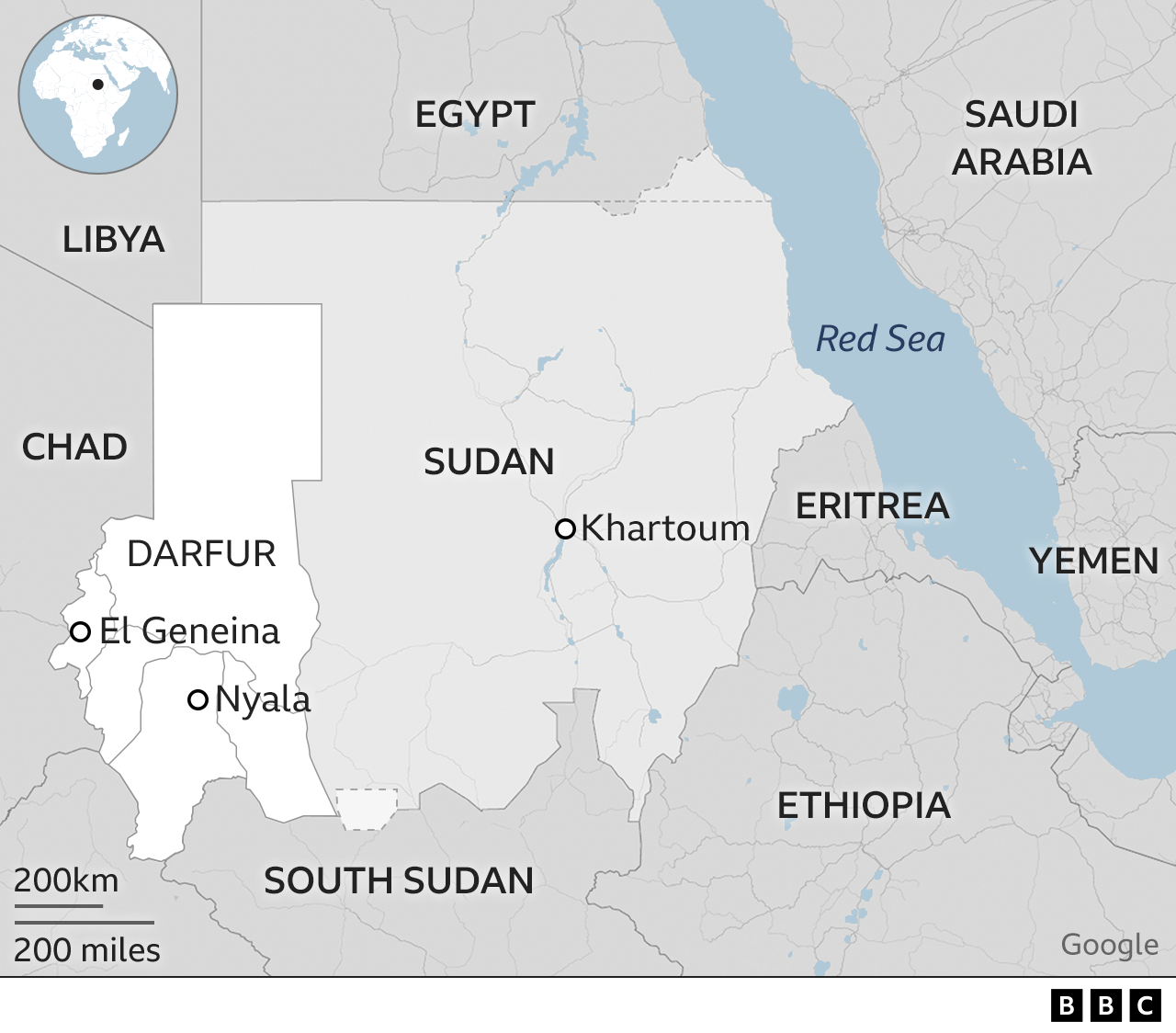
Darfur Arab and Black African communities in Darfur have been at loggerheads for years - with the worst violence erupting two decades ago when non-Arabs took up arms accusing the government of discrimination.
The RSF was born out of the notorious Janjaweed Arab militia, which brutally suppressed the rebellion, killing hundreds of thousands of people. The group was accused of widespread atrocities and ethnic killings, described as the first genocide of the 21st Century.
Fighting between the RSF and the Sudanese army, which erupted in April, seems to have re-ignited this conflict. Last month, the West Darfur governor was killed shortly after he accused the RSF of carrying out a genocide against the Masalit people.
This round of violence in many parts of Darfur doesn't appear to be random. We have heard allegations that there has been a systemic attempt by the RSF and allied Arab militias to target senior figures in Black African groups like the Masalit, forcing tens of thousands of them to flee into Chad.
The RSF says it is a revival of the ethnic violence seen in the 2000s and it is not involved.
On Thursday, the International Criminal Court (ICC) - which has been investigating crimes in Darfur since 2005 - opened a new probe into alleged war crimes in Sudan.
Chief prosecutor Karim Khan told the UN Security Council there was a risk of "allowing history to repeat itself - the same miserable history".
Like the thousands of Sudanese who have fled Darfur, Maalim does not have much to return to. His home has been burned down and all his family's possessions have been looted. But most painfully, many of his friends and family will not be there.
Latest Stories
-
President Mahama ends Resetting Ghana tour of Ahafo Region
5 minutes -
African negotiators seek delivery of climate commitments at COP31
6 minutes -
BoG develops AI rules for financial sector
8 minutes -
‘Big Push’: Government assures contractors of prompt payments
12 minutes -
Court fines miner for breaking into gold buying shop
22 minutes -
Tarkwa court jails labourer for three years over GH¢123,000 theft
1 hour -
GAEC must retain nuclear scientists for Ghana’s nuclear ambitions – Minister
2 hours -
Man reportedly mistaken for game and shot by hunter dead in forest
2 hours -
19-year-old mason jailed 15 years for defiling seven-year-old pupil
2 hours -
Ghana’s banking sector assets rise 20.47% to GH¢500.2bn – BoG Governor
2 hours -
22 injured as Sprinter bus overturns at Sege after tyre burst
2 hours -
UN housing expert urges Ghana to strengthen Rent Control Department amid housing affordability concerns
2 hours -
Delta-BCI partnership reaches 166,000 people with breast cancer education
2 hours -
Power restoration fault suspected in Kumasi Central Market fire
8 hours -
The 7-foot giant of Ngleshie Amanfro: Seven-foot Ghanaian Ephraim Saawa dreams of joining the national basketball team
8 hours