

Audio By Carbonatix
Ghana has a long tradition in lottery and is recognised for that across West Africa. What is, however, the global context of this sector and what are its economic impacts?
It is important to understand that each country has a vastly different regulatory framework that determines whether lottery can be operated by competing companies or only by a state monopoly.
In Africa, some of the monopolistic countries are Ghana, Ivory Coast, Senegal, Togo, DR Congo, while Nigeria, Kenya, Cameroon and Zambia count among competitive jurisdictions.
Most countries in Europe and the Americas operate lottery via state monopolies, where the proceeds are directed towards social development and good causes and this is also the case with the monopolistic jurisdictions in Africa, such as our own Ghana.
In fact, lottery is considered in most countries as a vital tool to generate additional funds for social development – funds that are added on top of the regular state budgets. With this perspective in mind, lottery is not merely a product for entertainment, but a key social development policy tool for many governments.
Some statistics may reveal the global impact (source: World Lottery Association). In 2018, the global lottery sales amounted to $303 billion, and thereof, $86 billion were allocated to good causes. For the sake of comparison, Ghana’s total GDP for the same year amounted to $66 billion.
However, the data also reveals that only a mere 0.6% (1.8 billion USD) of the global revenues were generated in Africa and thereof only 256 million USD were allocated to good causes.
This is low, as we need to consider that Africa’s share of the world economy is 3%, and hence, this clearly indicates an under-developed sector with significant growth potential.
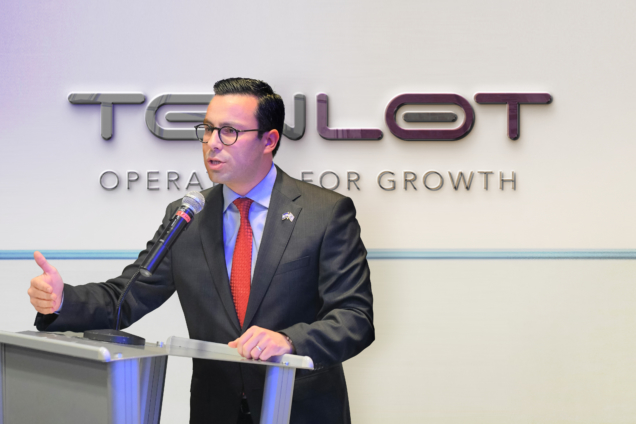
We talked with Yossi Abadi, CEO of TENLOT Group, to share his perspective on lottery in Africa. “Africa is evidently an under-developed market and we believe that many African countries have not nearly fulfilled their potential.”
TENLOT Group is a global lottery operator with a strong footprint in Africa and Latin America and is specialized in operating charity-oriented lotteries.
“I would like to point out that African governments should cease the opportunity to transform their lottery sectors into an important funding tool for good causes and social development, in addition to becoming a very important source for employment. This should be a core element within their strategic goal to go ‘Beyond Aid’”, Yossi Abadi added.
Lottery in Africa should be encouraged as a social development tool, by emulating the highly successful model of some countries in Europe, the Americas and Asia.
In order to achieve this, the public needs to be made well aware that by playing and entertaining itself, it also builds the economy and social wellbeing of the country.
Latest Stories
-
Ghana Psychological Association calls for greater involvement of people with lived experience in mental health care
25 minutes -
Ablakwa says Ghana could evacuate more citizens from South Africa if the situation worsens
52 minutes -
Violence against girls must be tackled through individual responsibility – Gender advocate
56 minutes -
Ghana’s BRICS bid must be guided by national interest – International Affairs Analyst
1 hour -
Journalists look back on a decade of breast cancer reporting in Ghana
2 hours -
President Mahama ends Resetting Ghana tour of Ahafo Region
4 hours -
African negotiators seek delivery of climate commitments at COP31
4 hours -
BoG develops AI rules for financial sector
4 hours -
‘Big Push’: Government assures contractors of prompt payments
4 hours -
Court fines miner for breaking into gold buying shop
4 hours -
Tarkwa court jails labourer for three years over GH¢123,000 theft
5 hours -
GAEC must retain nuclear scientists for Ghana’s nuclear ambitions – Minister
5 hours -
Man reportedly mistaken for game and shot by hunter dead in forest
5 hours -
19-year-old mason jailed 15 years for defiling seven-year-old pupil
6 hours -
Ghana’s banking sector assets rise 20.47% to GH¢500.2bn – BoG Governor
6 hours