

Audio By Carbonatix
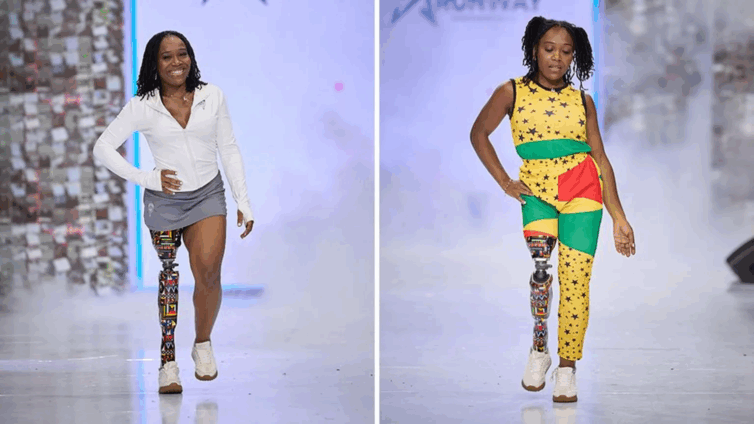
It was hard to miss the appearance of 33-year-old model and writer Abena Christine Jon'el at a recent major fashion show in Ghana.
Walking the runway in a colourful African print, her prosthetic leg wrapped, her appearance made a big impact.
The Ghanaian-American was hoping to make a statement about the visibility of people with disabilities, building on years of work in the US and here in Ghana of speaking out on the issue.
At two years old, Abena's life became defined by a challenge most adults would struggle to face.
A large tumour had appeared on her right calf, the first sign of a rare, aggressive soft-tissue cancer, rhabdomyosarcoma. Doctors presented her mother with a difficult choice: radiation, which could have left her dependent on a wheelchair, or amputation. Her mother chose the latter.
"It was the best decision she could have made," Abena says today without hesitation, speaking to the BBC surrounded by friends and family at a restaurant in the Ghanaian capital, Accra.
She now lives in Ghana, but she grew up in Chicago in the US.
Even before she understood what cancer was, her early life was shaped by treatment and recovery. Movement became a way to measure survival and rebuild confidence. In a way, it was taking ownership of a body that had been through so much.
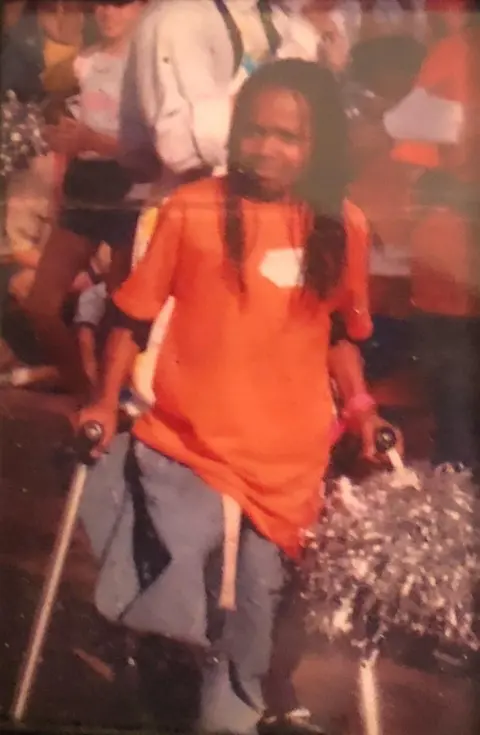
But when she speaks about her younger years, it is not the cliché story of the inspirational disabled child sometimes presented in glossy campaigns: a compliant person bravely but silently triumphing against adversity.
She rejects that stereotype entirely.
"People imagine disabled kids as straight-A students who are sweet, quiet and perfect," she says.
"I was the opposite. I was loud, I was a little black girl running around on one leg, I did not let anyone push me around, and I was struggling through school."
Her disability never softened her personality; it sharpened it.
And that sharpness, what she now jokingly describes as her "professionally inspirational" energy, is the very thing that would later carry her through life.
In the US, she worked as a writer – initially as a poet – and later became a public speaker who spoke about her life experiences, hoping to inspire people.
She wanted people to see what she was accomplishing and to "let me hold a mirror so you can see yourself and what you can accomplish if you believe".
Long before she dabbled with public speaking or modelling, Abena felt a pull towards Africa, a feeling she could not articulate but could not ignore.
As a young adult in the US, she immersed herself in books on the history of Africa before colonialism, particularly West Africa. The more she read, the stronger the pull became.
But her first visit to Ghana in 2021 changed everything.
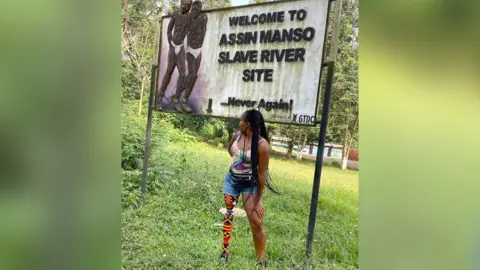
In the central region of Ghana, standing at the Assin Manso slave river site – where enslaved people were sold before travelling about 40km (25 miles) south to the coast - she experienced what she describes as "a moment that rearranged my entire understanding of myself".
The weight of history met the weight of belonging, forming a sense of identity she had never felt growing up in the US.
When she returned, she fell into a deep depression.
"It felt like I had finally found a missing part of myself in Ghana," she says."Leaving felt like being torn away from somewhere my soul belonged."
Three months later, she packed her bags and moved permanently.
Ghana embraced her in ways she still struggles to describe.
"I am Ghanaian by ancestry and adoption," she says with pride.
Over the four years she has lived in Accra, Ghanaians have claimed her in the way only Ghana knows how, with warmth, with teasing, with family, and with names. She now lives with a Ghanaian mother who introduces her as her own daughter.
"My Ghanaian identity is not pretend," she says. "It is not cosplay. It is ancestral. Like Kwame Nkrumah said: 'I am not African because I was born in Africa, but because Africa was born in me.' That is exactly what Ghana is to me."
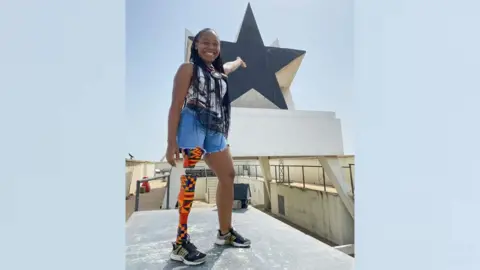
Her prosthetic leg itself is a declaration of that love.
Wrapped in Kente, it is as much a cultural symbol as a mobility aid.
"It always has been, and always will be, kente," she says. "It represents my love for this country, its heritage, its pride."
Living with a disability in Ghana has brought a new mission into her life, one that goes far beyond personal expression.
For Abena, the difference between how disabled people are treated in the US and Ghana comes down to visibility and access.
"In the States, progress is happening, slowly, imperfectly, but happening. Disabled people are being invited into more spaces," she explains. "It is still ableist, but at least there is an attempt to change the narrative."
Ghana, she says, is still at the beginning of that journey. Not for lack of compassion, but for lack of representation.
After her move, she continued to speak out for the rights of people with disabilities.
"In Ghana, disabled people have not been widely showcased in a positive light," she says. "So stigma thrives. Negativity thrives. People do not see us in powerful or beautiful or joyful positions; they see us only in struggle."
Her advocacy is built on changing that perception. Not with pity, but with visibility.
With her kente prosthetic, unfiltered personality and refusal to shrink herself to fit public expectations, Abena wants Ghanaians to see disabled people as they are: ambitious, stylish, talented, complex, proud and human.
"Disability is not a limitation. Having a disability is not what makes you disabled," she says.
"Lack of support, lack of accessibility, that is what disables you."
Her advocacy found a new stage, literally, at the 15th edition of Rhythms on the Runway, one of Africa's most celebrated annual fashion shows, which took place last month at Accra's historic Osu Castle.
In the build-up to the show, Abena approached the organisers directly.
She knew what her presence would mean, not just for herself, but for Ghana. She wanted to open the door to a different kind of representation, to force a conversation that the country had delayed for too long.
"I knew it would be a monumental moment for Rhythms on the Runway and for Ghana," she says. "If I wanted inclusivity in the industry, I had to be willing to take that first step."
And she did.
When she stepped onto the runway, draped in fabric and confidence, her prosthetic gleaming under the spotlights, the room shifted. What happened next became one of the most talked-about moments of the night.
"Her strength showed right through, speaking volumes. 'I am differently able, and I have got this,' Tourism, Culture and Arts Minister Abla Dzifa Gomashie said.
"Her walk was not just a performance; it was a powerful affirmation that talent, beauty, and confidence know no limitations. We are proud to have provided a platform where her light could shine so boldly," fashion show organiser Shirley Emma Tibilla said.
"Abena's presence was absolutely powerful. This is what true inclusion looks like, celebrating every story, everybody, and every ability," Dentaa Amoateng, entrepreneur and founder of the Guba diaspora investment awards, added.
But for Abena, the significance of the evening was not the applause. It was the message. Disabled people were not just spectators that night, they were centre stage.
Standing at the intersection of identity, disability, heritage and fashion, Abena represents a new way forward for Ghana, one where inclusion is not quietly suggested, but boldly demanded.
Her journey from a two-year-old cancer patient to a woman reshaping how Ghana sees disability is not a story of survival; it is a story of reclamation.
She reclaimed her identity, reclaimed her mobility, reclaimed her belonging and reclaimed her place in a country that, in her words, "fought for me before I even stepped foot here".
Her work is far from finished. But whether she is on a runway, behind a microphone, or mentoring young amputees, one thing is constant: she refuses to dim her light. And she refuses to let others like her be dimmed either.
"Ghana is my home," she says.
Latest Stories
-
Iran war lands ‘triple blow’ to flood-ravaged Sri Lankans
17 minutes -
Gunmen kill at least 11 people at Afghanistan picnic spot
30 minutes -
Woman, 25, in court for stealing baby at Bogoso
31 minutes -
Trump unveils giant gold-accented victory arch design for US capital
34 minutes -
We spoke to the man making viral Lego-style AI videos for Iran. Experts say it’s powerful propaganda
39 minutes -
Hungarians vote in big numbers on whether to end Orbán rule and elect rival
40 minutes -
At least 30 feared dead in crush at Haitian tourist site
40 minutes -
Boxing: Abdul Ahmed wins WBA Africa Cruiserwight title after dispatching Nigeria’s Eradeye
53 minutes -
Nearly 2,000 displaced, schools damaged as windstorm wreaks havoc in Gushegu
1 hour -
Ghana’s Derrick Kohn to work under Marie-Louise Eta as she becomes first woman to coach men’s Bundesliga team
1 hour -
Accra Open Championships conclude with strong performances ahead of African Championships
1 hour -
Ghana to begin camping with 12 athletes after Accra Open Championships – Bawa Fuseni
2 hours -
Anthony Joshua declines showdown with Tyson Fury but admits they ‘probably’ clash next
2 hours -
Tyson Fury dominates Makhmudov, calls out Joshua next
2 hours -
I have supported highway authority financially to fix roads in my constituency – A Plus
3 hours