


Audio By Carbonatix
At least 30 people have died and scores more are unaccounted for in just one county in North Carolina, after Hurricane Helene tore across the state and caused catastrophic flooding.
A clearer image of the damage the storm inflicted after barrelling through Florida and Georgia emerged throughout Sunday, with Buncombe County appearing to be the hardest hit area.
“We have biblical devastation,” said Ryan Cole, an emergency official in the county, which contains the mountain city of Asheville. "This is the most significant natural disaster that any one of us has ever seen."
At least 116 people have died nationwide since the hurricane made landfall in Florida on Thursday, according to the BBC's US partner CBS, and that figure is expected to rise as officials reach more areas.
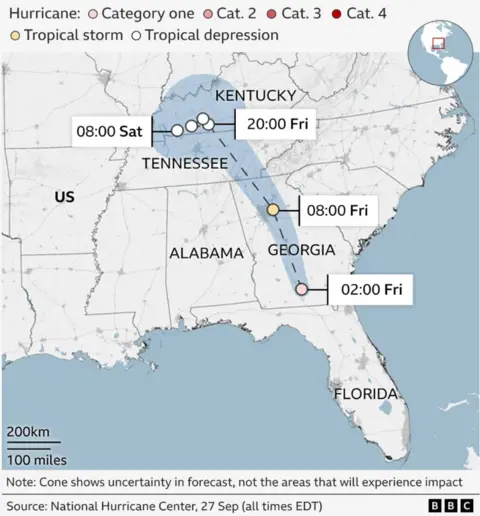
Helene began as a hurricane - the most powerful on record to hit Florida's Big Bend, and moved north into Georgia, the Carolinas and Tennessee. The majority of deaths have been confirmed in North and South Carolina where Helene landed as a tropical storm.
On Sunday evening, officials in North Carolina said 30 people had died in Buncombe County alone. Crews across the state are battling power and mobile service outages, downed trees and hundreds of closed roads.
Some residents returned to find their homes entirely destroyed on Sunday. And with some 1,000 people still unaccounted for in Buncombe County, relatives are working to locate family members with limited mobile service.
"This storm has brought catastrophic devastation... of historic proportions," North Carolina Governor Roy Cooper said.
The American Red Cross has opened more than 140 shelters for those in south-eastern states who evacuated their homes. More than 2,000 people are currently using the shelters, the organisation said on Sunday.

Erin Quevedo, the owner of a flooded salon in Buncombe County, spoke to The Asheville Citizen Times while ankle-deep in mud.
"The salon was completely destroyed. It looks like the water came up to about five feet inside," she said. "Right now, all we're doing is we're trying to salvage what we can."
Rescue operations are ongoing in North Carolina and supplies, including food and water, are being delivered by air to affected areas that cannot be reached due to closed roads.
"People are desperate for help and we are pushing to get it to them - [it is] a massive effort," Governor Cooper said.
The North Carolina National Guard has rescued more than 119 people - including one infant, according to Major General Todd Hunt. He said the largest rescue was of 41 people north of Asheville.
Many petrol stations are closed throughout North Carolina with long queues of cars at those that are still open. Meanwhile, the few open supermarkets have been crowded by customers attempting to buy bottled water.
The damage from the storm is estimated at between $95bn and $110bn (£71bn-£82bn) nationwide. The scale of the destruction will become clearer in the coming days.
The search for survivors is ongoingand federal emergencies have been declared in sixstates, including Florida and Georgia.
"The devastation we're witnessing in Hurricane Helene's wake has been overwhelming," President Joe Biden said on Saturday.
He was briefed by Deanne Criswell, head of the Federal Emergency Management Agency (FEMA), who he directed to speed up support to storm survivors, including deployment of extra teams to North Carolina.
Some of the areas most affected by the storm lie in states expected to be decisive in November's presidential election, namely Georgia and North Carolina.
The White House has said Vice President Kamala Harris will visit affected areas as soon as she can do so without affecting rescue operations.
Meanwhile Donald Trump's campaign said he would visit the Georgia city of Valdosta on Monday.
Although Helene has weakened significantly, forecasters warn that high winds, flooding and the threat of tornadoes could continue.
There could be as many as 25 named storms in 2024, the National Oceanic and Atmospheric Administration warned earlier this year.
Between eight and 13 of those storms could develop into hurricanes and a handful already have, including Helene. More storms could be on the horizon, officials warned, as the official end of hurricane season is not until 30 November.
Latest Stories
-
Let’s give OSP time to mature, not to scrap it – Hassan Tampuli
3 minutes -
Nigeria convicts 386 Islamist militants in mass trials
8 minutes -
Djibouti president wins election with 97.8% of vote, state media says
12 minutes -
We don’t have mandate to deduct tax from rent allowance of security services personnel – Interior Ministry clarifies
26 minutes -
Ablakwa receives Presidential Special Envoy on Reparations to advance global agenda
44 minutes -
Christina Koch becomes first woman to travel around the moon on Artemis II
55 minutes -
Epstein survivors’ calls to meet King Charles and Queen harder to ignore as US visit approaches
1 hour -
UN Secretary-General names Ghana’s Anita Kiki Gbeho as South Sudan envoy
1 hour -
Mali withdraws recognition of Sahrawi Republic, backs Morocco’s autonomy plan
1 hour -
Gov’t distributes over 8,500 laptops to One Million Coders project
1 hour -
Julius Debrah, ‘man to beat’ as NDC’s James Agbey dismisses Musah Dankwah’s polls
1 hour -
GPRTU in Savannah Region to protest alleged eviction in Damongo
2 hours -
Re: Reinsurance does not replace process — A response to the SIGA–SIC defence
2 hours -
Gender Ministry supports Harriet Amuzu in ongoing abuse case
2 hours -
AG joins plaintiff to scrap OSP ?: We should be mindful of the mischief in this – Bobby Banson
2 hours