


Audio By Carbonatix
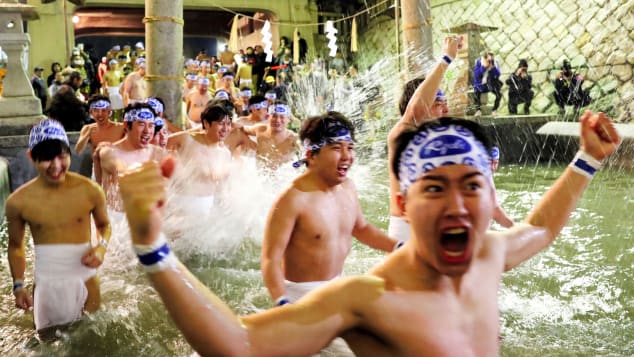
Thousands braved chilly weather on Saturday to gather at the annual "Naked Festival" in Okayama prefecture in the southern part of Japan's Honshu island.
The event, called "Hadaka Matsuri" in Japanese, is a wild and raucous festival held every year on the third Saturday of February at the Saidaiji Kannonin Temple, about a 30-minute train ride from Okayama city.
But the 10,000 or so male participants aren't as naked as the festival's name suggests.
They sport a minimal amount of clothing; usually a Japanese loincloth called a "fundoshi" and a pair of white socks called "tabi."
The festival, which celebrates the blessings of a bountiful harvest, prosperity and fertility, starts at around 3:20 p.m local time with a separate event for young boys -- aimed at fostering interest in younger generations.
"We hope they will be able to keep the tradition alive in the future," Mieko Itano, a spokeswoman from the Okayama tourism board, told CNN Travel.
In the evening, the men spend an hour or two running around the temple grounds in preparation and purify themselves with freezing cold water, before cramming themselves into the main temple building.
When the lights go out at 10 p.m., a priest throws 100 bundles of twigs and two lucky 20-centimeter-long shingi sticks into the crowd from a window four meters above.
That's when the commotion begins.
The 10,000 or so men, packed in like sardines, jostle with each other to get hold of one of the bundles and/or the two sticks. Whoever succeeds is guaranteed a year of good fortune, according to legend.
The shingi are more sought after than the less-coveted twigs, which can be taken home. The whole event lasts around 30 minutes and participants emerge with a few cuts, bruises and sprained joints.
Visitors come from all across Japan and a few from abroad to take part. Some attend the event alone, but many participants join as part of teams representing local businesses.
Something for everyone
The festival evolved from a ritual that started 500 years ago during the Muromachi Period (1338-1573), when villagers competed to grab paper talismans, which were given out by a priest at the Saidaiji Kannonin Temple. More and more villagers wanted those lucky paper talismans and the ritual grew in size. But they realized that when they went to grab the paper it ripped. Their clothes just got in the way too, so they eventually did away with them and exchanged paper for wood, said Itano. With its long heritage, the festival was also designated an Important Intangible Folk Cultural Asset in 2016. It's one of several "naked festivals" held across Japan, with another held at Yotsukaido in Chiba prefecture, featuring men in loincloths fighting and carrying kids through mud as a method of exorcism. There are plenty of other festivities to check out for those that don't feel like stripping down to a loincloth in mid-winter, too. Related content Okinoshima: World Heritage Site banned to women Before the main Okayama event, there is an afternoon of traditional dances and a performance by a troupe of female drummers. A fireworks show starts at 7 p.m. At Gofuku-dori, a nearby shopping street, locals open their doors and welcome participants and spectators. You don't have to be a local to take part in the main "naked" event. You can either register in advance to buy your loincloth and tabi socks, or buy them on site if you feel like joining in. This year, festival organizers have also taken extra precautions amid the coronavirus outbreak. Itano suggested participants in the naked part of the festival not wear masks during the rough and tumble part of the main event. However, she added that hand sanitizers were placed at the temple entrance and around the festival.Something for everyone
The festival evolved from a ritual that started 500 years ago during the Muromachi Period (1338-1573), when villagers competed to grab paper talismans, which were given out by a priest at the Saidaiji Kannonin Temple. More and more villagers wanted those lucky paper talismans and the ritual grew in size. But they realized that when they went to grab the paper it ripped. Their clothes just got in the way too, so they eventually did away with them and exchanged paper for wood, said Itano. With its long heritage, the festival was also designated an Important Intangible Folk Cultural Asset in 2016. It's one of several "naked festivals" held across Japan, with another held at Yotsukaido in Chiba prefecture, featuring men in loincloths fighting and carrying kids through mud as a method of exorcism. There are plenty of other festivities to check out for those that don't feel like stripping down to a loincloth in mid-winter, too. Related content Okinoshima: World Heritage Site banned to women Before the main Okayama event, there is an afternoon of traditional dances and a performance by a troupe of female drummers. A fireworks show starts at 7 p.m. At Gofuku-dori, a nearby shopping street, locals open their doors and welcome participants and spectators. You don't have to be a local to take part in the main "naked" event. You can either register in advance to buy your loincloth and tabi socks, or buy them on site if you feel like joining in. This year, festival organizers have also taken extra precautions amid the coronavirus outbreak. Itano suggested participants in the naked part of the festival not wear masks during the rough and tumble part of the main event. However, she added that hand sanitizers were placed at the temple entrance and around the festival.DISCLAIMER: The Views, Comments, Opinions, Contributions and Statements made by Readers and Contributors on this platform do not necessarily represent the views or policy of Multimedia Group Limited.
Tags:
DISCLAIMER: The Views, Comments, Opinions, Contributions and Statements made by Readers and Contributors on this platform do not necessarily represent the views or policy of Multimedia Group Limited.
Latest Stories
-
Why must I renew my vehicle’s registration number every 2 years?
1 minute -
Parliamentary Privilege and the Limits of Personal Liberty: A study on the immunity of members of parliament from arrest in Ghana
3 minutes -
Kwabenya Court denies bail to six accused in alleged 3.9-tonne cocaine shipment
3 minutes -
Ghana opposes calls to abolish ICC, urges stronger action against crimes against humanity
10 minutes -
Cedi remains under pressure due to Christmas demand; going for GH¢11.90 at forex bureaus
12 minutes -
NDC opens nominations for 2026 regional executive elections on October 6
12 minutes -
Ghanaian nurses to receive higher pay, health insurance and rent allowance under new Saint Kitts and Nevis agreement
21 minutes -
JoyNews’ Emmanuel Adu Gyamfi named ‘Digital Tourism Icon of the Year’ in Ahafo Region
25 minutes -
Hurricane Polo makes landfall on Mexico’s Pacific coast
29 minutes -
US ban on Canadian alcohol and dairy comes into effect as trade war drags on
31 minutes -
GES orders SHS heads to refund unauthorised fees collected from parents
39 minutes -
AFCON 2027Q: ‘We don’t need to cry over spilled milk’ – Damba on Ghana injury concerns
43 minutes -
NDC communicator blames documentation, payroll validation for teachers’ promotion arrears delay
44 minutes -
2026 JoyNews Impact Maker Award winner brings clean water to Yoko Tsume after years of cattle dugout dependence
51 minutes -
Sarkodie commends Mahama for rejecting US health compact
51 minutes