

Audio By Carbonatix
The UK's economy shrank slightly in April as the Iran war began to have an impact on businesses, official data has indicated.
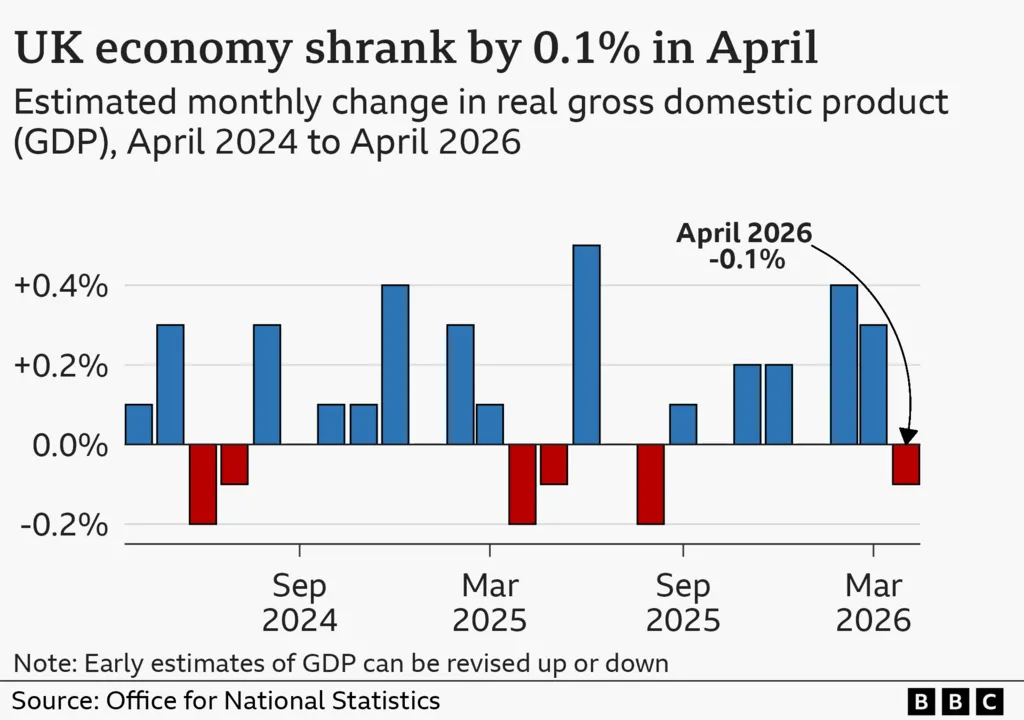
The economy contracted by 0.1% in the month, the Office for National Statistics (ONS) said, with some firms citing the conflict in the Middle East as having raised costs and affected turnover.
April's contraction was the first monthly fall since August last year, but had been forecast by economists after stronger than expected growth in March.
Analysts said that after a good start to the year the economy was set to slow over the next few months, and they expect the Bank of England to keep interest rates unchanged when it meets next week.
In the three months to April - which is generally seen as a less volatile measure - the ONS said the economy grew by 0.7% compared with the previous three-month period.
When the Iran war broke out it led to the effective closure of the Strait of Hormuz, a key shipping route for oil tankers, causing crude oil prices to surge.
The price of a barrel of Brent crude, the international benchmark, has risen as high as $120 since the conflict began, but has fluctuated as hopes of an end to the war have risen and fallen.
On Friday, the price sank to a three-month low of $86 on hopes that a resolution to the conflict could be close.
The increase in oil prices since the start of the war has led to a rise in petrol and diesel prices in the UK. Household energy bills will also increase in the coming months with the energy price cap rising in July.
Oil prices also have a wide-reaching effect on the cost of many goods and services.
Yael Selfin, chief economist at KPMG UK, said that while the economy grew over the three months to April, "the contraction in April is more indicative of growth prospects for the economy going forward".
The monthly figure, she said, "points to renewed fragility in the UK economy, with pressure on both consumers and businesses likely to persist over the coming months".
Consumers are bracing for a sharp rise in their energy bills, she added, and as a result "have signalled their intention to cut back on purchases and increase their savings, which will weigh on economic activity".
And while businesses are also facing rising costs, "subdued domestic demand is limiting firms' ability to pass these higher costs on to consumers, which is likely to squeeze profit margins".
Responding to the figures, Chancellor of the Exchequer Rachel Reeves said that the war "will have an impact at home".
"Before the conflict in the Middle East, growth was higher than expected and inflation was falling," she said.
"The choices I have made as Chancellor mean our economy is in a stronger position to deal with the costs of the war."
Shadow chancellor Mel Stride said "putting Benefits Street first leaves the economy weaker", adding that only the Conservatives "have a plan to get Britain working again".
Liberal Democrat Treasury spokesperson Daisy Cooper said the GDP figures showed the government was "asleep at the wheel", adding Labour had left the economy "vulnerable... in the face of Trumpflation and geopolitical turmoil".
Reform's Treasury spokesperson Robert Jenrick said: "The economy is shrinking because of the choices Rachel Reeves is making."
The BBC has contacted the Green Party for comment.
The ONS said that the main driver of the contraction in April was a 0.2% fall in the dominant services sector - which accounts for about three-quarters of the UK's economy
Areas of the services sector that were particularly hard hit included arts and entertainment, sports activities and amusement and recreation activities.
The ONS said that "some of this fall can be attributed to the effects from the conflict in the Middle East, with the cancellation of multiple sporting events in the Middle East affecting the output of UK-based businesses".
It also added that some manufacturing, transport and travel business had also seen their trading affected by the impact of the Iran war.
Ruth Gregory, deputy chief UK economist at Capital Economics, said the Bank of England could raise interest rates later in the year, but "the weakness in economic activity will probably mean rates stay on hold this year".
The Bank is widely expected to keep rates unchanged when it meets next week. Before the Iran war broke out, analysts had widely expected it to cut rates this year.
Gregory said the contraction in April "showed the strong start to the year is now faltering".
"We expect the economy to come to a standstill this quarter and next as the hit to households' real incomes from higher energy prices intensifies."
BBC News has contacted the Green Party for comment.
Latest Stories
-
Daily Insight for CEOs: Preparing for 2027 Board and Executive Conversations
2 minutes -
World Cup Visa Scandal: There is no ‘justification’ to dismiss me – Kofi Adams
13 minutes -
2028 Olympic Games qualification ‘really tough’ – Black Queens coach Björkegren
39 minutes -
GRFU, GOC Women’s Commission hold breast cancer awareness, expresses gratitude to Sunda International Ghana
42 minutes -
COCOBOD raises GH¢3.4bn as Cocoa Capital PLC lists inaugural commercial paper on GFIM
59 minutes -
No Party Card, just a Party Microphone! A Ghanaian story of Elections, Referees and Convenient Amnesia
1 hour -
Minority welcomes suspension of teachers’ strike, demands timely payment of promotion arrears
1 hour -
Customary ownership accounts for 80% of land; it complicates land administration – Lands Commission
1 hour -
NRSA to auction vehicles of non-subscribers who fail to pay towing charges within 21 days
1 hour -
WAFU B U17: Black Starlets target AFCON slot after booking semi-final place
1 hour -
Ghana faces $6.1bn debt-service burden from 2027 to 2029 due to Akufo-Addo’s DDEP – Haruna Iddrisu
2 hours -
GoldBod targets 150 hectares of forest reclamation in 2027
2 hours -
Despite substantial accommodation capacity, room demand still weakens – GSS report
2 hours -
No amount of foreign exchange is worth a lost forest – GoldBod
2 hours -
Chelsea’s defensive crisis: Alonso’s system, missing pieces, or individual errors?
2 hours