

Audio By Carbonatix
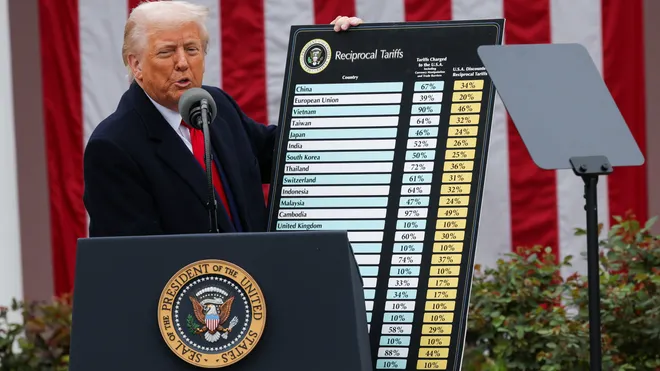
President Donald Trump has delayed imposing higher tariffs on US imports while sending letters to 14 countries including Japan and South Korea detailing the levies they face.
The latest development comes as a 90-day pause the White House placed on some of its most aggressive import taxes was set to expire this week.
The president renewed his threat of a 25% tax on products entering the country from Japan and South Korea and shared a batch of other letters to world leaders warning of levies from 1 August.
Higher tariffs had been set to come into effect on 9 July, having previously been suspended with White House officials saying they would look to strike trade deals.
When asked by a reporter whether the new August date was a hard deadline, Trump said: "I would say firm, but not 100% firm. If they call up and they say we'd like to do something a different way, we're going to be open to that."
The extension came as no surprise since trade agreements often take years to finalise, economist Adam Ahmad Samdin from research firm Oxford Economics told the BBC.
"Such deals are usually extremely detailed," he said, adding that although Vietnam became only the second country after the UK to strike an agreement with the US, it was more of a "broad framework" speeding up talks, rather than a detailed deal.
Also on Monday, Trump shared letters addressing leaders of 14 countries on social media, informing them of his latest tariff plans, while adding that the rates could be modified "upward or downward, depending on our relationship with your country".
Most of the tariff rates outlined by Trump were similar to those outlined in April,when he made his "Liberation Day" announcement, threatening a wave of new taxes on goods from various countries.
The comments suggested Trump would be open to further trade talks, investment strategist Vasu Menon from OCBC bank said.
"The expectations that Trump is once again engaged in a negotiating tactic rather than making serious tariff threats, offer hope to investors," Menon said.
The president argues that introducing tariffs will protect American businesses from foreign competition and also boost domestic manufacturing and jobs.
But economists say the measures will raise prices in the US and reduce trade. The three main share indexes in the US slipped on Monday, with Toyota's US-listed shares down 4%.
Japan sent more than $148bn in goods to the US last year, making it America's fifth biggest supplier of imports, after the European Union (EU), Mexico, China and Canada, according to US trade data. South Korea was also in the top 10.
As well as South Korea and Japan, Trump on Monday set out plans for a 40% tariff on goods from Myanmar and Laos, a 36% tariff on goods from Thailand and Cambodia, a 35% tariff on goods from Serbia and Bangladesh, a 32% tariff on Indonesia, a 30% tariff on goods from South Africa and a 25% tariff on goods from Malaysia and Tunisia.
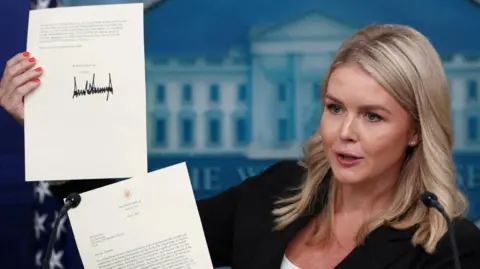
White House press secretary Karoline Leavitt said more letters could follow in the days ahead.
She disputed the suggestion that the shifting tariff deadlines from 9 July to 1 August might reduce the power of Trump's threats.
"The president's phone, I can tell you, rings off the hook from world leaders all the time who are begging him to come to a deal," she said.
When the president first announced a raft of steep tariffs in April, turmoil broke out on financial markets, leading to the president suspending some of the highest duties to allow for talks, while keeping in place a 10% levy.
'Busy couple of days'
Treasury Secretary Scott Bessent said he expected "a busy couple of days".
"We've had a lot of people change their tune in terms of negotiations. So my mailbox was full last night with a lot of new offers, a lot of new proposals," he told US business broadcaster CNBC.
Trump had initially described his April tariffs as "reciprocal", claiming they were required to fight back against other countries' trade rules he saw as unfair to US exports.
He has separately announced tariffs for key sectors, such as steel and cars, citing national security concerns, and threatened to raise levies on other items, such as pharmaceuticals and lumber.
The multi-layered policies have complicated trade talks, with car tariffs a key sticking point in negotiations with Japan and South Korea.
So far, the US has struck agreements with the UK and Vietnam, as well as a partial deal with China. In all three of those cases, the agreements have raised tariffs compared with levels before Trump returned to the White House, while key issues remain unresolved.
The US has said a deal with India is close.
The EU is also engaged in talks, with reports suggesting officials in the bloc were not expecting to receive a tariff letter. A spokesperson for the EU also said the European Commission's president Ursula von der Leyen had a "good exchange" with Trump.
Just a few weeks ago, the US president had threatened the EU with a 50% tax unless it reached an agreement.
Last week, Trump said Japan could face a "30% or 35%" tariff if the country failed to reach a deal with the US by Wednesday.
Latest Stories
-
Pentecost University to host international sustainability conference
6 minutes -
Ampofo Ankrah did not collect World Cup visa money – Lawyer
16 minutes -
Baffour Awuah to spend night in EOCO custody – Atta Akyea
18 minutes -
Torgbiga Wenya III opposes proposed elevation of 36 Anlo chiefs to Paramount status
25 minutes -
The strengthening El Niño and what it could mean for Ghana
29 minutes -
Baffour Awuah formally charged with money laundering, loss of public funds – Lawyer
29 minutes -
Drone flight over EOCO building could attract 30-year jail term – Security consultant
37 minutes -
Flying drone over EOCO premises is strictly prohibited – Security consultant
38 minutes -
SIC file was surrendered to client, EOCO has no reason to search Manhyia South MP’s firm – Atta Akyea
38 minutes -
EOCO search of Baffour Awuah’s law firm raises confidentiality concerns – Atta Akyea
39 minutes -
“I will never ignore an invitation from EOCO if I had received one” — Manhyia MP
41 minutes -
Baffour Awuah ready to cooperate fully with EOCO investigation – Bosome Freho MP
1 hour -
How a Ghanaian technology is helping fish farmers detect hidden threats before fish die
1 hour -
AI tool helps Ghanaian farmers identify crop threats from field observations
1 hour -
NEIP: Designing a Ghana Startup Agency that builds enterprises, not programmes
1 hour