

Audio By Carbonatix
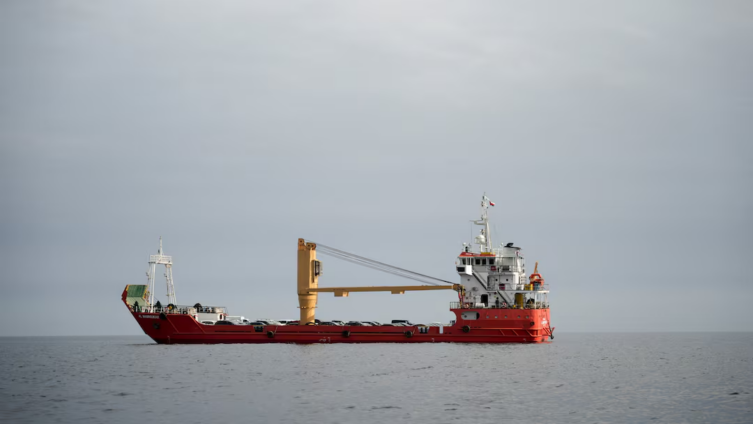
The U.S. military said it will begin a blockade of all maritime traffic entering and exiting Iranian ports and coastal areas on Monday after weekend talks failed to reach a deal to end the war with Iran, jeopardizing a fragile two-week ceasefire.
The talks in Islamabad, which ran from Saturday into early Sunday, were the first direct U.S.-Iranian meeting in more than a decade and the highest-level discussions since Iran's 1979 Islamic Revolution.
The negotiations came days after a ceasefire began on Tuesday, aimed at ending six weeks of fighting that has killed thousands of people across the Gulf, throttled vital supplies of energy and sparked fears of a wider regional conflict.
The U.S. Central Command said on Sunday that the U.S. blockade, starting at 10 a.m. ET (1400 GMT), would be "enforced impartially against vessels of all nations entering or departing Iranian ports and coastal areas, including all Iranian ports on the Arabian Gulf and Gulf of Oman."
Vessels transiting the Strait of Hormuz to and from non-Iranian ports will not be impeded, the U.S. military said. Additional information would be provided to commercial mariners through a formal notice prior to the start of the blockade, it said.
President Donald Trump on Sunday also said U.S. forces would intercept every vessel in international waters that had paid a toll to Iran.
"No one who pays an illegal toll will have safe passage on the high seas," Trump wrote on social media, adding: "Any Iranian who fires at us, or at peaceful vessels, will be BLOWN TO HELL!"
He added that the U.S. Navy will begin destroying mines that the Iranians had dropped in the Strait of Hormuz, a choke point for about 20% of global energy supplies.
While shipping data showed three supertankers fully laden with oil passed through the Strait on Saturday, tankers were steering clear of the waterway on Monday, ahead of the U.S. blockade.
IRAN SAYS 'ZERO LESSONS LEARNED'
After Trump's initial remarks on Sunday, Iran's Islamic Revolutionary Guards warned that military vessels approaching the strait will be considered a ceasefire breach and dealt with harshly and decisively, underlining the risk of a dangerous escalation.
A U.S. official said Iran rejected Washington's call for an end to all uranium enrichment, the dismantling of all major enrichment facilities and the transfer of highly enriched uranium.
Iran also refused U.S. demands that Iran cease funding for Hamas, Hezbollah and the Houthis, as well as fully open the Strait of Hormuz, the official added.
Iranian media said there was agreement on a number of issues, but the strait and Iran's nuclear program were the main sticking points.
Iranian Foreign Minister Abbas Araqchi said Iran had "encountered maximalism, shifting goalposts, and blockade" when just inches away from an "Islamabad MoU."
"Zero lessons learned," he added. "Good will begets good will. Enmity begets enmity."
Six weeks of fighting has killed thousands, roiled the global economy and sent oil prices soaring as Iran prevented traffic through the Strait.
The U.S. dollar and oil rose in early trading on Monday after the failure of the talks, while stocks in Asia eased.
Trump told Fox News' "Sunday Briefing" program that oil and gasoline prices may remain high through November's midterm elections, a rare acknowledgement of the potential political fallout from the war.
Iran's Qalibaf posted a map of Washington-area gasoline prices on social media with the comment: "Enjoy the current pump figures. With the so-called 'blockade'. Soon you'll be nostalgic for $4–$5 gas."

MORE NEGOTIATIONS?
Trump told Fox News on Sunday that he believed Iran would continue to negotiate and called the Islamabad discussions "very friendly."
"I do believe they're going to come to the table on this, because nobody can be so stupid as to say, ‘We want nuclear weapons,’ and they have no cards," he said.
But several hours later, the U.S. president said he did not care whether a "desperate" Iran returned to the negotiating table.
"If they don't come back, I'm fine," Trump told journalists on Sunday night after he returned to the Washington area from an overnight stay in Florida.
Qalibaf blamed the U.S. for not winning Tehran's trust, despite his team offering "forward-looking initiatives," Iran's President Masoud Pezeshkian, who discussed the talks in a call with Russian President Vladimir Putin, said Tehran wanted "a balanced and fair agreement."
"If the United States returns to the framework of international law, reaching an agreement is not far off," he told Putin, Iranian state media reported.
Latest Stories
-
There is no time to waste – Bawumia orders NPP to begin 2028 work
4 minutes -
Sarkodie visits MobileMoney Fintech LTD
6 minutes -
John Boadu unveils new NPP strategy to win back youth and modernise party
11 minutes -
Hawa Koomson elected NPP National Women’s Organiser
14 minutes -
John Boadu begins NPP rebuild from grassroots ahead of 2028 election
15 minutes -
Titus Glover wins NPP National Organiser race on second attempt
18 minutes -
Winning 2028 election won’t be easy; we must work harder – Bawumia
19 minutes -
You’ll be part of 2028 campaign; there’s enough work for all of us – Bawumia to NPP aspirants
27 minutes -
John Boadu moves to unite NPP after heated leadership contest
29 minutes -
Today is not a day of victory but a day of responsibility and great unity – John Boadu
30 minutes -
Let us choose unity over division – John Boadu to NPP
33 minutes -
Our task is to build a renewed NPP – John Boadu
36 minutes -
Teamwork, discipline will drive NPP’s 2028 victory – Justin Kodua after retaining General Secretary position
43 minutes -
John Boadu elected National NPP Chairman
52 minutes -
Justin Frimpong Kodua retains position as NPP General Secretary
53 minutes