

Audio By Carbonatix
Former Executive Vice President of Unilever Ghana and Nigeria, Yaw Nsarkoh, says Ghana may have embraced the appearance of democracy, but the substance never arrived.
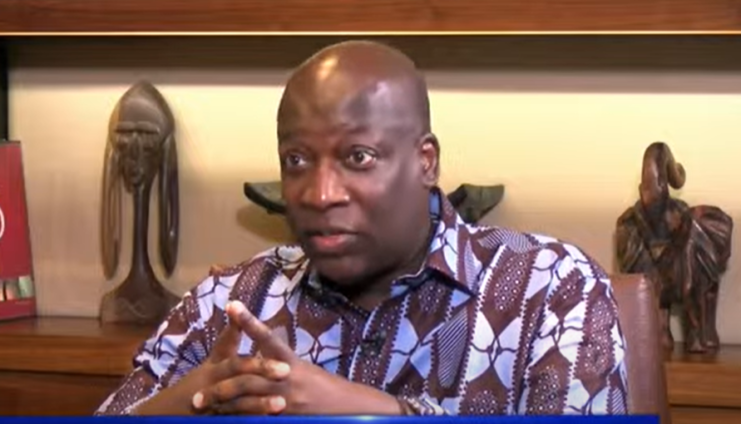
He said this during an unflinching conversation on JoyNews’ PM Express following his lecture titled “Iniquities of Iniquity in Our Santa Claus Democracy.”
In his view, what Ghana practices is not a homegrown democratic system, but an imported template lacking the critical foundations that make such a system thrive elsewhere.
He said in his Santa Claus democracy, he “was trying to describe a democracy that exists in form, but not always in substance. And what I tried to say was that a democracy exists to deliver tangible improvement in livelihoods when it doesn't deliver that something is already going wrong, and some of the features of a Santa Claus democracy are what I said.
“You see the institutional forms, but they exist in ritualistic ways, in the sense that accountability for delivery to the mass of the people is a little bit broken. I didn't make the statistics up.
“Ghana Statistical Services have just issued a report on May 28, where they say 70% of the population feels that they are not able to influence decision making. You cannot have a democracy that is functioning, a true democracy, and 70% of the population feel they cannot influence. Some of the salient feature are over monetization, the lack of transparency of fund flows and some things we spoke about earlier.
"One of things about democracy is an ongoing thing. You have to keep modifying things because you are learning. You need to keep customising things, there is no perfect template anywhere. But if you lock it, and you just say to yourself, ‘We became democratic on such a date and that’s it, then, there is political fermentation going to take place and we will land where we are," he said.
He said the language of power, English Language, which is used in Parliament and the court system has already excluded many people.
Yaw Nsarkoh said after 33 years of practising democracy it is time for the country to introspect, take the learnings, do the corrections and move.
“If we don’t do something about it, it can go in directions we don’t want. So we must start the conversation together saying that let’s begin the reforms,” he stated.
His argument is rooted in both history and political economy.
Unlike nations where modern democratic systems evolved after sustained industrialisation and capital accumulation, Ghana and much of Africa, he explained, attempted to graft democracy onto states still grappling with the hangover of colonialism and severe economic fragility.
“When modern European democracy took root, they were distributing wealth that had already been created. We didn’t have that. We started from under $3,000 per capita GDP. That’s a fundamentally different conversation,” he said.
Yaw Nsarkoh emphasised that democracy without a robust economic and institutional foundation simply becomes a transactional contest—what he termed “a public auction for the highest bidder.”
In such systems, the electorate is reduced to passive participants, voting every four years and then retreating into silence while elite groups trade power for personal gain.
He was especially critical of the idea that independence equated to sovereignty.
“Amilcar Cabral said it and got into a lot of trouble: what kind of independence do you really have if you don’t control your productive forces?” Yaw Nsarkoh asked.
“Having a dark-skinned president and a new anthem doesn’t mean you’ve achieved independence. You’re still navigating a distorted reality.”
Citing the work of political economist Claude Ake, Yaw Nsarkoh argued that African states did not emerge organically but were shaped by colonial disruptions, leaving behind weak and artificial structures.
“The post-colonial elite essentially took over the facilities of the state and became the new colonialists. They looked after themselves,” he said. “That’s the deformity we’ve refused to confront.”
He lamented the collapse of local governance, describing it as a symptom of a broader democratic decay.
“Look at the space we’re in, local government has essentially collapsed?” Yaw Nsarkoh asked.
Latest Stories
-
GRA assures Tullow of collaboration to settle $393m tax liability without disrupting its petroleum operations
13 minutes -
South Korea demands apology from Pyongyang for landmine blasts that injured three
17 minutes -
Carlos Queiroz not the sort of coach Black Stars need – Nii Lante Vanderpuye
47 minutes -
AFCON 2027Q: ‘Our Black Stars team is gone’ – Former Sports Minister
1 hour -
Prof. Prempeh calls for public review of draft constitutional reform bills
1 hour -
AFCON 2027Q: ‘I have never seen a poor performance from Black Stars like against Gambia’ – Nii Lante Vanderpuye
1 hour -
Nigeria set to launch National Digital Address System 9 years after Ghana showed the way
2 hours -
Policy rate decision takes time to reflect in lower lending rates – BoG
2 hours -
Western Regional Minister applauds Karpowership’s role in Ghana’s power sector
2 hours -
Playback: Road safety crises: Where are we getting it wrong?
2 hours -
Enterprise Life celebrates 25 years of protecting families and building trust
3 hours -
ICC London rules in favor of Ghana against Tullow over $400m tax charge
3 hours -
We are disappointed in ICC’s ruling over our corporate income tax assessment in Ghana – Tullow Oil
3 hours -
Cost of building inflation for August 2026 increases to 4.6% – GSS
3 hours -
Today’s front pages: Wednesday, September 30, 2026
3 hours