

Audio By Carbonatix
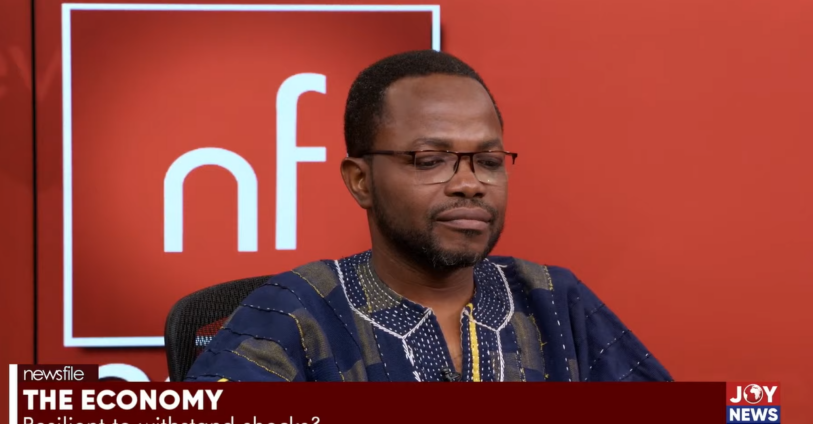
A development economist at the Institute of Statistical, Social and Economic Research (ISSER), University of Ghana, has warned of a crisis in Ghana’s agricultural sector.
Prof Fred Dzanku revealed that many local farmers are unable to find buyers for their produce, threatening the entire value chain and potentially leading to a sharp decline in production.
Speaking on JoyNews’ Newsfile, he illustrated the severity of the situation explaining that a colleague who had just returned from the Ketu area in the Volta Region sent him a message detailing the struggles of farmers. According to him, the challenge is not limited to one region.
“The entire value chain of agriculture… even farmers who are producing locally are not getting markets for their products. Go to Edem Agbana’s district, the stockpile of rice that farmers are not able to sell. You go to other parts of the country, farmers are producing and they are not able to sell.”
He warned of grave consequences, noting that the lack of market access has demoralized farmers to the point where many are considering abandoning farming altogether.
“In fact, they sent us a message that probably next year, many of them are not going to produce,” he revealed.
Prof. Dzanku’s comments come in the wake of a recent presidential directive urging the purchase of local rice. However, he noted that such calls appear to be going unheeded.
“They are not doing it,” he asserted. “In fact, there are people who are supposed to be purchasing local rights, [who] are importing rice into this country.”
He emphasized that the situation demands greater accountability from political leaders. “So, I mean, we have to hold our politicians more accountable,” he said.
When pressed by the host on how to achieve this, Prof. Dzanku pointed to what he described as the core political economy problem hindering progress: the country’s entrenched two-party system.
“One of the things I think we have to do is to move away from this NPP, NDC politics,” he argued. “Because it's almost as if they know that if NPP is in power for at least eight years maximum, the next time NDC will come, NPP will come, and therefore this duopoly in our politics is part of the political economy problem that we are facing in this country.”
He contended that the current system provides little incentive for meaningful change, leaving vulnerable groups like farmers without a voice.
“Until we bring that for them to know that the citizens of this country deserve better and we put pressure on them to do the right thing, it's not going to change because they have no incentive to change what is going on, right?” he questioned. “The farmer, you know, in the Upper East Region who is producing soybean, who is not getting market for it, there's no voice for that farmer.”
Prof. Dzanku called on civil society organizations and academics to step up and advocate for change, emphasizing the need for a non-partisan approach to solving the crisis.
“So that has to change, and it's one of the things that we have to do as civil society, as academics, speak to the issue, devoid of politics, and to force change,” he concluded.
Latest Stories
-
UNICEF Ghana launches first Children’s Film Festival to amplify children’s voices
58 seconds -
Ghana must close gaps that allow drug trafficking – Dr Pelpuo
9 minutes -
Emmanuel Osei: President Mahama, dissolve GFA and save our soul
22 minutes -
Uganda Airlines to launch direct Accra-Entebbe flights from October 27
24 minutes -
Ghana records surge in 2025 tourism receipts as Ahafo Region honors top industry players
26 minutes -
I don’t have an official car, I use my own – Pelpuo
37 minutes -
Maiden Black Star Fashion Week to highlight Ghana’s national fashion platform
37 minutes -
GPRTU has entrusted vehicle inspection responsibility to station masters – GPRTU member
37 minutes -
President Mahama to open housing finance conference in Accra on October 7
45 minutes -
Cocaine probe: Speaker is right in dismissing Minority’s motion of parliamentary inquiry – Dr Pelpuo
45 minutes -
Academic City presents cybersecurity white paper to Communications Minister
46 minutes -
Pelpuo calls for independent commission to oversee Ghana’s public sector remuneration
46 minutes -
Bekwai MP to engage Assembly over traders displaced by market redevelopment
48 minutes -
Accra-Abidjan flight relaunch will boost trade, investment and regional integration – Ambassador Alhassan Abu
49 minutes -
Mahama tasked me to identify initiatives that fit Reset Agenda – Pelpuo
50 minutes