

Audio By Carbonatix
More than 200,000 children in Ghana suffer from uncorrected refractive errors, a leading cause of visual impairment, with one in four schoolchildren requiring vision correction.
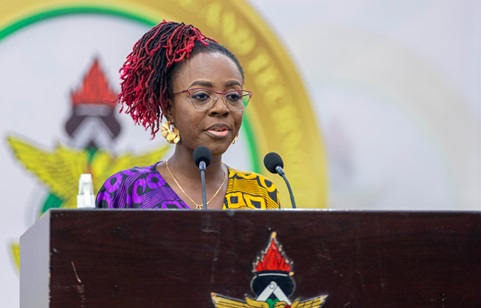
A Chief Optometrist at the Trust Hospital in Accra, Dr Naa Kowah Agyemfra, said that although refractive error, which causes visual impairment, accounts for 50 per cent of the cases, less than 30 per cent of those with refractive errors have access to proper correction due to cost, access issues or myths.
“Obviously, this is not just a clinical problem but a public health crisis and a cultural communication gap,” she stressed.
Dr Agyemfra made the remarks while delivering an address at the second Refractive Error Day Symposium & 8th White Coat Ceremony at the Kwame Nkrumah University of Science and Technology (KNUST)
it was on the theme: “Bridging the gap: Dispelling refractive error myths to improve access”.
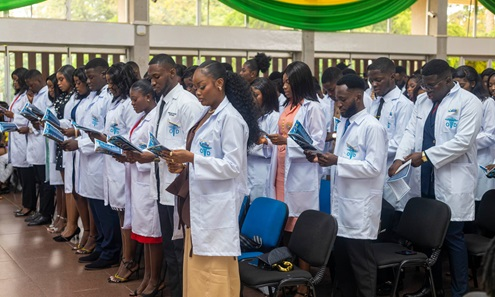
The white coat ceremony marked the transition of 100 level 400 Doctor of Optometry students from preclinical studies to clinical practice, where they were robed in white coats, widely recognised as a symbol of medical professionals.
They took the optometry oath, promising to practise the art and science of optometry diligently and conscientiously, uphold and promote the highest standards, ethics and ideals of the profession, as well as safeguard patients' information.
Disproving myths about refractive errors, she explained that it was false to believe spectacles weaken the eyes.
Instead, she emphasised they help the eyes focus better, stressing “without them, you strain your eyes more and may even develop headaches”.
Additionally, she said sugar does not directly cause refractive errors.
However, it can affect the vision of people with diabetes, but glasses or spectacles are for refraction and not for sugar levels.
She also added, “children, teens and adults can all have refractive errors.”
Dr Agyemfra, also the Chief Executive Officer (CEO) of Eye Express, Accra, emphasised that wearing glasses was not a sign of weakness but a means of empowerment, noting, “refractive errors are not curses but are correctable conditions”.
Recruitment
The President of the Ghana Optometry Association (GOA), Professor Samuel Bert Boadi-Kusi, stated that no optometrists have been employed in the public sector for nearly five years, despite training institutions producing approximately 200 optometrists annually.
Instead, he said that what was always done was replacing those in active service who retired, resigned or died.
Therefore, he called on the government to recruit optometrists to work actively, especially in underserved areas.
Furthermore, he urged the Ministry of Health and its agencies to urgently review the long-overdue approval of a two-year horsemanship programme for Doctors of Optometry, with suitable remuneration.
Prof. Boadi-Kusi advocated refractive services to be integrated into primary healthcare and included in the National Health Insurance Scheme (NHIS). He emphasised that refractive error was a health issue and a barrier to education, opportunities and dignity.
Challenges myths
A Professor at the School of Optometry and Visual Science, University of Cape Coast (UCC), Professor Emmanuel Kwesi Abu, who chaired the event, said that globally, refractive errors remained underdiagnosed, undertreated and misunderstood.
Despite the availability of simple, affordable interventions such as spectacles, he expressed concern that millions still suffer because of misinformation, cultural beliefs and limited access to services.
He told the students that their field was rapidly evolving with advances in diagnostic imaging, ocular therapeutics, contact lens innovations, and public health strategies.
Therefore, he encouraged them to stay curious and keep up with new trends.
Impact
In a welcome address, the Head of Department of Optometry and Visual Science at KNUST, Professor Mohammed Abdul-Kabir, stated that refractive error, if left uncorrected, can significantly and adversely affect patients' well-being and may also lead to poor academic performance among children.
He urged the students stepping out to begin the clinical phase of their training to work harder and stay up-to-date with modern eye health and optometry care techniques.
Latest Stories
-
Mahama’s proposed airline looks to South America, Caribbean as Ghana confronts mounting drug trafficking cases
7 minutes -
5% progress on Suame Interchange Phase One inadequate – Roads Minister tasks contractor to speed up work
10 minutes -
Photos: Vice President joins GAAS Awards to celebrate outstanding women leaders
11 minutes -
OSP vs Ken Ofori-Atta, SML and others: Court gives OSP four more weeks to serve Ofori-Atta with summons
12 minutes -
High Commission sends caution to Ghanaians in South Africa ahead of planned protests
15 minutes -
Okai Mintah outlines vision for NDC Youth Wing as he engages MMDCEs
21 minutes -
Mahama Ayariga leads renewed push for stronger local governance through partnerships
25 minutes -
NDC youth organiser aspirant Okai Mintah consults MMDCEs ahead of elections
25 minutes -
PHOTOS: Ayikuma Methodist Basic School wins National Juniors Challenge
28 minutes -
Silence has entered our homes : Salomey Awiti Bafoh and the chilling effect of free expression in Ghana
29 minutes -
UG Pro-VC calls for stronger research funding to curb brain drain
31 minutes -
Woman in critical condition after shooting at funeral grounds in Yeji
33 minutes -
Breast Cancer awareness must lead to action – Deputy Health Minister
35 minutes -
UK identified as leading destination for Ghana’s illicit cannabis exports – Report
37 minutes -
Drug money allegedly finances Ghana’s political parties and real estate – Global Organised Crime Index
42 minutes