

Audio By Carbonatix
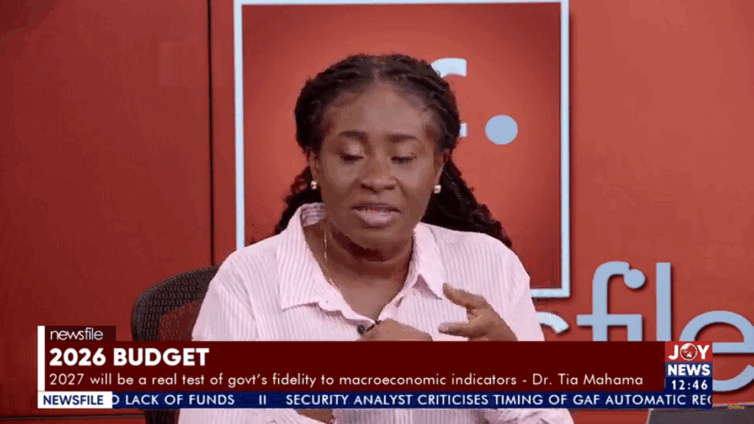
Economist and Senior Lecturer at the University of Ghana, Dr Priscilla Twumasi Baffour, has welcomed the government’s renewed emphasis on infrastructure development in the 2026 Budget but cautioned that the real test lies in effective implementation and prudent use of public funds.
Speaking on JoyNews’ Newsfile on Saturday, November 15, Dr Twumasi Baffour said the budget outlines ambitious intentions regarding expenditure and revenue, with encouraging commitments to strengthening the economy’s productive base.
“I believe that the budget is basically government’s intentions in terms of expenditure and revenue,” she explained. “The plans are bold; we are excited about the fact that we are investing in infrastructure to build on the productive base of the economy.”
However, she stressed that many similar projects had appeared in previous budgets without corresponding action, making efficient implementation crucial.
“So the reality of it is in the implementation,” she said. “Some of the projects we see have been observed in earlier budgets. The implementation is critical, as is efficiency in the usage of public funds.”
Dr Twumasi Baffour highlighted procurement as a major national challenge, warning that inefficiencies and corruption in the system often lead to inflated government expenditure.
“Government expenditure is always over-bloated. So in that regard, we hope that that office will work efficiently and not become another conduit to delay and extort funds from contractors.”
Turning to the financing of the proposed infrastructure drive, the economist cautioned that the government’s reliance on mineral resources may be risky, given declining oil revenues.
“Our expectation is that if the funding is available… I must indicate that a lot of the big-push infrastructural funding is based on mineral resources,” she explained.
“Oil revenues have been going down due to the reduction in oil production in the country.”
Despite these concerns, Dr Twumasi Baffour said the potential benefits could be significant if the plans are executed properly.
“We hope that, if all things are equal, there is improvement in connectivity, access to roads, and connecting farms to factories,” she said.
Latest Stories
-
NDC threatens sanctions over oversized campaign posters, gives aspirants 5 days to comply
11 minutes -
Star Oil paid GH¢2.7bn in taxes, levies in nine months of 2026
26 minutes -
Samson’s Take: The rule of law is cheaper before the bulldozer
27 minutes -
GRA blames system failure for delay in issuing receipt over passenger’s customs duty
48 minutes -
Livestream: Newsfile discusses World Cup visa scandal, beach demolitions, education strikes, BRICS bid
52 minutes -
NC-PTAs welcomes end of teachers’ strike, urges parents to prepare children for Monday
1 hour -
Government procures over 2,000 transformers as Ghana’s electricity access hits 89.13% – Energy Minister
1 hour -
UTAG-UG threatens strike on October 19 over unpaid allowance
2 hours -
Let The Constitution direct Chieftaincy to deliver “All Development Is Local”
3 hours -
John Jinapor outlines renewable energy, nuclear power priorities for 2027
3 hours -
Ghana explores centre of excellence for hearing, communication and cochlear implant care
4 hours -
Schizophrenia-related disorders lead mental health cases recorded in Ghana
5 hours -
Dutch authorities enlist Ghana in hunt for fugitive drug lord Bolle Jos
5 hours -
Ghana housing finance conference adopts communiqué to improve affordable housing access
9 hours -
Special Initiatives Minister urges Wa Technical Institute to enrol more girls as EU-backed solar training lab opens
10 hours