

Audio By Carbonatix
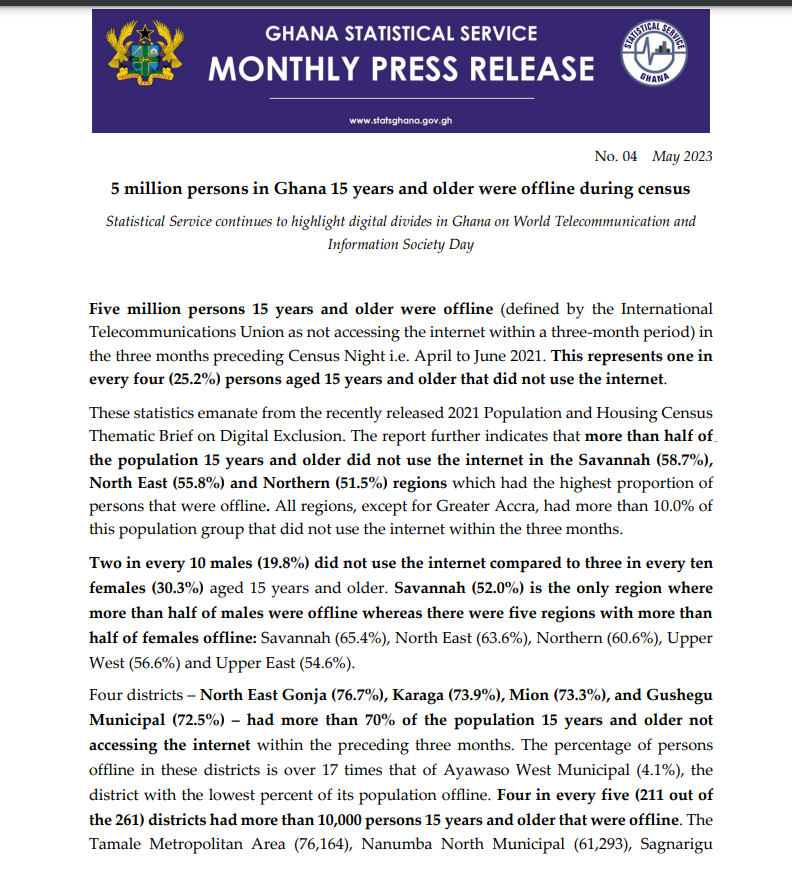
The Ghana Statistical Service (GSS) has revealed that at the time they were recording the population census in 2021, about five million people, 15 years and older, were offline.
The report was released by GSS on World Telecommunication and Information Day commemorated under the theme “Empowering the least developed countries through information and communication technologies”.
GSS stated that from April to June 2021, (the census night) three regions recorded the highest proportion of persons that were offline.
“More than half of the population 15 years and older did not use the internet in Savannah (58.7%), North East (55.8%) and Northern (51.5%) regions which had the highest proportion of persons that were offline.”
The Statistical Service defined offline as prescribed by the International Telecommunications Union which states that offline is not accessing the internet within a three-month period.
GSS indicated that for these regions, two in every 10 males (19.8%) did not use the internet compared to three in every ten females (30.3%).
“Savannah (52.0%) is the only region where more than half of males were offline whereas there were five regions with more than half of females offline: Savannah (65.4%), North East (63.6%), Northern (60.6%), Upper West (56.6%) and Upper East (54.6%).”
Also, four districts namely North East Gonja, Karaga, Mion, and Gushegu Municipal had more than 70% of the population 15 years and older not accessing the internet within the preceding three months.
They indicated that Greater Accra is the only region which did not have more 10.0% of its population offline.
GSS indicated that with 4.1%, Ayawaso West Municipal in the Greater Accra region is the district with the lowest percentage of its population offline.
“Four in every five (211 out of the 261) districts had more than 10,000 persons 15 years and older that were offline. The Tamale Metropolitan Area (76,164), Nanumba North Municipal (61,293), Sagnarigu Municipal (59,054), East Mamprusi Municipal (58,248) and Gushegu Municipal (56,152) had more than 50,000 persons that were offline.”
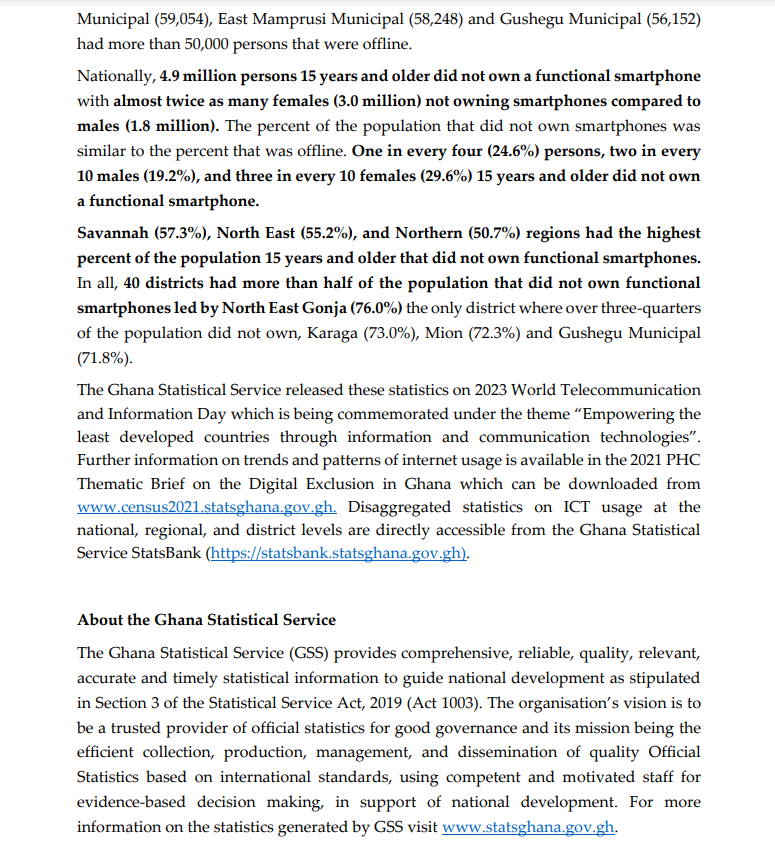
Meanwhile, on cellphones, GSS revealed that nationally, 4.9 million persons 15 years and older did not own a functional smartphone.
They indicated that about 1.8 million males did not own a smartphone and almost twice 3.0 million also did not own a smartphone.
“The percent of the population that did not own smartphones was similar to the per cent that was offline. Savannah (57.3%), North East (55.2%), and Northern (50.7%) regions had the highest percent of the population 15 years and older that did not own functional smartphones.”
“In all, 40 districts had more than half of the population that did not own functional smartphones led by North East Gonja (76.0%) the only district where over three-quarters of the population did not own, Karaga (73.0%), Mion (72.3%) and Gushegu Municipal (71.8%).”
Read the full press statement below:
Latest Stories
-
Special Initiatives Minister urges Wa Technical Institute to enrol more girls as EU-backed solar training lab opens
5 minutes -
In the matter of my first year at the Bar
17 minutes -
ActionAid Ghana calls for an end to child marriage, greater investment in girls’ rights
22 minutes -
Newsfile to tackle World Cup visa scandal, beach demolitions, education strikes, BRICS bid
46 minutes -
UK-Ghana Trade & Investment Summit: Trade Resource Centre to help businesses maximise UK-Ghana trade opportunities
1 hour -
Embassy of Denmark celebrates World Maritime Day
1 hour -
Linking LEAP to productive inclusion could cut extreme poverty by 2030 – UNICEF
2 hours -
Trade Ministry backs use of creative arts to rehabilitate prison inmates
2 hours -
Negotiations with government to continue despite strike suspension – GNAT
2 hours -
‘Ghana cannot afford to waste public resources; every cedi has a job’ – Ato Forson
2 hours -
Ghana expects economic boost as World Assemblies of God Congress brings 10,000 delegates to Accra
3 hours -
Joy in Nayilifong as Farouk Aliu Mahama donates 100kVA transformer to improve power supply
3 hours -
Chief Justice urges employers to tackle mental health stigma in workplaces
4 hours -
Analysis: Ghana’s yellow fever numbers reveal a gap between vaccination and protection
4 hours -
Education Ministry welcomes suspension of teachers’ strike
4 hours