


Audio By Carbonatix
Some premium tea bags might be leaving billions of microscopic plastic particles in your cup, new research suggests.
Canadian researchers found that some plastic tea bags shed high levels of microplastics into water.
Microplastics have widely been found in the environment, in tap and bottled waters, and in some foods.
The World Health Organization (WHO) says such particles in drinking water do not appear to pose a risk.
But the WHO said the findings were based on "limited information" and it called for greater research on the issue.
The researchers, from McGill University in Montreal, Canada, also called for more investigation into the health effects of microplastics, defined as small (less than 5mm in length) pieces of any kind of plastic debris.
For the study, they bought four different commercial teas packaged in plastic tea bags.
Most tea bags are made from paper, with a small amount of plastic used to seal them shut. But some premium brands have switched to using greater amounts of plastic mesh for their product instead.
This is usually so that the tea bag is held in a pyramid shape, which producers claim helps the tea leaves infuse better.
The researchers removed the tea and placed the empty teabags in water heated to 95C (203F) as if they were brewing tea.
They found that a single plastic teabag released about 11.6bn microplastic and 3.1bn smaller nanoplastic particles into the hot water. The particles are completely invisible to the naked eye.
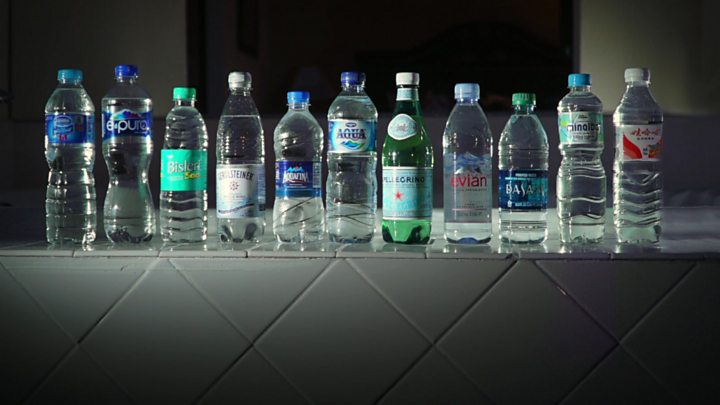
The plastic particles lurking in your bottled water
The level of "particles released from the teabag packaging are several orders of magnitude higher than plastic loads previously reported in other foods", according to the study, which was published by the journal of Environmental Science and Technology.
Researcher Laura Hernandez says they were surprised by the amount released compared to those recorded in other studies into things like bottled water.
She says the discrepancy could be in part due to the fact they focused on the tiniest of particles - both microplastics, which are about the thickness of one hair, and nanoplastics, which are a thousand times smaller.
But she also said it could be due to the fact "it's a piece of plastic being exposed to boiling water" and not just water at room temperature.
Ms Hernandez and her team did not disclose the particular tea brands used in their study.
"The consumer should avoid plastic packaging, not a specific brand, and definitely not the tea that comes inside," she said in an email. "We encourage consumers to choose loose teas that is sold without packaging or other teas that come in paper teabags."
She noted this is a chance for consumers, like those looking to reduce their plastic use, to be more aware of their purchases.
"There is really no need to package tea in plastic, which at the end of the day becomes single-use plastic," she said. "[And] which is contributing to you not just ingesting plastic but to the environmental burden of plastic."
Latest Stories
-
NSMQ 2026: Kumasi Academy storms back to nationals with commanding 63-point victory
15 minutes -
NSMQ 2026: Nyakrom SHS secures second-ever NSMQ qualification as twin sisters steal spotlight in emotional qualifier
20 minutes -
One Year On: Sneak peek inside Daddy Lumba’s final resting place
54 minutes -
NSMQ 2026: Aggrey Memorial qualifies for nationals after hard-fought Central region qualifier win
1 hour -
Elsie Appau-Klu receives ‘Excellence in Public Policy and Governance’ honours in London
1 hour -
NSMQ 2026 : St. Hubert’s Seminary SHS completes comeback against Afua Kobi to book national championship place
2 hours -
Emotional scenes as family marks One Year Anniversary of Lumba’s passing
3 hours -
First-ever Wa Vendors Expo sparks economic boom and empowers female entrepreneurs
3 hours -
Joshua knocked down twice as dramatic win sets up Fury fight
3 hours -
Glasgow 2026: Ghanaian boxer Amadu Mohammed makes Bantamweight quarters after 1st round stoppage of Temakau
3 hours -
NSMQ 2026: Edinaman SHS storms to nationals with highest opening score in Central region qualifiers
4 hours -
‘It’s not just an inconvenience’: We’ve underestimated the health impacts of heavy periods
4 hours -
Sonzele Community Bank works to meet BoG’s GH₵5m capital requirement, declares 25.8% dividend
4 hours -
Bohyen chief appeals for fire station
4 hours -
Martin Kpebu says legal vacation could delay Wontumi’s bail application
4 hours