

Audio By Carbonatix
Spain, one of the countries worst hit by the coronavirus, is beginning to ease strict lockdown measures that have brought its economy to a standstill.
People in manufacturing, construction and some services are being allowed to return to work, but must stick to strict safety guidelines.
The rest of the population must still remain at home.
Almost 17,500 people with Covid-19 have died in Spain, but the rate of new infections has been falling.
Italy - the hardest hit country in Europe, with almost 19,900 deaths - will allow a narrow range of firms to resume operations on Tuesday.
Spain's health ministry said on Monday that the daily number of deaths had dipped slightly, with 517 reported in the previous 24 hours, compared with 619 announced on Sunday. The official total death toll is now 17,489.
The number of new infections continues to drop, with 3,477 confirmed cases bringing the total to 169,496.
"We are still far from victory, from the moment when we will recover normality in our lives," Prime Minister Pedro Sánchez warned over the weekend.
"We are all keen to go back out on the streets... but our desire is even greater to win the war and prevent a relapse," he added.
On Monday, the government lifted some of the restrictions put in place on 27 March and allowed businesses whose employees cannot work remotely to reopen.
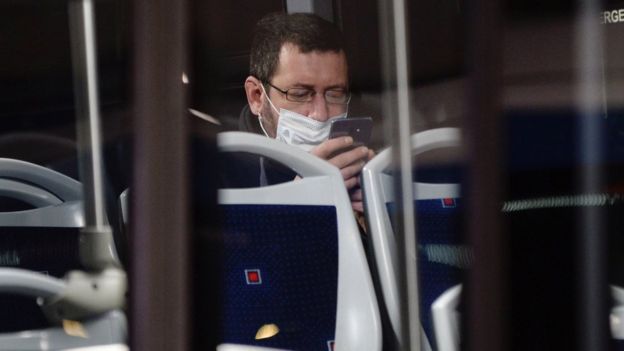
Officials intend to distribute 10 million face masks on public transport.
The head of the regional administration in Catalonia, Quim Torra, said he would not comply with any easing of the lockdown for non-essential workers, warning that "the risk of a new outbreak and a second lockdown is enormous".
Mr Sánchez said the decision was taken after consulting a committee of experts.
He also noted that Spain had not entered the "second phase" of the fight against the coronavirus, when there would be any further loosening of the lockdown. That was at least two weeks away and would "be very gradual", he added.
Builders can only work in areas away from local residents, so they cannot yet go back to doing home improvements.
Spaniards go back to work
The lifting of some lockdown restrictions in Spain today has meant a return to normality of sorts for many non-essential workers. Two weeks ago they were told to stay at home as the national lockdown was tightened.
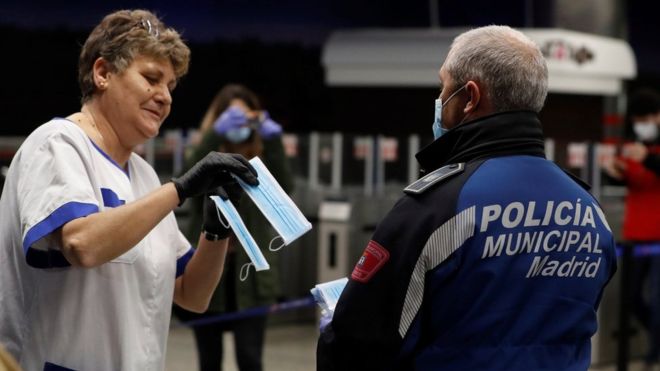
On the Madrid metro and at bus and railway stations, police handed out face masks to commuters as part of a national strategy. However, even at rush hour, use of Madrid's transport system was much lower than normal.
Antonio Álvarez, a self-employed manual worker, described it as a relief to be able to resume work on the digging of a swimming pool on a private property near the capital.
"I think the restrictions so far have worked. If they hadn't implemented them it would have been disastrous," he said.
Easter is a major holiday in the Spanish calendar, usually packed with religious events and marking the beginning of a busy tourist season. But this year, for the first time since the 1930s, there were no Easter processions and bars, restaurants, beaches and squares across the country were empty.
As an alternative, some churches streamed Catholic Mass into the homes of worshippers, while websites replayed footage of religious processions from previous years.
Italy reported 431 new deaths on Sunday - the lowest for more than three weeks. However, the country is almost certain to join the United States on Monday with a death toll of more than 20,000.
Prime Minister Giuseppe Conte said last week that the lockdown would continue until 3 May, but that a few types of shops and businesses would be allowed to reopen on Tuesday. They would include bookshops, stationers and shops selling children's clothes, he said.
Factories will not reopen, although Mr Conte said he would continue to assess the trend of new infections and "act accordingly" if conditions allowed it.
In Germany, where 3,022 people with Covid-19 have died, pressure is also growing from businesses for a plan on how to exit the country's lockdown. On Wednesday, Chancellor Angela Merkel will discuss a strategy with regional leaders.
Elsewhere in Europe, the number of people who have died with the virus in the Netherlands rose by 86 to 2,823 on Monday. The total number of cases increased by almost 1,000 to 26,551.
And in France, which is expected to extend its lockdown until 10 May, police said dozens of worshippers defied the measures to attend a secret Easter Mass on Saturday.
A priest was fined while other churchgoers were given a warning, the AFP news agency reports.
Latest Stories
-
Afoko: Women’s inclusion key to NPP’s electoral comeback
53 seconds -
2026 U-20 WWC: Black Princesses suffer another group stage exit after defeat to France
13 minutes -
No policy to teach Arabic, Chinese in all public schools – Mahama
13 minutes -
Students’ academic freedom central to Africa’s democratic future – Prof Appiagyei-Atua
28 minutes -
Ɔdadeɛ Global Executives congratulate PRESEC on historic 9th NSMQ trophy
29 minutes -
Mahama announces maize processing plant for Sissala area to tackle glut
34 minutes -
Ghana undertaking Africa’s largest road infrastructure programme – Agbodza claims
1 hour -
Prospective homeowners troop to Day 2 of JoyNews-Republic Bank Habitat Fair, engage experts on homeownership
1 hour -
Video: Medeama suffer preliminary round exit after losing to TP Mazembe
2 hours -
Police interdict officer over death of 23-year-old law student, Ivan Baidoo
2 hours -
BECE: ‘I’m happy we’re seeing our children’s true results because cheating is curtailed’ – Mahama
2 hours -
24-Hour Economy targets greenhouses, cold storage and air cargo to transform horticulture
2 hours -
Taxpayers’ money shouldn’t fund National Cathedral; Christians can contribute towards it – Mahama
2 hours -
U.S. Embassy launches Girls’ soccer initiative in Ghana to build leaders on and off the pitch
3 hours -
CAF Champions League: GPL champions Medeama eliminated at the preliminary round
3 hours