

Audio By Carbonatix
The Electoral Commission’s decision to conduct registration for a new voter register amidst a public health crisis could threaten human lives and have severe consequences for the right to vote.
Ghana is currently one of Africa’s most Covid-19 affected countries. But with the blessing of the Supreme Court, the EC has adopted a new voter registration policy that requires mass registration of citizens for an election that is only 6 months away.
In the face of a growing pandemic where people must adhere strictly to Covid-19 preventive protocols, asking Ghanaians to converge at designated locations for the purpose of voter registration is not only risky but also leads to reduced numbers at the polls.
Many would rather stay home than risk contracting Covid-19 through a registration process that requires contact with commonly touched biometric machine surfaces.
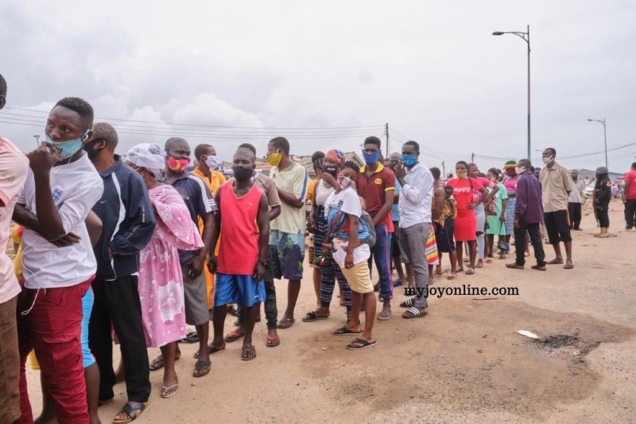
Fear of contracting Covid-19 during voter registration is well-founded: since the beginning of the registration exercise on June 30, EC officials have struggled to control crowds at registration centers.
Media reports indicate that at many registration centers people do not observe Covid-19 prevention protocols. In the Ketu South Municipality in the Volta Region, for instance, EC officials struggled to control scores of residents who stormed the Akuse Park registration center. In the Odododiodoo Constituency in the Greater Accra region also, Covid-19 safety protocols were seldom deployed.
Although the EC has since introduced a queue management system to help control applicant traffic at registration centers, the situation is yet to improve at many centers across the country, and we risk significantly increasing the number of Covid-19 cases if this continues.
In the face of this worrying trend, it comes as no surprise that a group of medical practitioners has petitioned the EC to stop the ongoing voters’ registration exercise over breaches of Covid-19 preventive protocols at centers across the country.
‘Considering the increasing number of infections coupled with challenges in testing for early identification of cases, it is disquieting to observe huge numbers of people at and around registration centers mostly ignoring precautionary protocols,’ the group said.
With limited healthcare facilities and the uneven distribution of healthcare professionals especially in rural areas, embarking on a new voter registration exercise with only 6 months to an election amidst a pandemic is poor policy.
The number of medical professionals capable of treating Covid-19 patients continues to dwindle as some have also tested positive. Over a dozen contracted the coronavirus last week while in the line of duty, according to the Ashanti Regional Chairperson of the Ghana Medical Association.
Aside from the public health considerations, voter suppression is a disturbing, probable outcome of the recent rules as I have witnessed firsthand working in the Western Region.
Under the new policy, a citizen of Ghana can only register to be a voter if he or she bears a valid passport or a national identification card (‘Ghana card’), yet these documents are in short supply across the majority of the country.
As of June 17, 2020, the National Identification Authority (NIA) had issued 9,050,346 Ghana cards to qualified Ghanaians. Not many Ghanaians eligible to vote have valid passports. That leaves a good number of people with neither the Ghana card nor a valid passport.
A person lacking any of these two documents can only register to vote after completing a voter registration identification guarantee form signed by two registered voters. It is important to note, however, that a registered voter cannot guarantee the identity of more than ten persons.
This policy contributes to voter suppression, particularly in rural areas where many people would hardly be eligible after their ‘guarantors’ have guaranteed the identity of 10 people.
The EC must reconsider this new voter registration policy to avoid further endangering lives and suppressing many eligible voters ahead of the presidential and parliamentary election in December.
***
Grace Ayensu-Danquah MD, MPH, FACS, is the NDC Parliamentary Candidate for the Essikado Constituency and a member of the NDC Covid-19 Technical Team.
Latest Stories
-
Gov’t targets recruitment of 16,500 health professionals in 2026
6 minutes -
Two-week strike will not derail academic calendar – GNAT President
21 minutes -
Headmaster detained after BBC investigation into alleged sexual abuse of students
30 minutes -
GNAT pushes for clear implementation procedures of teachers’ conditions of service
50 minutes -
Recurrent strikes threaten quality of education and academic calendars – Prof Bokpin
53 minutes -
‘Cockroach’ group leaders among hundreds detained in Delhi protest
57 minutes -
Don’t let speed of information become your judgement – CJ tells new lawyers
2 hours -
World Cup visa scandal: People have leveraged public office to facilitate fraud – Senyo Hosi
2 hours -
Glut! Farmers count losses as prices crash, customers happy
2 hours -
GSA postpones auction of unserviceable vehicles
2 hours -
Man charged with attempted murder after stabbing
2 hours -
World Cup visa scandal: Senyo Hosi says issue goes beyond calls for Sports Minister’s resignation
2 hours -
Yaw Ampofo Ankrah hasn’t taken or received any money to facilitate visas – Lawyer insists
3 hours -
World Cup visa scandal: Senyo Hosi urges focus on constitutional accountability
3 hours -
La Beach demolition: Senyo Hosi condemns lack of consultation
3 hours