

Audio By Carbonatix
President John Dramani Mahama has received 10 petitions for the removal of two heads of public institutions and two deputies appointed under Article 70 of the Constitution.
The institutions are the Electoral Commission (EC) and the Office of the Special Prosecutor (SP).
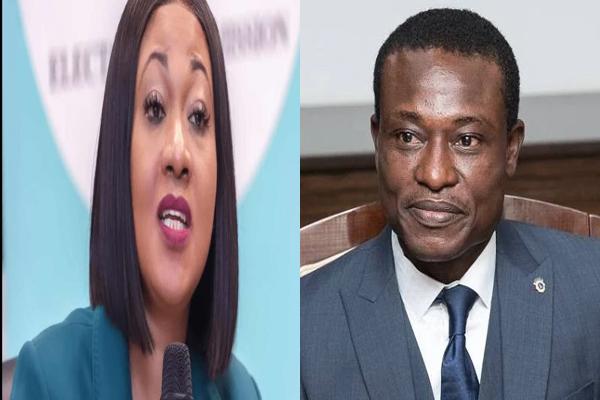
Seven petitions were filed against the Chairperson of the EC, Jean Mensa, and her two deputies, Dr Bossman Eric Asare, who is in charge of Corporate, and Samuel Tettey, in charge of Operations.
Three other petitions are against the removal of the SP, Kissi Agyebeng.
Checks by Graphic Online's Emmanuel Ebo Hawkson indicate that the various petitions have been forwarded to the Chief Justice, Justice Paul Baffoe-Bonnie.
Article 70(2) of the Constitution states that “The President shall, acting on the advice of the Council of State, appoint the Chairman, Deputy Chairmen and other members of the Electoral Commission.”
The Chairperson of the EC and the deputies have the same conditions of service as those of Justices of the superior courts — the Supreme Court, the Court of Appeal and the High Court — and so are their removal processes.
While the Chairperson of the EC has the same terms and conditions of service as a Justice of the Court of Appeal, the two Deputy Chairmen of the Commission have the same terms and conditions of service as are applicable to a Justice of the High Court.
Removal of EC chair
According to Article 146 of the 1992 Constitution, a Justice of the Superior Court or a Chairman of the Regional Tribunal shall not be removed from office except for stated misbehaviour or incompetence or on the ground of inability to perform the functions of his office arising from infirmity of body or mind.
The second clause provides that a Justice of the Superior Court of Judicature may only be removed in accordance with the procedure specified in Article 146(3).
“If the President receives a petition for the removal of a Justice of a Superior Court other than the Chief Justice or for the removal of the Chairman of a Regional Tribunal, he shall refer the petition to the Chief Justice, who shall determine whether there is a prima facie case.
“Where the Chief Justice decides that there is a prima facie case, he shall set up a committee consisting of three Justices of the Superior Courts or Chairmen of the Regional Tribunals or both, appointed by the Judicial Council and two other persons who are not members of the Council of State, nor members of Parliament, nor lawyers, and who shall be appointed by the Chief Justice on the advice of the Council of State.
It also provides that the committee appointed shall investigate the complaint and shall make its recommendations to the Chief Justice, who shall forward it to the President.
Article 146 also provides that all proceedings under the article shall be held in camera, and the Justice or Chairman against whom the petition is made is entitled to be heard in his defence by himself or by a lawyer or other expert of his choice.
“The President shall, in each case, act in accordance with the recommendations of the committee,” clause nine of the same article further provides.
Special Prosecutor
Section 15 of the Office of the Special Prosecutor Act, 2017 (Act 959) deals with the removal of the SP, with timelines.
Similar to that of the EC, the SP “shall not be removed from office except for (a) stated misbehaviour or incompetence; (b) incapacity to perform the functions of the Office by reason of infirmity of body or mind; (c) wilful violation of the Official Oath or Oath of Secrecy; (d) conduct which (i) brings or is likely to bring the Office of the Special Prosecutor into disrepute, ridicule or contempt; or(ii) is prejudicial or inimical to the economy or security of the State.
A person who seeks to remove the SP from office must submit a petition to the President, who must, within seven days, refer the petition to the Chief Justice,e who shall, within 30 days, determine whether there is a prima facie case.
Where a prima facie case is determined, the CJ shall, within 14 days, set up a committee similar to that of the removal of any of the heads of constitutional bodies appointed by the President.
The committee is duty-bound to investigate the matter within 90 days and make its recommendation to the President through the Chief Justice.
The President then has no choice but enjoined to act in accordance with the recommendations of the committee.
Latest Stories
-
Total expenditure as of July 2026 amounted to GH¢147.07bn, 16% below target – BoG
2 hours -
Total revenue & grants stood at GH¢144.5bn in July 2026, slightly below target – BoG
2 hours -
Ghana Sports Fund urges sports federations to submit credible proposals and measurable targets
2 hours -
Sally Rooney books withdrawn in UK over Palestine Action support
2 hours -
Musk says US government may be behind slowdown of Ukraine drone speeds
2 hours -
Picking Chief Justices nearing retirement could give Mahama immense power – Bentil
2 hours -
Netflix to shed 1,000 jobs in steepest cuts since 2022
3 hours -
Burnham had two hospitality dinners with Man City chairman, deleted records show
3 hours -
Semenyo ‘froze’ after alleged racist abuse, court told
3 hours -
‘Shameless’ – Mourinho critical of Vinicius Jr ban timing
3 hours -
Loyalty can outweigh competence in Chief Justice selection – Bentil
3 hours -
Man City suffer as PSG masterclass sets up Champions League win
4 hours -
Customer Service Africa CEO urges business leaders to observe staff and customer interactions
4 hours -
On night of mayhem for Liverpool, Barcola arrives in style
4 hours -
Muzic Mensah finds healing and renewed love in new single ‘WayƐ Late’
4 hours