

Audio By Carbonatix
Before 1961 when the government took over administration of the Korle lagoon, the leadership of Ga-Dangbe people manned the water body as it is within Ga-Dangbe territory.
The people maintained the lagoon with a taboo in Ga which translates directly to English as ‘you do not cross the Korle lagoon with a corpse.’
This was owed to the belief that a god, Korle, dwelled in the lagoon and he hated corpses. He also hated everything filthy and stinky. The people believed that persons who crossed the lagoon with a corpse or introduced dirt or stench into it, would introduce bad luck into their families. As a result, the lagoon was so clean that children went to play at its banks and the Ga-Dangbe community fed their homes with fish that came from it. The dominant fish caught here was tilapia in varied sizes.
When government took over the lagoon in 1961, it became a state property though the people continued to worship the Korle and perform traditional rituals in it. Right about this time, Accra was fast developing and modernization was fast creeping in with big roads, industries, immigration, Christianity and capitalism among others.
Several people who came to live in Accra, who had direct interaction with the lagoon did not know or understand the culture of the Ga-Dangbes and what the lagoon stood for. This meant that in the era of capitalism, the lagoon was exploited by smaller organisations and private individuals aside government activities.
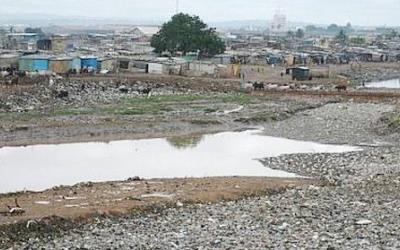
By the early 90s, when Old Fadama popularly known as Sodom and Gomorrah was established, the toxin and stench in the Korle lagoon was becoming normal. Few years later, the lagoon would become unrecognizable.
By 2002, the Waste Management Department was able to manage only 60% of waste produced across the city. The remaining 40% ended up in the lagoon and some of it drained into the Gulf of Guinea. These included e-waste, industrial waste, plastic waste, human excrement, etc. (theguardian.com) Journalist Robert Bourgoin, after extensive research and consultancy with Theo Anderson, director of Friends of the Earth in Ghana, wrote that the Korle Lagoon is one of the most polluted places on earth.
The people of Ga-Dangbe reported that their god, Korle had left the lagoon. Revered for its ability to cleanse subjects of their sins and bad omen after washing with its water, the very essence of Korle was its cleanliness.
The introduction of stench and dirt into the Korle lagoon has not only deprived Accra of a potentially beautiful tourist site and economic income; it has also deprived a community of their god.
“Anderson thinks that the persistent strength of traditional beliefs in regions where Christian beliefs are weaker could be put to good use in enlisting people’s efforts for the protection and clean-up of the lagoons”. (Bourgoin, 2002).
Anderson is essentially saying that the authority of the Ga-Dangbe traditional leaders is key to solving the sanitation problem and achieving beautification of the Korle Lagoon¸ though he feared a dwindling sense of community could make this difficult. He also said that an environmental law accompanied by heavy penalties and effective enforcement would lead us in the right direction.
So when people felt obliged to obey the Korle as a god, the lagoon remained clean and served the community well. Unfortunately, modernization replaced obligation with freedom and the end result is evident in the lagoon today.
In light of the subject of taboos, I can gracefully conclude that this is proof that Ghanaian traditional culture is important for the progress of our nation and must not be left behind in an attempt to promote modernism and urbanization.
Latest Stories
-
GloMeF CEO urges intensified public education on new road traffic regulations
31 seconds -
Akim Swedru MP opposes ChatGPT tax, says it threatens education and innovation
4 minutes -
Obuasi SHTS sexual abuse scandal exposes systemic failure in child protection – Moving Masculinity
5 minutes -
Hubtel CEO calls for national data-sharing framework to boost AI development
7 minutes -
Twelve Golden Rules of real estate development in Ghana, Africa
12 minutes -
Five new telephony cell sites in Ashanti Region to be activated in October 2026 – Sam George
12 minutes -
Mahama cuts sod for Afienya Industrial Park, targets 120 enterprises
17 minutes -
Rush for fuel from accident tankers is stealing, punishable by law – NPA boss, Edudzi Tamakloe
23 minutes -
GhIG pushes for legislation to regulate geoscientists’ activities
29 minutes -
Mfantsipim @150: Ace Anan Ankomah leads project to preserve school’s musical heritage
33 minutes -
Gov’t launches rCOMSDEP in Ahanta West, Mpohor Fiase to promote responsible community mining
34 minutes -
AI is forcing professionals to rethink how they deliver value – Hubtel CEO
37 minutes -
Daily Insight for CEOs: Strengthening the CEO’s Leadership Legacy
38 minutes -
Jimmy Aglah’s ‘When the River Testified’ approved by NaCCA as Supplementary Reader
47 minutes -
Hubtel willing to contribute to Ghana’s proposed AI fund – CEO
51 minutes